Fibteq Myrel
An open-source, self-hostable workspace where AI agents do the work inside your projects.

Try it · Docs · Download · Self-host · Architecture · Discussions
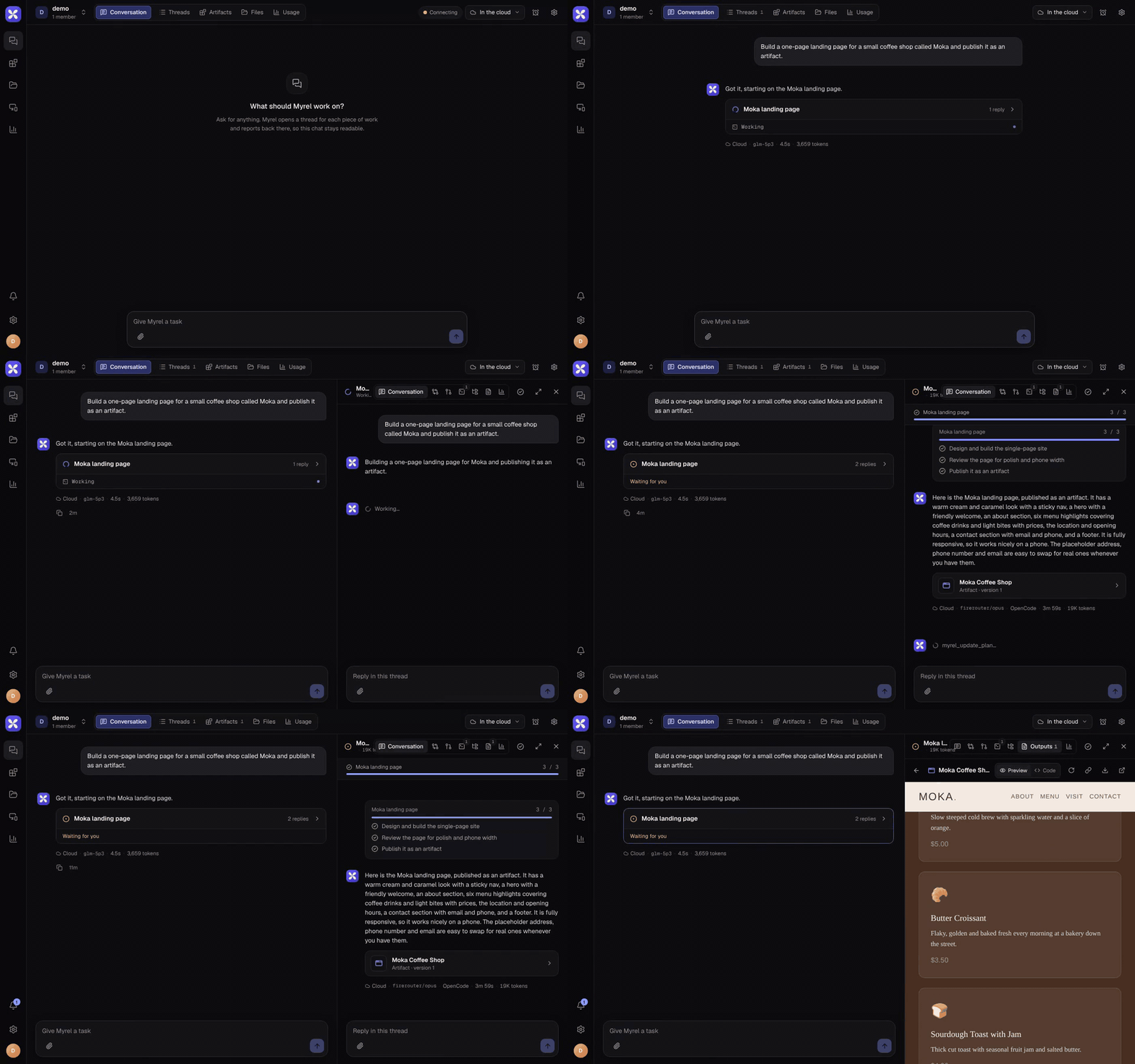
Fibteq Myrel gives a team a project chat with a coordinator agent in it. Ask for something and the coordinator opens a thread for it; a thread agent takes the task, shows its progress as a live checklist, and answers in the thread. When something is beyond its scope, the thread agent asks the coordinator for direction, much like a teammate would. Projects keep their artifacts, files and memory in one place. The idea is close to Claude Projects, but open, multi-model and running on your own Cloudflare account.
Status: early. Projects, the coordinator and thread agents that do real work (in a cloud sandbox or on your own computer) are running in production at myrel.fibteq.io. Expect breaking changes. See the roadmap.
Why Myrel
- Coordinator and threads. One agent routes, many agents work. The coordinator never does the work itself; each thread agent owns its task, shows a live checklist and asks for permission or a decision when it needs one.
- Real agents, your choice of where. A thread's agent is a coding harness:
OpenCode in a per-thread Cloudflare Sandbox, or your own Claude Code, Codex,
Antigravity CLI, OpenCode, Hermes Agent, Cursor CLI, Muse Code or Kimi Code on your computer through
myrel-runner. Your CLI logins never leave your computer. - Any model. Fireworks, Anthropic and OpenAI out of the box, optionally through Cloudflare AI Gateway. Bring your own key.
- Yours to run. One Cloudflare Worker with Durable Objects, D1, R2 and Containers. No servers to manage.
- Apps that follow you. Web, iOS and Android apps (Android on Google Play), and a desktop app for macOS, Windows and Linux with the runner built in (releases), all connect to any Myrel server you point them at.
What it does
- Project chat and threads with decision cards, reactions and a progress checklist per thread.
- Artifacts: pages and apps an agent publishes, versioned and served from a separate origin.
- Project memory and files: instructions, memory notes and uploads every thread can use.
- GitHub: connect repositories through a GitHub App; agents clone, branch and open pull requests, and CI or review events wake the thread.
- Your computer: pair a computer with
myrel-runner, give a project one or more folders, and approve access to anything outside them from the thread. - Skills and connectors: Agent Skills (written in the app or taken from GitHub) and your own MCP servers, for yourself or per project.
- Routines and notifications: scheduled prompts, plus in-app, email and push notifications.
- Usage: every model call and sandbox minute metered per project and thread, with an estimated cost under agent replies (turns on your own computer use your CLI's login and show none).
Download
- Web: use the hosted server at myrel.fibteq.io or run your own.
- Desktop (macOS, Windows, Linux): installers are attached to the
latest release
(
.dmg,.exe/.msi,.AppImage,.deb,.rpm). The app updates itself and has the runner built in. - Android: Google Play.
- Runner only:
npx myrel-runner pair <code>pairs a computer without the desktop app (the code is in Myrel under Devices). See packages/myrel-runner/README.md.
Architecture
flowchart LR
  clients["Web, mobile and desktop apps"]
  subgraph worker["Cloudflare Worker: myrel"]
    assets["Static assets<br/>(apps/web)"]
    api["Hono API /api/*<br/>Better Auth"]
    pa["ProjectAgent DO<br/>coordinator, project chat"]
    ta["ThreadAgent DO<br/>one per thread, MCP tools"]
    ra["RunnerAgent DO<br/>one per paired computer"]
    sb["Sandbox DO + Container<br/>OpenCode per thread"]
  end
  runner["myrel-runner<br/>your computer, your CLI"]
  d1[("D1<br/>users, projects, skills")]
  r2[("R2<br/>files, artifacts")]
  llm["LLM provider<br/>Fireworks, Anthropic, OpenAI"]
  clients --> assets
  clients --> api
  clients -- WebSocket --> pa
  api --> d1
  pa -- start_thread, message_thread --> ta
  ta -- request_coordinator --> pa
  ta -- cloud turn --> sb
  ta -- local turn --> ra
  runner -- outbound WebSocket --> ra
  sb -- MCP --> ta
  runner -- MCP --> ta
  pa --> r2
  pa --> llm
  sb --> llm
- API: Hono on Cloudflare Workers, Better Auth (email and password, bearer tokens for apps), D1 through Drizzle.
- Coordinator: one
ProjectAgentDurable Object per project runs a small provider-neutral loop (apps/api/src/llm) that only routes. - Thread agents: each turn is one harness run, OpenCode in the thread's
Cloudflare Sandbox or the
person's CLI through the runner. It talks to people through Myrel's tools over
MCP (
reply,update_plan,ask_decision,publish_artifact,request_coordinator,resolve_threadand more), and theThreadAgentDurable Object keeps the thread's state between turns. - Local runner:
myrel-runner(packages/myrel-runner) keeps an outbound WebSocket to aRunnerAgentDurable Object. See packages/myrel-runner/README.md. - Realtime: messages live in the project's Durable Object SQLite with a
monotonically increasing
seq, so clients resync after reconnecting. - Clients: web (Vite, React 19, TanStack Router and Query, Tailwind CSS 4),
mobile (Expo) and desktop (Tauri 2), sharing
packages/protocol,packages/clientandpackages/i18n(English and Turkish; read its README before adding UI text).
More detail is in docs/architecture.md.
apps/api           Hono Worker, Durable Objects (ProjectAgent, ThreadAgent, RunnerAgent, Sandbox)
apps/artifacts     Worker that serves artifacts from their own origin
apps/web           Vite + React SPA
apps/mobile        Expo app for iOS and Android
apps/desktop       Tauri 2 desktop app with the runner built in
packages/protocol  shared types and zod schemas
packages/client    typed API client + reconnecting project socket
packages/i18n      UI strings (en, tr) for web and mobile
packages/db        Drizzle schema and D1 migrations
packages/runner-core     harness adapters shared by the sandbox and the runner
packages/myrel-runner    @fibteq/myrel-runner, the local daemon (myrel-runner-alias: its short npm name)
docs/              self-hosting, architecture, maintainer notes
ee/                commercial features: hosted plans and billing (ee/billing)
Quick start (local)
Requires Node 24.22.1+ (see .node-version) and pnpm 10.
pnpm install
cp apps/api/.dev.vars.example apps/api/.dev.vars    # set BETTER_AUTH_SECRET and a model key
cp apps/artifacts/.dev.vars.example apps/artifacts/.dev.vars
pnpm db:migrate:local                               # applies D1 migrations to the local database
pnpm dev                                            # API on :8787, artifacts on :8788, web on http://localhost:5173
Open http://localhost:5173, create an account (sign-ups are on locally), create a project and ask for something in the project chat.
Other scripts: pnpm typecheck, pnpm test, pnpm build. After changing
packages/db/src/schema.ts, run pnpm db:generate to create a migration.
Self-hosting
Myrel runs on your own Cloudflare account and deploys with
Workers Builds, so
every push to your main branch ships. The
self-hosting guide covers the D1 database, the build
settings, every variable and secret, model providers, AI Gateway, sign-ups and
connecting the apps.
Roadmap
| Phase | What it adds | State |
|---|---|---|
| 0 | Monorepo, auth, D1, deploy pipeline | Done |
| 1 | Coordinator and thread agents, project chat | Done |
| 1.5 | Local myrel-runner with your own Claude Code, Codex, Antigravity CLI, OpenCode, Hermes Agent, Cursor CLI, Muse Code or Kimi Code |
Done |
| 2 | Cloud sandbox (OpenCode), project files on R2, GitHub (clone, branch, PR) | Done |
| 3 | Artifacts, project memory, decision cards, mobile app | Done |
| 4 | Routines, notifications, MCP connectors, skills, desktop app | Done |
| 5 | Members and roles, hosted plans and billing, one-click deploy | Done except one-click deploy |
Contributing
Contributions are welcome. Read CONTRIBUTING.md first; you will be asked to sign the Contributor License Agreement on your first pull request. Report vulnerabilities privately as described in SECURITY.md, and follow the Code of Conduct.
Questions and ideas go to Discussions. If Myrel is useful to you, a star on GitHub helps others find it.
License
Fibteq Myrel is open core:
- Everything outside
ee/is licensed under the GNU Affero General Public License v3.0 (AGPL-3.0-only). If you run a modified Myrel as a network service, you must offer its source to its users. - Code in
ee/is licensed under the Fibteq Myrel Enterprise License. It is source-available but needs a commercial license for production use.
"Fibteq" and "Fibteq Myrel" are names of Fibteq. The licenses cover the code, not the names or logos; a fork you distribute should use its own name.