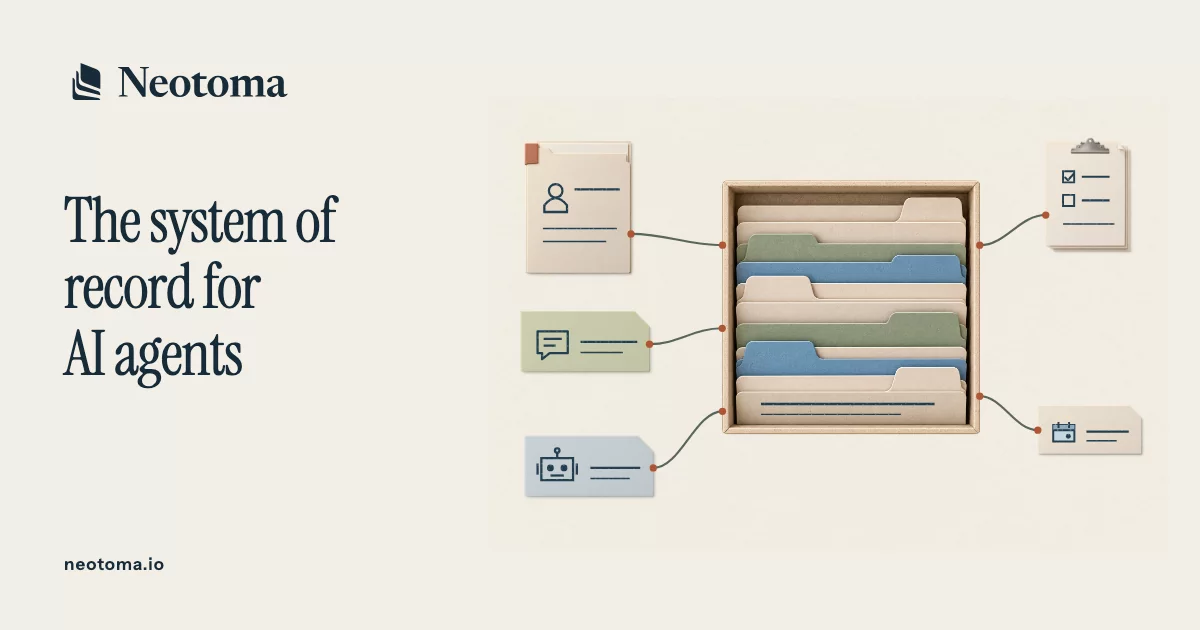

A record, not recall.
Neotoma is the system of record for AI agents. Without one, an agent works from whatever it happens to recall: part of the last session, a note its tool saved, or nothing. With one, it reads what was stored, from which source, and what is current now, so the agents you connect can defer to one answer.
npm install -g neotoma
neotoma init
neotoma setup --tool claude-code
neotoma setup --tool claude-code connects Claude Code: it writes MCP entries, CLI instruction files, and an allow rule that lets Claude Code run any neotoma command; Install lists everything it writes. Human-run setup omits --yes; automated setup may add it after the operator authorizes those changes. Omission does not prevent every setup write.
After a plain npm install, CLI data commands such as neotoma store return AUTH_REQUIRED, because the CLI uses the production profile, which needs a token. Run them as neotoma dev ... or with NEOTOMA_ENV=development.
Other hosts are listed under Connect your tools.
Known limitations: docs/known_limitations.md lists behaviour you may run into, each with a workaround and its tracking issue.
Agents cannot own work they cannot verify.
You cannot delegate real work to agents you cannot hold to account. Accountability has two halves: what was true, and who was authorized. Neotoma answers what was true. Your agents can produce a value; they cannot tell you its version, its source, or whether it is still current. Neotoma keeps every fact as an observation tied to its source, so you can see where a value came from and what is current now.
What ships today is the foundation of that record: Neotoma ingests sources into observations that the write path does not edit (the database does not enforce this) and computes entity snapshots, with each current field tracing back to the observation that set it. It is exposed over an MCP server, a REST API, a CLI, and a bundled web Inspector. See Vision and execution status for exactly where the implementation stands against the vision.
It is built for developers building and operating AI agents who need a shared record that connected agents can defer to, with provenance on every field. The same engine serves two further groups: individuals keeping one record across their assistants on a single-user install, and operators running a shared, multi-user instance with agent access control. Agents store structured records (contacts, tasks, transactions, decisions, events, and any other type) once and read them back across every tool and session. The same observations and rules give the same snapshot.
neotoma.io · Install · Documentation (also served in-app at /docs)
What Neotoma is
Neotoma is a system of record, not a chat memory or a vector cache. It records observations from your sources, resolves them into entities, and computes a current snapshot for each entity by reducing its observations in a deterministic order. No observation is overwritten by a later write. Corrections and reinterpretations add new observations, and the earlier observations stay readable for that entity.
Three properties hold across every interface:
- Deterministic. Entity IDs, event IDs, and reducer output are derived from the inputs by hashing. Entity IDs agree across instances unless tenant-scoped entity IDs are on (
NEOTOMA_SANDBOX_MODEorNEOTOMA_TENANT_SCOPED_ENTITY_IDS). Source and observation IDs also depend on the user and on the interpretation run, so they can differ between instances. The stdio MCP server writes as the shared local development user, but the HTTP server, and therefore the CLI, runs by default inlocal_sandboxmode with a per-install user, so the same data stored on two installs gets different source and observation IDs. Each interpretation run also gets a new observation ID. Do not rely on source or observation IDs matching across instances. The same observations and rules give the same snapshot regardless of order or timing. IDs are derived from inputs; observation timestamps are wall-clock, and the default merge rule orders by them. - Immutable and auditable. The write path adds sources and observations and does not edit them; the database does not enforce this with a constraint. Each current field names the observation that set it, and a stored observation names its source. A correction observation has no source, and a write from the CLI records no writer.
- Self-hosted and portable. The engine is embedded SQLite plus content-addressed file storage under a directory you control, with optional AES-256-GCM at-rest encryption. Nothing is used for training, and you can export your data as current state; observation history is not part of the export. In single-user mode the data stays entirely local; multi-user, peer-sync, and hosted modes are opt-in (see Deployment modes).
How it works
graph LR
  Sources["Sources (files, messages, API payloads)"] --> Obs[Observations]
  Obs --> Res[Entity resolution]
  Res --> Snap["Entity snapshots (reduced, versioned)"]
  Snap --> Graph["Graph + timeline"]
  Graph <--> MCP[MCP]
  Graph <--> REST[REST API]
  Graph <--> CLI[CLI]
  Graph <--> Inspector[Inspector]
- Source. Raw input is stored once, deduplicated by SHA-256 content hash, with a deterministic source ID.
- Interpretation. Structured fields are extracted from the source (directly for structured input, or via an LLM interpretation run whose model, temperature, and prompt are recorded).
- Observation. Each extracted fact becomes an observation with a hash-derived ID, linked to its source and interpretation.
- Entity resolution. A deterministic canonical name (driven by the type's schema) maps the observation to an entity, creating it if needed.
- Snapshot. All observations for an entity are reduced into a current snapshot using per-field merge policies, with a stable order (
observed_at DESC, id ASC) and a field-to-observation provenance map. - Timeline and relationships. Date fields emit deterministic timeline events; typed relationships connect entities into a graph.
What you can do with it
Neotoma v0.26.0 exposes 67 MCP tools and 112 REST paths in its OpenAPI spec. They cover largely the same capabilities, but the MCP server, the REST API, and the CLI are separate implementations, and some checks and attribution differ between them (see Known limitations). The capability surface includes:
Ingest and store. Store structured records or raw files in one call. File ingestion extracts text from PDF (with a first-page image fallback), CSV (with adaptive chunking for large files), Parquet, JSON, and plain text; images and audio are stored as raw sources. A committed, keyed structured store started on v0.26.0 that stops partway finishes its missing observations on a same-key retry; a store carrying an interpretation returns ERR_STORE_WRITE_INCOMPLETE, and keys left over from earlier versions behave differently over MCP and HTTP (see Known limitations). See Known limitations.
Resolve, retrieve, and search. Look up entities by identifier (name, email, and similar), resolve identity from multiple signals with confidence scoring, list observations, retrieve a field's provenance chain, traverse the relationship graph N hops, and pull a full graph neighborhood. When an embedding key is configured, semantic vector search runs over entity snapshots (stored locally in sqlite-vec); keyword filtering works without it.
Correct and evolve. Submit corrections as high-priority observations, never edits; the earlier observation stays readable. Schemas are inferred from your data, recommended from recurring unknown fields, and can be auto-enhanced or updated incrementally with versioning. New entity types work without any code change.
Relate and sequence. Create typed relationships (for example PART_OF, DEPENDS_ON, REFERS_TO, DUPLICATE_OF), query timeline events across types and date ranges, and read an entity's observation history in a deterministic order.
Manage the entity lifecycle. Merge duplicates, split an entity by predicate, soft-delete and restore, list potential duplicates, and run GDPR-oriented deletion. Merge and split are transactional and audited.
Control multi-agent access. Writes carry attribution when the writer signs its requests (AAuth) or reports a client name. Unless an agent signs its requests, the name is the writer's own claim, and some write paths, including the CLI, record no writer. Agent grants express least-privilege capabilities (which operations on which entity types). This is infrastructure behind the guarantees above, not a feature to evaluate on its own. The mechanics, including optional hardware-attested authentication and guest access tokens, are documented in the AAuth reference.
Federate, sync, and intake. Register peer instances and sync entities between them with configurable scope and conflict resolution (last-write-wins, source priority, or manual). Subscribe to entity or event changes over webhooks (HMAC-signed) or Server-Sent Events. Accept guest entity submissions, mirror GitHub issues into conversation threads, and mirror your data to deterministic, git-trackable canonical Markdown.
Export and own your data. Produce a bounded MEMORY.md summary, a JSON snapshot export of current entity state with a per-field provenance map (field to the observation ID that set it) and attribution metadata (the observations themselves, and so the observation history, are not exported), or a complete Markdown mirror of every entity, relationship, source, and timeline day.
Interfaces
The same record is reachable four ways. The MCP server, the REST API, and the CLI are separate implementations, so some checks and attribution differ between them (see Known limitations).
| Interface | What it is | Transports |
|---|---|---|
| MCP server | Model Context Protocol tools for agents to store and retrieve state | stdio, WebSocket, streamable HTTP |
| REST API | Full HTTP interface for application integration | HTTP/HTTPS, OAuth or key-based auth |
| CLI | The neotoma command, around 170 commands for setup, scripting, and direct access |
local process |
| Inspector | Bundled web app for browsing and managing the store | served by the API server |
The Inspector
The Inspector is a single-page web app bundled into the build and served by the API server (at / for browsers, no separate deployment). It is an operator console for the data store, with screens for:
- Entities (browse, detail, correct fields, view history and provenance, per-entity timeline)
- Observations, sources, interpretations, and recent activity
- An interactive knowledge-graph explorer
- Relationships and the global timeline
- Schemas and entity types (browse, register, inspect merge policies)
- Agents, agent grants (create, suspend, revoke, restore), peers, and subscriptions
- Issues, conversations and turns (the agent audit trail), access policies, and compliance
- Search, analytics and usage, settings (including dark mode), a sandbox surface, and an in-app documentation browser at
/docs
Install
npm install -g neotoma
neotoma init
neotoma setup --tool claude-code
In v0.26.0, neotoma setup --tool claude-code writes the MCP entries and more:
- Two MCP entries in the project's
.mcp.json:neotoma-dev(development profile,neotoma.db) andneotoma(production profile,neotoma.prod.db). They use separate databases, so an agent on one entry does not see what an agent on the other stored. - CLI instruction files for Claude Code, Cursor, and Codex in the project:
.claude/rules/neotoma_cli.mdc,.cursor/rules/neotoma_cli.mdc, and.codex/neotoma_cli.md. - When
claudeis on your PATH, it runsclaude plugin marketplace addandclaude plugin installto install the Neotoma Claude Code plugin (five hooks). Withoutclaudeon PATH, setup writes everything else and then exits with status 1. - When
~/.claudeexists, it links 12 Neotoma skills into~/.claude/skills.
It also adds two allow rules, Bash(neotoma:*) and Bash(npm install -g neotoma:*), to .claude/settings.local.json (project scope, the default). The first is a wildcard: Claude Code then runs any neotoma command without asking, including destructive ones such as neotoma reset, neotoma storage merge-db, neotoma backup restore, and neotoma processes kill. --scope both also writes the rules to ~/.claude/settings.json, and --skip-permissions writes none. For Cursor the same two rules go to .cursor/allowlist.json; for Codex they go to the user-level ~/.codex/config.toml whatever the scope.
For another host, use its row in Connect your tools; neotoma setup --help lists the supported hosts. To check MCP config files later, neotoma mcp config scans for them and asks before adding a missing entry.
Prerequisites: Node.js 20.x (see .nvmrc) and npm 9+. No .env is required for local storage. The neotoma doctor command checks your environment, database, and security configuration.
The CLI also handles MCP config scanning and sync, harness configuration, lifecycle hook installation, peers and access management, plans, transcript and onboarding import, server and database management, memory export, and the canonical mirror. See the CLI reference.
Example
neotoma store --json='[{"entity_type":"task","title":"Submit expense report","status":"open"}]'
neotoma entities list --type task
neotoma upload ./invoice.pdf
Agents do the same through MCP tool calls such as store, retrieve_entities, and retrieve_entity_by_identifier. The MCP server and the CLI are separate implementations, so some behaviour differs (see Known limitations). The MCP server logs the equivalent CLI command for each tool call.
Connect your tools
Neotoma works across MCP-capable hosts. Most are a single setup command; some add lifecycle hooks, which capture turns automatically when the local API is running.
| Host | Modes | Install |
|---|---|---|
| Cursor | MCP + hooks | neotoma setup --tool cursor |
| Claude Code | MCP + hooks | neotoma setup --tool claude-code |
| Claude Desktop | MCP (local + remote) | neotoma setup --tool claude-desktop |
| Codex CLI | MCP + hooks | neotoma setup --tool codex |
| OpenClaw | Native plugin + MCP | neotoma setup --tool openclaw |
| ChatGPT | MCP App + Custom GPT Actions | Manual HTTPS + OAuth |
| Windsurf, Continue, VS Code (Copilot) | MCP | Manual MCP config; see the per-host guides in the Integrations matrix (neotoma setup --help lists only the five hosts above) |
| OpenCode | hooks | plugin install |
Full matrix: Integrations.
Hooks are the reliability floor (capture of each turn while the local API is running, retrieval injection, compaction awareness) and MCP is the quality ceiling (agent-driven structured writes). The Claude Code plugin's hooks post to 127.0.0.1:3080 unless NEOTOMA_BASE_URL is set, and fail quietly when nothing is listening there (see Known limitations). Per-harness packages live under packages/: claude-code-plugin, cursor-hooks, opencode-plugin, codex-hooks, claude-agent-sdk-adapter.
Client SDKs: @neotoma/client (TypeScript) and neotoma-client (Python).
OpenClaw native plugin: Neotoma ships as a native OpenClaw plugin with kind: "memory", so it can fill the dedicated memory slot with all MCP tools registered as agent tools.
Vision and execution status
As agent use expands, reality fragments across chat histories, agent memories, files, databases, tickets, and application state. The failure is not retrieval. It is that humans and agents can no longer answer: which assertion is current? which source introduced it? was it observed, inferred, or decided? who had authority to correct it? which agents relied on the previous version? is there legitimate disagreement? Neotoma's long-term role is collective epistemic coherence: not "better semantic memory," but deterministic, governed, multi-party state that humans and agents maintain together: attributed, correctable, disagreement-aware, portable, and independent of any one model or application.
| Vision phase | What it means | Status |
|---|---|---|
| P0: Deterministic single-writer state | Observations the write path does not edit, hash-derived entity IDs, deterministic reduction, field-level provenance, corrections as new observations, per-entity observation history | ✅ Shipped: in daily use; a later ordinary write can still replace a correction (see Known limitations) |
| P1: Multi-user state foundations | Human and agent identities, attributed writes, tenant isolation, access controls, shared instances | 🟡 Partially shipped: hosted multi-user mode with user_id tenancy, per-agent identity (AAuth, optional hardware attestation), capability grants, guest tokens, peer federation. Not yet: organizations/workspaces, membership lifecycle, invitations, offboarding |
| P2: Authority over state | Domain ownership, correction rights, supersession, policy ownership, temporary grants, disclosure logs | 🟡 Mechanisms exist (corrections, SUPERSEDES relationships, per-operation access controls); authority semantics (who may correct what, scoped by domain) are future work |
| P3: Multi-principal semantics | Competing interpretations, disputed claims, official positions, consensus vs unresolved disagreement, field-level policies, historical validity | 🔜 Planned: interpretations are first-class today; dispute/official-position semantics are not |
| P4: Organizational intelligence substrate | Non-developer governance UI, "why does the system believe this?" explanations, impact analysis, authority-graph views, enterprise administration | 🔭 Vision: the Inspector's provenance and audit views are the seed |
Ateles is the other half. Its repository describes it as an operating system for humans and AI agents to jointly initiate, execute, approve, and reconcile work under explicit authority. Neotoma holds the record that this work runs against. Neither is sufficient alone. A record without authority tells you what happened but not whether it was permitted; authority without a record tells you who may act but not against what state.
Skills
Skills are guided workflows that teach an agent to import, extract, and persist data. They ship with the npm package and are installed by neotoma setup.
| Skill | Description |
|---|---|
| ensure-neotoma | Install Neotoma, configure MCP, verify connectivity. Prerequisite for the rest. |
| remember-email |