
JavaScript client library for consuming OpenAPI-enabled APIs with axios. Types included.
Battle-tested in production. See who uses openapi-stack →
Features
- Create API clients from OpenAPI v3 definitions
- Client is configured in runtime. No generated code!
- Generate TypeScript definitions (.d.ts) for your APIs with full IntelliSense support
- Easy to use API to call API operations using JavaScript methods
client.getPet(1)client.searchPets()client.searchPets({ ids: [1, 2, 3] })client.updatePet(1, payload)
- Built on top of the robust axios JavaScript library
- Isomorphic, works both in browser and Node.js
Documentation
New! OpenAPI Client Axios documentation is now found on openapistack.co
https://openapistack.co/docs/openapi-client-axios/intro
Quick Start
npm install --save axios openapi-client-axios
yarn add axios openapi-client-axios
With promises / CommonJS syntax:
const OpenAPIClientAxios = require('openapi-client-axios').default;

const api = new OpenAPIClientAxios({ definition: 'https://example.com/api/openapi.json' });
api.init()
  .then(client => client.getPetById(1))
  .then(res => console.log('Here is pet id:1 from the api', res.data));
With async-await / ES6 syntax:
import OpenAPIClientAxios from 'openapi-client-axios';

const api = new OpenAPIClientAxios({ definition: 'https://example.com/api/openapi.json' });
api.init();

async function createPet() {
  const client = await api.getClient();
  const res = await client.createPet(null, { name: 'Garfield' });
  console.log('Pet created', res.data);
}
Client
OpenAPI Client Axios uses operationIds in OpenAPIv3 definitions to call API operations.
After initializing OpenAPIClientAxios, an axios client instance extended with OpenAPI capabilities is exposed.
Example:
const api = new OpenAPIClientAxios({ definition: 'https://example.com/api/openapi.json' });
api.init().then((client) => {
  client.updatePet(1, { age: 12 });
});
client is an axios instance initialized with
baseURL from OpenAPI definitions and extended with extra operation methods for calling API operations.
It also has a reference to OpenAPIClientAxios at client.api
Operation methods
OpenAPIClientAxios operation methods take 3 arguments:
client.operationId(parameters?, data?, config?)
Parameters
The first argument is used to pass parameters available for the operation.
// GET /pets/{petId}
client.getPet({ petId: 1 })
For syntactic sugar purposes, you can also specify a single implicit parameter value, in which case OpenAPIClientAxios will look for the first required parameter for the operation. Usually this is will be a path parameter.
// GET /pets/{petId} - getPet
client.getPet(1)
Alternatively, you can explicitly specify parameters in array form. This method allows you to set custom parameters not defined in the OpenAPI spec.
// GET /pets?search=Garfield - searchPets
client.searchPets([{ name: 'search', value: 'Garfield', in: 'query' }])
The type of the parameters can be any of:
- query
- header
- path
- cookie
Data
The second argument is used to pass the requestPayload
// PUT /pets/1 - updatePet
client.updatePet(1, { name: 'Odie' })
More complex payloads, such as Node.js streams or FormData supported by Axios can be used.
The first argument can be set to null if there are no parameters required for the operation.
// POST /pets - createPet
client.updatePet(null, { name: 'Garfield' })
Config object
The last argument is the config object.
The config object is an AxiosRequestConfig object. You can use it to
override axios request config parameters, such as headers, timeout, withCredentials and many more.
// POST /user - createUser
client.createUser(null, { user: 'admin', pass: '123' }, { headers: { 'x-api-key': 'secret' } });
Paths Dictionary
OpenAPI Client Axios also allows calling API operations via their path and HTTP method, using the paths dictionary.
Example:
client.paths['/pets'].get(); // GET /pets, same as calling client.getPets()
client.paths['/pets'].post(); // POST /pets
client.paths['/pets/{petId}'].put(1); // PUT /pets/1
client.paths['/pets/{petId}/owner/{ownerId}'].get({ petId: 1, ownerId: 2 }) ; // GET /pets/1/owner/2
This allows calling operation methods without using their operationIds, which may be sometimes preferred.
Typesafe Clients
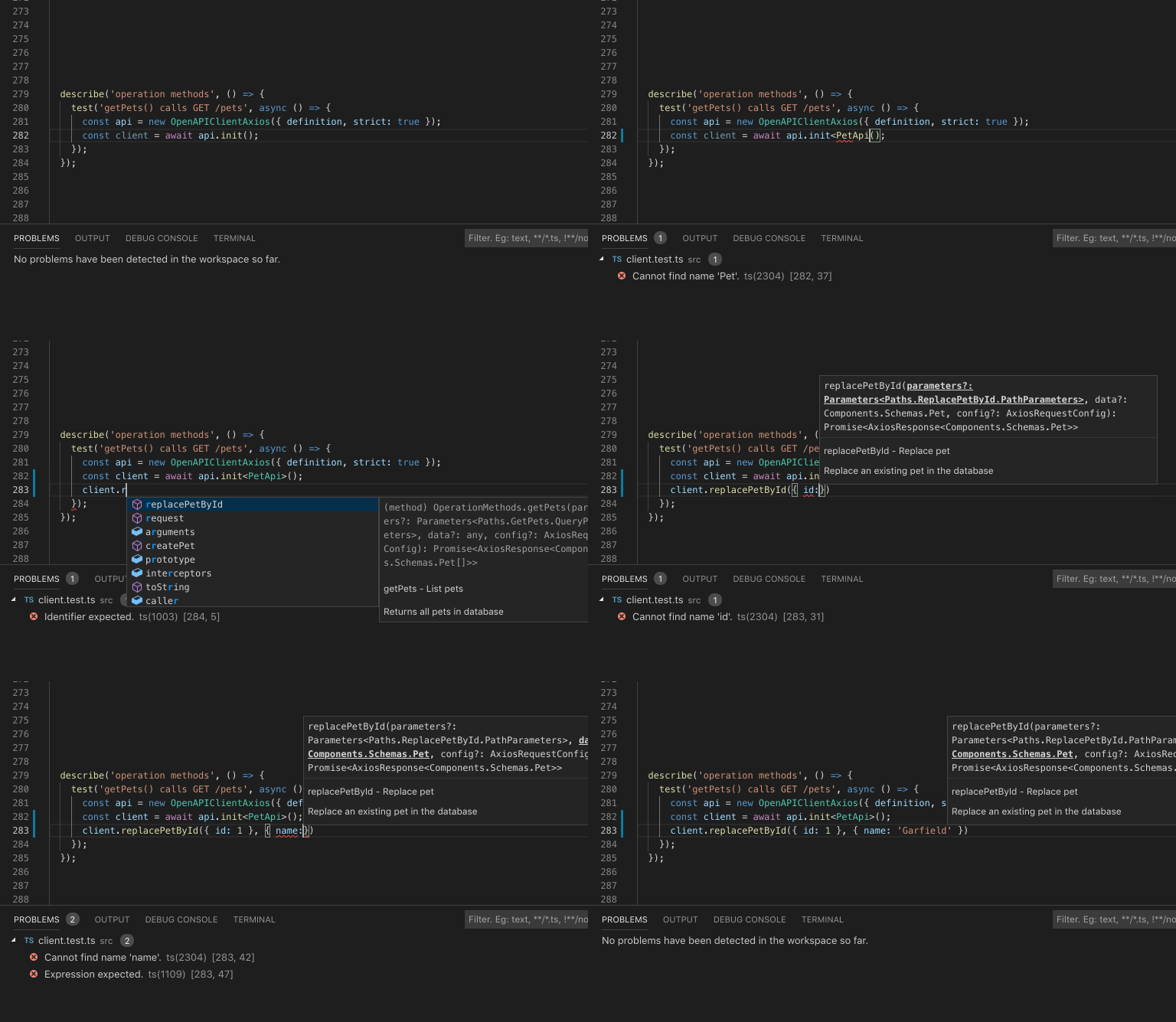
openapi-client-axios comes with a CLI command openapicmd typegen to generate Typescript types for type safety and code autocomplete.
npx openapicmd typegen ./openapi.yaml > src/types/openapi.d.ts
The output of typegen exports a type called Client, which can be used for instances created with OpenAPIClientAxios.
Both the api.getClient() and api.init() methods support passing in a Client type.
import { Client as PetStoreClient } from './client.d.ts';

const client = await api.init<PetStoreClient>();
const client = await api.getClient<PetStoreClient>();
openapicmd typegen supports using both local and remote URLs for OpenAPI definition files.
$ npx openapicmd typegen ./petstore.yaml
$ npx openapicmd typegen https://petstore3.swagger.io/api/v3/openapi.json
Commercial support
For assistance with openapi-client-axios in your company, reach out at support@openapistack.co.
Contributing
OpenAPI Client Axios is Free and Open Source Software. Issues and pull requests are more than welcome!