
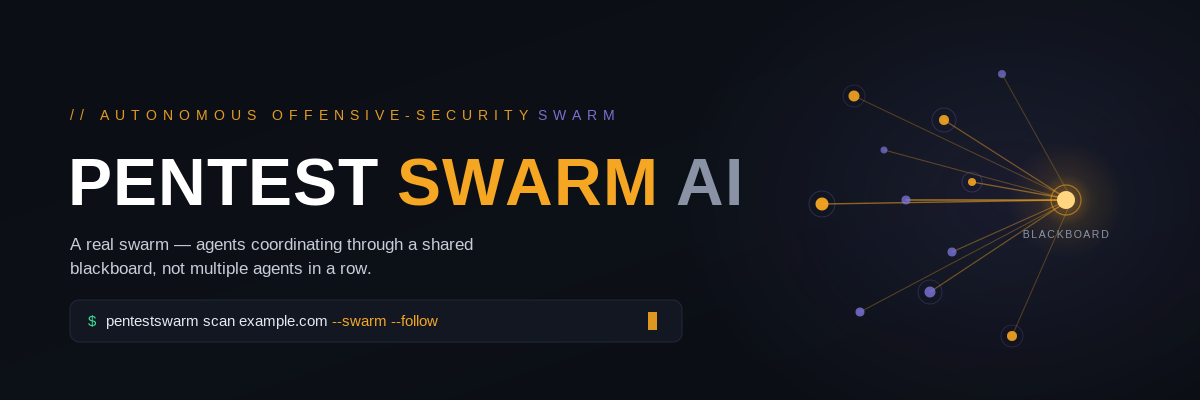
The open-source XBOW alternative —
an autonomous API & web-app pentester.
Dozens of AI agents don't just scan — they exploit. They chain attacks (BOLA/IDOR, JWT forgery, mass assignment, SSRF, injection), build and score attack paths, and prove real vulnerabilities at machine speed.
Built for pentesters · bug bounty hunters · red teamers · security researchers
📖 Documentation · Quick Start · Use Cases · vs. XBOW · Swarm vs. Multi-Agent · How It Works · Mission · Coverage · Roadmap
Pentest Swarm AI is an autonomous, open-source API & web-app pentester built on a real swarm. Dozens of AI agents coordinate through a shared stigmergic blackboard to exploit, chain, and prove vulnerabilities at machine speed.
- 🐝 A real swarm, not a pipeline — dozens of agents work your surface concurrently, coordinating via pheromone-weighted findings; attack chains emerge instead of being scripted.
- 💥 Exploits, doesn't just scan — chains BOLA/IDOR, JWT forgery, mass assignment, SSRF, SQLi/NoSQLi, GraphQL abuse — then captures evidence and writes the report.
- 🧠 Any model, self-hosted — Claude, Together AI (GLM/Qwen/DeepSeek), Gemini, OpenAI-compatible, or fully local Ollama / LM Studio. We're the harness that gives models hands.
- ✅ Proof over maybes — non-LLM verification oracles (OOB / differential / timing) confirm findings against the live target; proven ones get a VERIFIED badge.
- 🛡️ Safe by construction — fail-closed scope, egress guard, an authorization gate, and a full audit trail.
- 🎯 Drop-in use cases — bug bounty, external ASM, CI/CD, internal network, CTF, GraphQL, OWASP Top 10 — each a one-command playbook.


🏴 Presented at Black Hat Arsenal — India · the open-source pentest swarm, demoed live.
⚠️ Authorized use only. This is an autonomous offensive tool that sends real attack traffic to live targets. Use it only against systems you own or have explicit written authorization to test. Unauthorized use is a crime, and you are solely responsible. Scope is enforced fail-closed, and the tool makes you affirm authorization before it attacks a real target.
Read the Responsible Use Policy before you run anything.
Hack at machine speed.
📖 New here? Start with the documentation — quickstart, provider setup, CLI reference, and troubleshooting. (Or run
pentestswarm docsto open it.)
XBOW proved a point: AI can top the bug-bounty leaderboards. But XBOW is a closed, hosted SaaS — one agent, on their cloud, on their model, at their price. We think the future of offense is open, self-hosted, and a swarm — so we built it.
Pentest Swarm vs. XBOW
| Pentest Swarm AI | XBOW | |
|---|---|---|
| Open source | ✅ AGPL, fork it | ❌ closed |
| Self-hosted | ✅ your infra, your model, $0 floor | ❌ their cloud, their bill |
| A real swarm | ✅ dozens of agents, concurrent | ❌ single agent |
Three structural wins — and the swarm is the one that compounds. This isn't a single planner LLM walking recon → classify → exploit → report down a fixed line. Dozens of agents work your surface at once, coordinating through a shared stigmergic blackboard: the instant a finding lands it wakes whichever agent it's relevant to, so a 1,000-subdomain target gets hit in parallel — attacking at machine speed. And unlike a scanner that spits out unverified "maybes," the swarm exploits what it finds, proves it with captured evidence, then writes the report.
Who it's for: pentesters covering a whole scope overnight · bug bounty hunters racing to first-blood on a fresh target · red teamers who need breadth fast · researchers pushing autonomous offense.
Run it on any model — Claude, anything OpenAI-compatible (incl. Together AI's hosted Llama/Qwen/DeepSeek), the new security-tuned open models (Pentest-R1 and the wave behind it), or fully local Ollama / LM Studio. We don't compete with those models — we're the harness that gives them hands: real tools, swarm coordination, scope safety, and evidence-backed reports. Air-gapped, zero API cost, and not one byte of your data leaving your box.
For authorized testing only — see the full legal disclaimer and Responsible Use Policy.
What makes this a swarm?
Most "multi-agent" pentesting tools are a single planner LLM dispatching to specialist agents in a fixed order — recon → classify → exploit → report. That's a pipeline, not a swarm.
Pentest Swarm AI is built around three swarm-intelligence primitives:
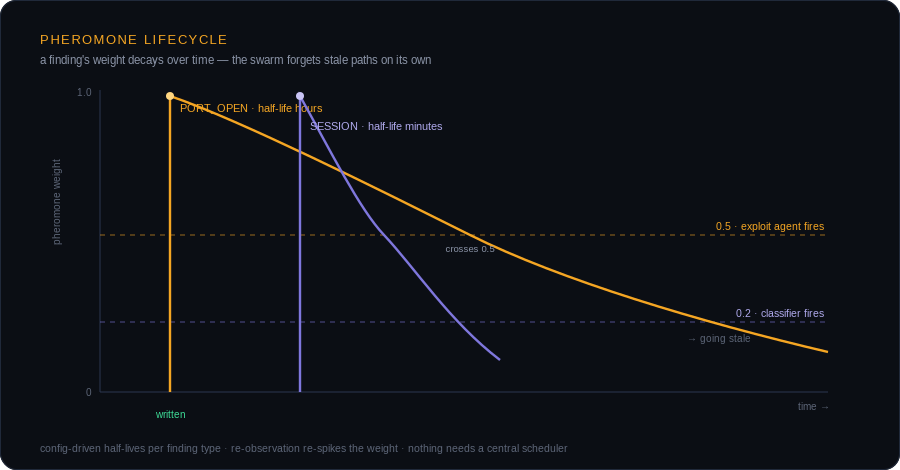
- Stigmergy — agents coordinate by reading and writing findings on a shared blackboard, not by a central planner telling them what to do. A finding's pheromone weight biases other agents toward it and decays over time, so stale paths die naturally.
- Emergence — attack chains appear that no single agent planned. A recon finding wakes the classifier; a high-severity classification wakes the exploit agent; exploit results feed back into the board and wake the report agent. Order isn't prescribed — it emerges from the blackboard state.
- Decentralization — each agent runs its own trigger predicate. Add a new agent with its own predicate and it joins the swarm without anyone rewriting the orchestrator.
Why it wins: a pipeline is sequential (one stage at a time), can't fold a mid-run discovery back into recon, and is bounded by its slowest stage. A swarm works your surface concurrently, reacts to every new finding, lets attack chains emerge instead of scripting them, and lets stale paths decay and die. The payoff on stage is breadth — a long list of proven findings, because many agents chew on the surface at once.
📖 Full write-up: Architecture — Swarm vs. Pipeline (the blackboard, pheromone decay, emergent chains, and why concurrency stays cheap). Diagrams also live in docs/.
We built this because the category was empty. Every tool marketed as "swarm" was actually a pipeline. If you find a counter-example, open an issue — we'll add them to the comparison table.
Quick Start
One command to install. One command to run. No API key, no cloud, no bill to start.
1 · Install (pick one)
npm install -g @armurai/pentestswarm                                       # npm (Node ≥16)
curl -fsSL https://raw.githubusercontent.com/Armur-Ai/Pentest-Swarm-AI/main/scripts/install.sh | sh   # any macOS/Linux
brew install Armur-Ai/tap/pentestswarm                                     # Homebrew
go install github.com/Armur-Ai/Pentest-Swarm-AI/cmd/pentestswarm@latest    # Go toolchain
docker run --rm ghcr.io/armur-ai/pentestswarm:latest --help                # Docker
2 · Run it
pentestswarm run
That's it. run opens the interactive TUI launcher — no flags to memorize:
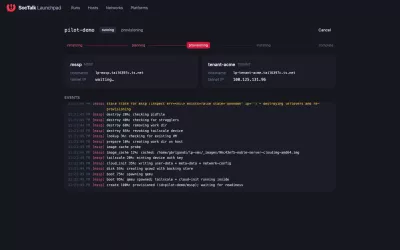
- Pick your AI provider and paste a key right in the UI — Together AI (hosted Llama / Qwen / DeepSeek), Claude, OpenAI, Gemini, or fully local Ollama / LM Studio (no key at all).
- Point it at a target — a URL, or a bundled vulnerable lab (crAPI, Juice Shop, VAmPI, DVGA) that spins up, gets attacked, and tears down after. Legal, safe, zero setup.
- Choose your live view — a web dashboard on
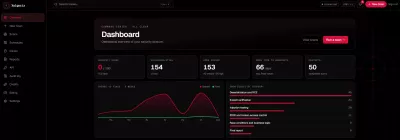
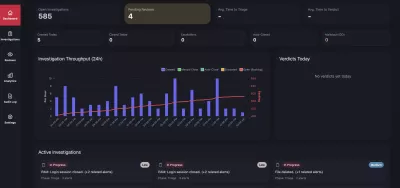
localhost:7777and a full-screen terminal TUI with live charts, a swarm-topology diagram, and a graded findings stream. Both, by default. - Then launch and watch the swarm work at machine speed.
A readiness check runs right in the launcher (Go, Docker, tools, provider) — it never blocks; anything missing is shown as a note you can fix or ignore.
Prefer flags? (scripting / CI)
run just wraps scan, so everything is scriptable too:
# watch it find a real vuln in ~2 min — bundled lab, local model, no key
pentestswarm scan --lab --lab-target crapi --provider ollama --swarm --tui

# a real target, cloud model for max quality
export PENTESTSWARM_ORCHESTRATOR_API_KEY=your-key-here
pentestswarm scan <authorized-target> --scope <target> --swarm --follow

# prove findings, don't just report them: confirm each high-stakes finding
# against the live target with a non-LLM oracle (OOB / differential / timing)
pentestswarm scan <authorized-target> --scope <target> --swarm --verify
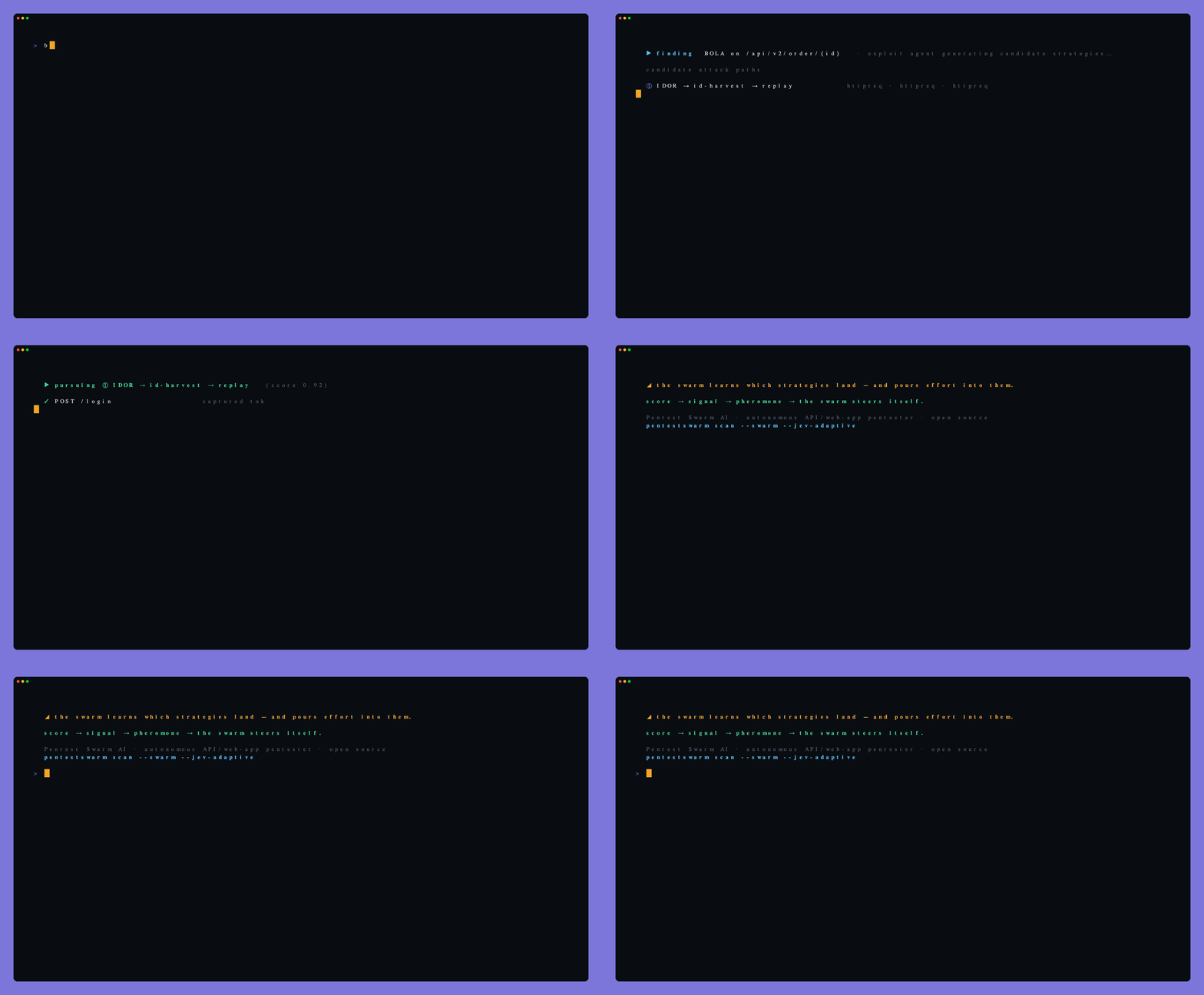
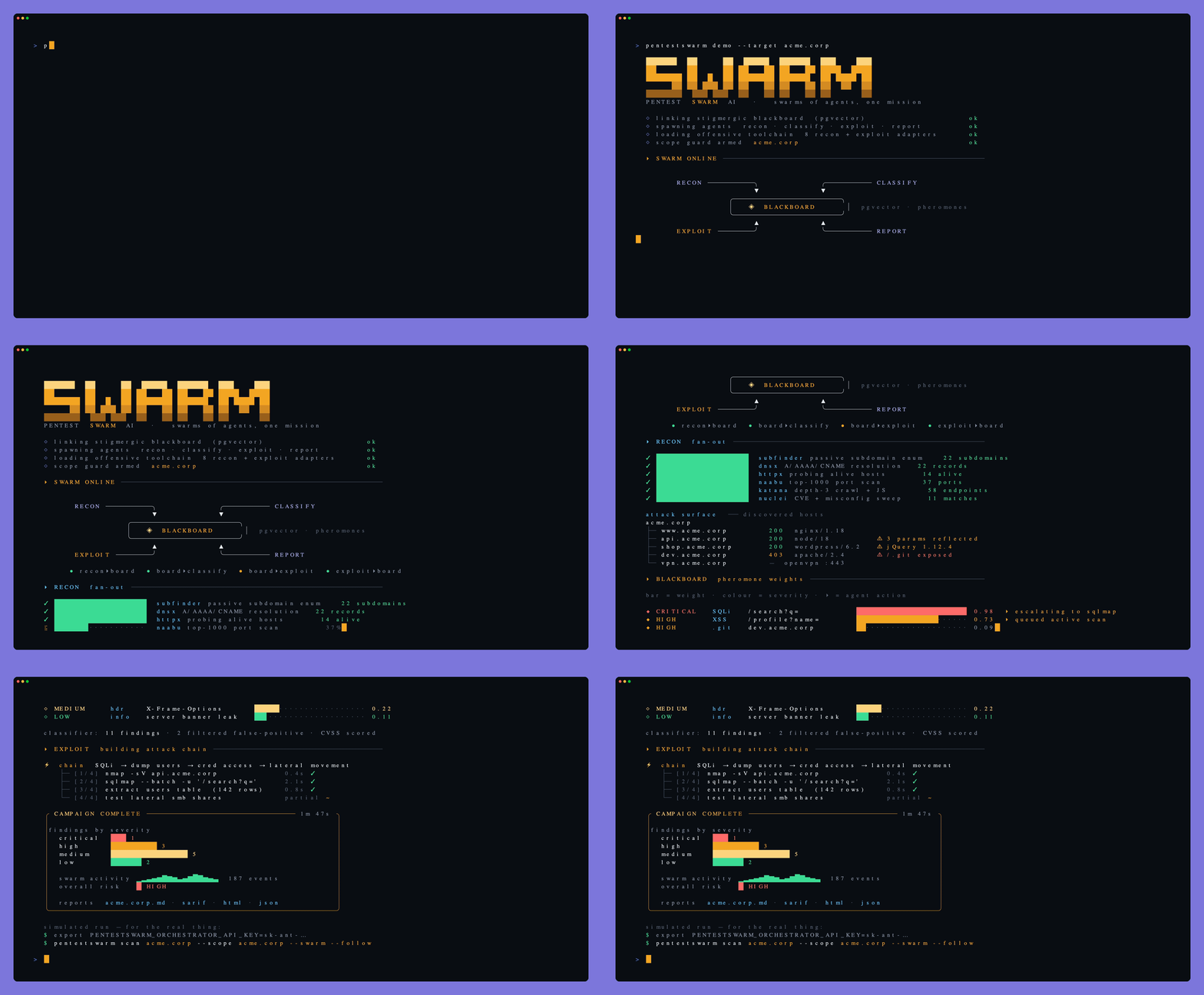
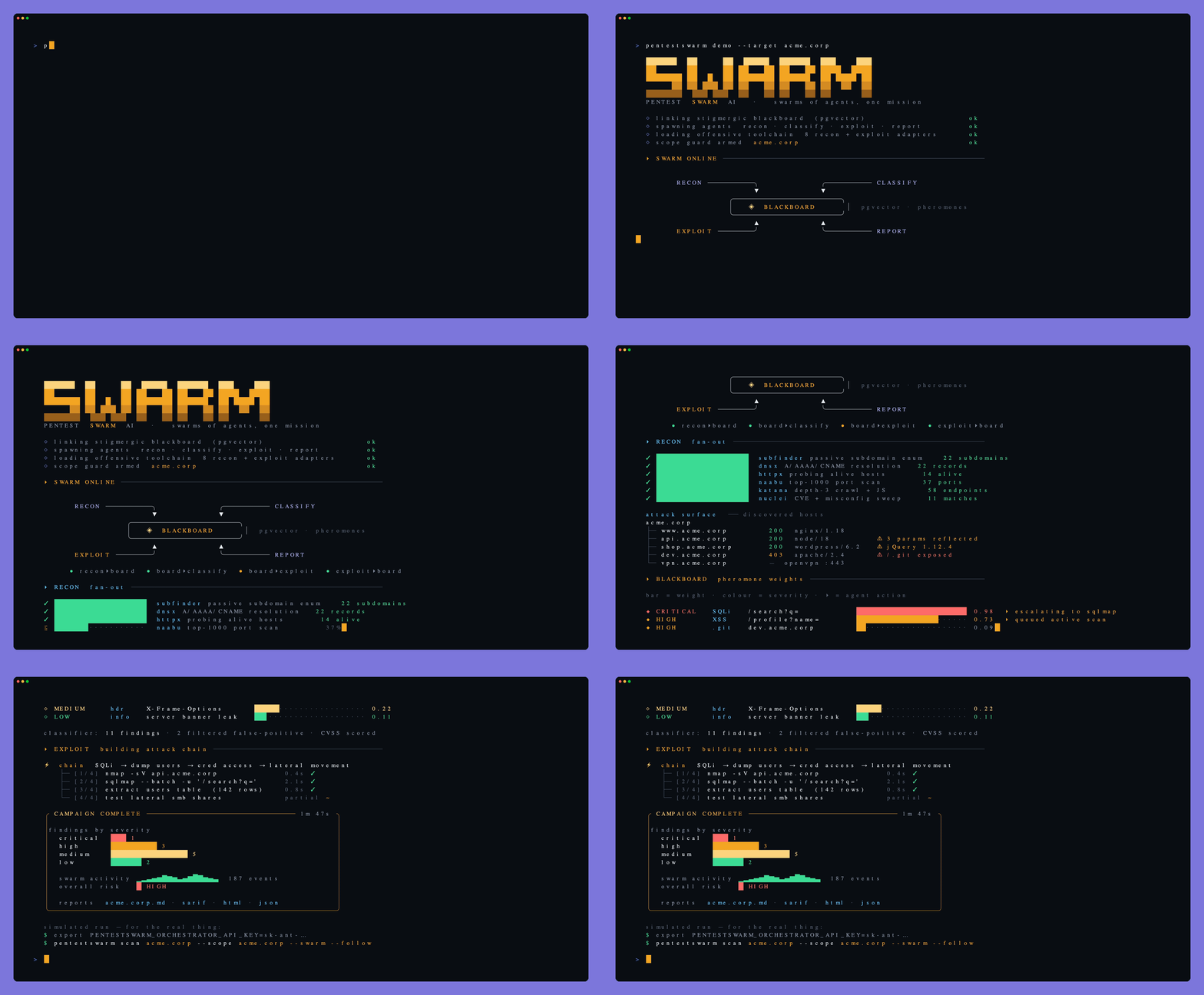
New here? pentestswarm demo plays the whole campaign offline — that's the GIF above. Running inside GitHub Actions? See deploy/github-action/example-workflow.yml.
Use cases
Each use case is a one-command playbook — a curated swarm configuration for a
specific job. List them with pentestswarm playbook list; run one with
pentestswarm playbook run <name> --target <t> --scope <scope>.
| Use case | What the swarm does | Playbook | Example |
|---|---|---|---|
| Bug bounty — first blood | race a fresh target: recon → classify → exploit → proof, breadth-first | bug-bounty |
pentestswarm playbook run bug-bounty --target https://app.example.com --scope example.com |
| External ASM | enumerate a whole external surface and prove the exploitable edges | external-asm |
pentestswarm playbook run external-asm --target example.com --scope example.com |
| CI/CD gate | fast, scriptable scan with SARIF output for a pipeline | ci-cd-security |
pentestswarm playbook run ci-cd-security --target $STAGING_URL --scope $STAGING_HOST |
| API security (BOLA/IDOR/BFLA) | object-level & function-level authz abuse across an API | api-security |
pentestswarm playbook run api-security --target https://api.example.com --scope api.example.com |
| GraphQL audit | introspection, field-level authz, injection, batching abuse | graphql-audit |
pentestswarm playbook run graphql-audit --target https://api.example.com/graphql --scope api.example.com |
| OWASP Top 10 | broad web-app coverage mapped to the Top 10 | owasp-top10 |
pentestswarm playbook run owasp-top10 --target https://app.example.com --scope example.com |
| Internal network | authorized internal-range sweep and service exploitation | internal-network |
pentestswarm playbook run internal-network --target 10.0.0.0/24 --scope 10.0.0.0/24 |
| CTF solver | autonomous flag hunting on a CTF target | ctf-solver |
pentestswarm playbook run ctf-solver --target http://ctf.local:8000 --scope ctf.local |
| Try it with no target | attack a bundled vulnerable lab (crAPI, Juice Shop, VAmPI, DVGA) that spins up and tears down | — | pentestswarm scan --lab --lab-target crapi --swarm --tui |
Full walkthroughs with sample output live in the documentation and the coverage catalog.
How the swarm works
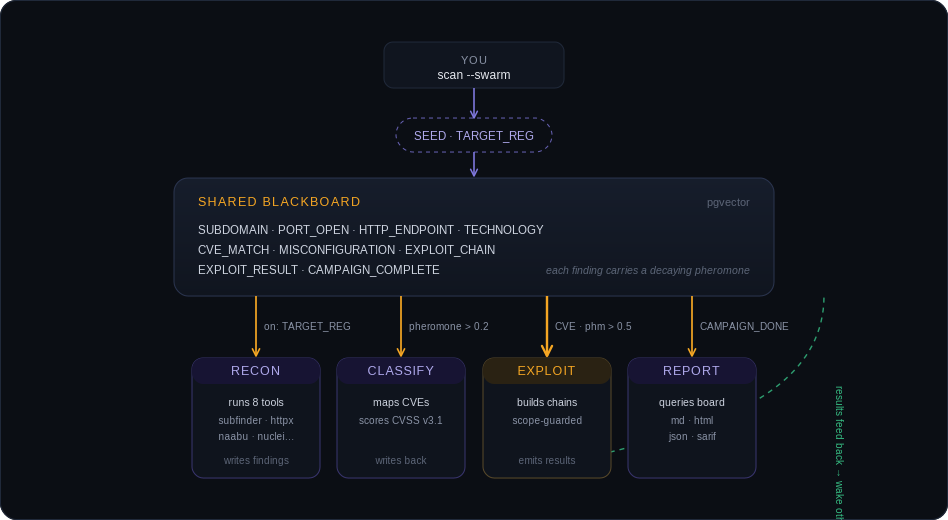
Key behaviours:
- Agents are independent. Any one of them can be removed, replaced, or added without rewiring the others.
- Pheromones decay per-finding-type. A
PORT_OPENstays hot for hours; aSESSIONfor minutes. Config-driven half-lives. - Scope is enforced at the tool layer and again at the executor. Defence in depth —
--scopeis not bypassable. - Cleanup is always registered before execution. SIGINT, crashes, and budget exhaustion all trigger reverse-order cleanup. See
internal/pipeline/cleanup_memory.goandcleanup.go. - Prompt caching on Claude cuts cost and latency on repeated system prompts (enabled by default for recon + classifier).
Comparison
How we position vs. the rest of the ecosystem. We'll ship real benchmark numbers in a future release (see the benchmarks roadmap).
| Tool | Open / self-host | Architecture | Executes vs. suggests | Memory | Tools wired | MCP | Swarm? |
|---|---|---|---|---|---|---|---|
| Pentest Swarm AI | ✅ open, self-hosted | Stigmergic blackboard | Executes | pgvector + pheromones | 8 ProjectDiscovery + nmap; sqlmap / Burp MCP / Metasploit in roadmap | Yes | ✅ real |
| XBOW | ❌ closed SaaS | Autonomous agent (hosted) | Executes | Hosted | Managed | No public API | No |
| PentestGPT | ✅ open | Single-agent ReAct | Suggests | None | None native | No | No |
| HackingBuddyGPT | ✅ open | Single-agent | Executes | Run logs | Shell passthrough | No | No |
| PentAGI | ✅ open | 4 agents + planner | Executes | pgvector | 40+ via MCP/shell | Partial | Pipeline |
| Shannon | ✅ open | White-box + browser | Executes | Session state | Browser DOM | No | Pipeline |
| HexStrike | ✅ open | MCP tool wrapper | Delegates to client LLM | None (stateless) | 150+ via MCP | Yes | No |
| Pentest-R1 | ✅ open (model) | RL-tuned LLM | Executes | Trajectory | CTF-scope | No | No |
If any entry here is wrong or out of date, please open a PR — we want this table to stay honest.
Feature status
Honesty labels: stable means shipped + tested, beta means works but rough edges, alpha means experimental, planned means in the roadmap.
| Feature | Status | Notes |
|---|---|---|
| Sequential 5-phase runner | stable | Default mode; battle-tested core |
| Stigmergic swarm scheduler | alpha | --swarm flag; memory-backed blackboard wired |
| ProjectDiscovery toolchain | stable | subfinder, httpx, nuclei, naabu, katana, dnsx, gau |
nmap adapter |
stable | XML parsed; scope-validated |
| Cleanup registry | stable | Always runs on SIGINT / exit / budget-cancel |
| Claude prompt caching | stable | Enabled for recon + classifier by default |
--strict LLM mode |
stable | Promotes LLM errors to fatal |
| CVSS v3.1 scoring | stable | FIRST spec |
| Jev false-positive filter | beta | --jev; optional second-opinion pass via TypeSafe's Jev — off by default, fails open. Docs |
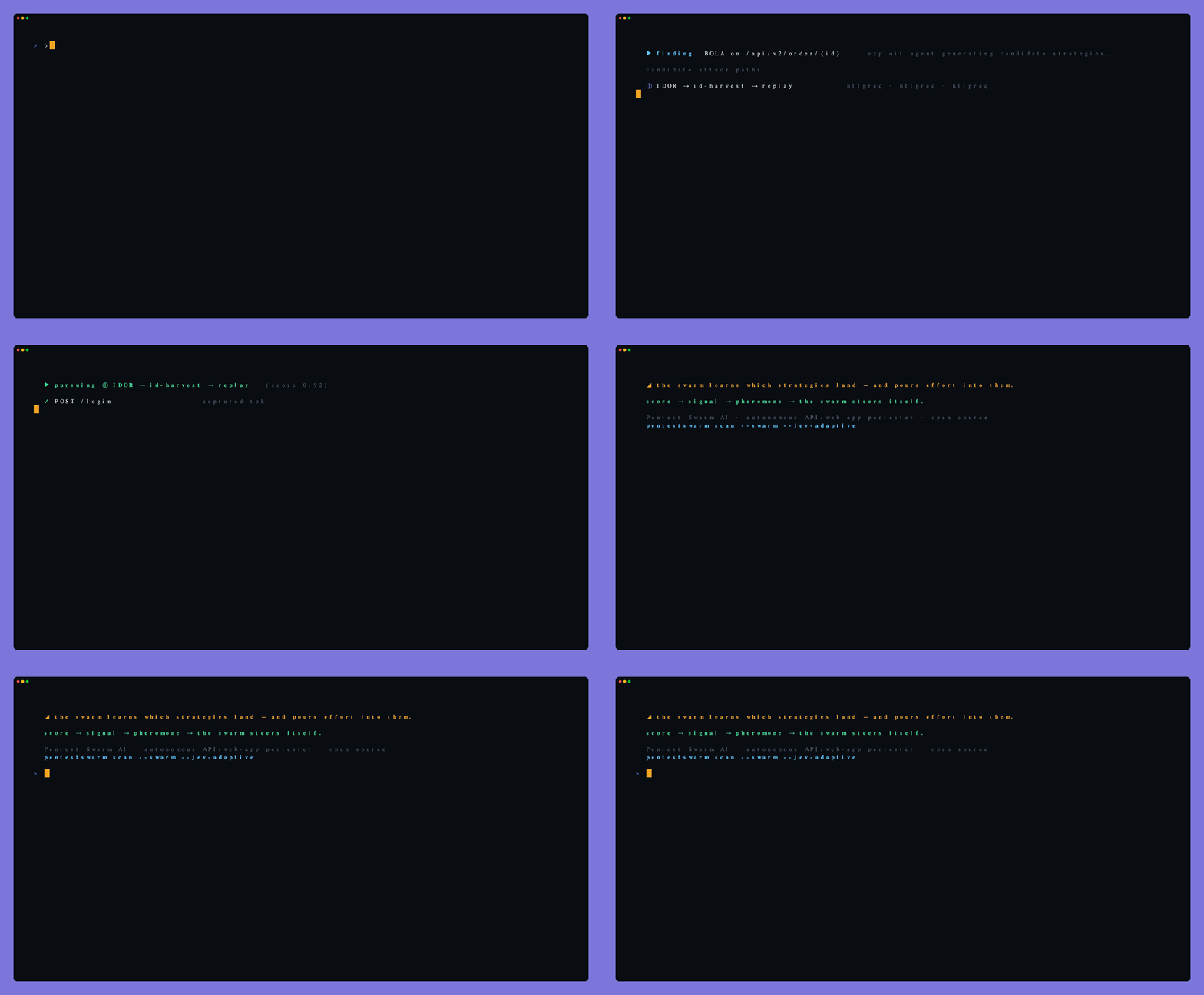
| Jev adaptive attack-path scoring | beta | --jev-adaptive; the swarm scores its candidate attack strategies with Jev in real time and pursues the best first (graded pheromone). Off by default, fails open. |
| External verification oracles | beta | --verify; confirm a finding against the live target with a non-LLM signal — out-of-band callback, differential response, or timing — and trust that verdict over the model. Proven findings get a VERIFIED badge and a 1.0 attack-graph edge. Scope-guarded; off by default; ignored under --dry-run/--safe-mode. Docs |
| Exploit chains | beta | chain run/list/update; a growing library of named, CVE-tied exploit chains (SSRF→RCE, auth-bypass→RCE…) — fingerprint + safe verify + report. Lean binary + on-demand updates. [Docs](https://armur-ai.github.io/Pentest-Swarm-AI/docs/exploit-cha |