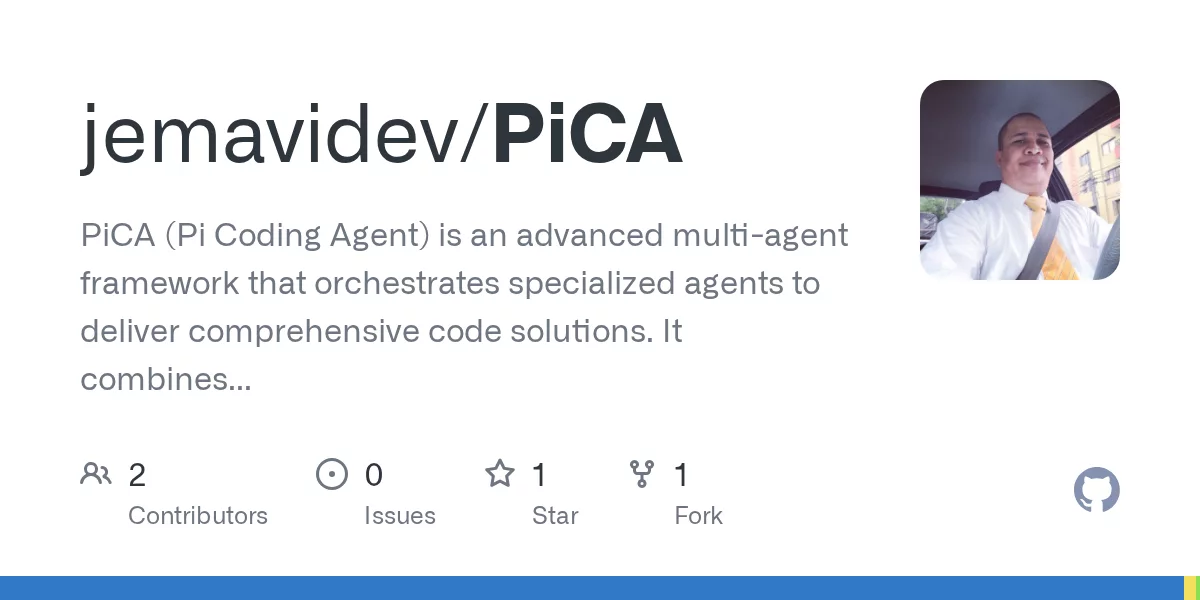

PiCA - Pi Coding Agent
A specialized multi-agent framework for intelligent code analysis, design, generation, and validation.
PiCA is an advanced orchestration system that coordinates multiple specialized agents to deliver comprehensive code solutions. Built with safety, approval workflows, and extensibility at its core.
🎯 What is PiCA?
PiCA (Pi Coding Agent) is a framework for building intelligent agent-based systems that can:
- Analyze code with deep architectural understanding
- Design solutions with best practices
- Generate high-quality code implementations
- Validate code correctness and safety
- Maintain repository cleanliness and structure
It combines:
- 🔄 Multi-Agent Orchestration - Critic, Architect, Coder, Tester agents working in harmony
- 🎛️ Approval Framework - 5-level security model for all operations
- 🎣 Hook System - 8 lifecycle events for extensibility
- 💾 Memory Management - Session tracking with checksummed integrity
- 🚀 Parallel Execution - Up to 4x speedup with agent parallelization
- 🏠 Repository Hygienizer - Automated structure analysis and maintenance
🚀 Quick Start
Installation
npm install @pica/agent
Initialize PiCA
import { initializePiCA } from '@pica/agent';

const pica = await initializePiCA({
  projectPath: '/path/to/project',
  piPath: '/path/to/.pica',
  apiKey: process.env.OPENROUTER_API_KEY,
});

console.log('✅ PiCA initialized');
Run Analysis
const result = await pica.agentx.orchestrate({
  sessionId: 'session-1',
  userInput: 'Analyze this component for performance issues',
  projectPath: '/path/to/project',
});

console.log('Analysis complete:', result.finalOutput);
🏗️ Architecture
┌─────────────────────────────────────────────────────────────┐
│                        User Input                           │
├─────────────────────────────────────────────────────────────┤
│                   AgentX Orchestrator                       │
│  ├─ Intent Detection                                       │
│  ├─ Agent Selection                                        │
│  └─ Result Consolidation                                  │
├─────────────────────────────────────────────────────────────┤
│                   Multi-Agent System                        │
│  ├─ Critic Agent (Analyze)                                │
│  ├─ Architect Agent (Design)                              │
│  ├─ Coder Agent (Generate)                                │
│  ├─ Tester Agent (Validate)                               │
│  └─ Hygienizer Agent (Maintain)                           │
├─────────────────────────────────────────────────────────────┤
│              Support Infrastructure                         │
│  ├─ HookManager (Events)                                  │
│  ├─ ApprovalManager (Security)                            │
│  ├─ MemoryManager (State)                                 │
│  ├─ ProviderManager (Models)                              │
│  └─ ParallelExecutor (Performance)                        │
├─────────────────────────────────────────────────────────────┤
│              External Integrations                          │
│  ├─ OpenRouter API                                        │
│  ├─ Git / Version Control                                 │
│  └─ Project File System                                   │
└─────────────────────────────────────────────────────────────┘
🧠 The Four Core Agents
1. Critic Agent 🔍
Analyzes code for issues, patterns, and improvements.
- Code quality assessment
- Anti-pattern detection
- Performance analysis
- Security review
2. Architect Agent 🏛️
Designs system structure and high-level solutions.
- Architecture reviews
- Design pattern recommendations
- System redesigns
- Structural improvements
3. Coder Agent 💻
Generates production-ready code.
- Feature implementation
- Bug fixes
- Code generation
- Refactoring
4. Tester Agent ✅
Validates code correctness.
- Test generation
- Test execution
- Coverage analysis
- Validation reports
🔐 Safety & Governance
5-Level Approval Framework
Level 0: Auto      - Automatic execution (read-only operations)
Level 1: Prompt    - Ask user before executing
Level 2: Required  - Always require explicit approval
Level 3: Manual    - Manual execution only
Level 4: Blocked   - No execution allowed
8 Lifecycle Hooks
onSessionStart- Session initializationonSessionEnd- Session completiononAgentSelected- Agent dispatchedonAnalysisComplete- Analysis finishedonCodeGenerated- Code createdonValidationComplete- Validation doneonError- Error occurredonApprovalRequired- Approval needed
🏡 Repository Hygienizer
Automated repository structure maintenance:
# Quick status check
/repo-status

# Full audit with recommendations
/repo-audit

# Suggest correct location for a file
/repo-suggest-location src/my-file.ts

# Generate cleanup plan
/repo-cleanup
Features:
- File classification (CORE, CONFIG, DOCS, DEVELOPMENT, GENERATED)
- Automatic location validation
- Misplaced file detection
- Import rule enforcement
- Hygiene scoring (0-100)
⚡ Performance
Parallel Execution
Run multiple agents simultaneously with automatic rate limiting:
const result = await executor.executeParallel({
  agents: [criticAgent, architectAgent],
  context: agentContext,
  executeAgent: async (agent, ctx) => { /* ... */ },
  checkApproval: async (agent, ctx) => 'approved',
  getProviderUsage: () => ({ currentRequests: 45, maxRequests: 100 }),
});

// 2 agents in parallel: ~500ms instead of ~1200ms (2.4x faster)
console.log(`Success rate: ${(result.successRate * 100).toFixed(0)}%`);
Context Efficiency
Intelligent context loading with caching:
- 40% token reduction vs full context
- Incremental loading strategy
- Cache-aware consolidation
- Compression support
📊 Memory & State
Session Memory
Automatically tracks:
- User interactions
- Agent decisions
- File operations
- Cost tracking
- Error history
Checksum Validation
All memory is SHA256-validated:
const validation = await memoryManager.validateChecksum(session);
if (validation.isValid) {
  console.log('✅ Memory integrity verified');
}
🔌 Provider Management
Switch between providers transparently:
const providerManager = new ProviderManager({
  primary: 'openrouter',
  providers: {
    openrouter: {
      apiKey: process.env.OPENROUTER_API_KEY,
      models: {
        orchestrator: 'openrouter/openai/gpt-4-turbo',
        analysis: 'openrouter/deepseek/deepseek-chat',
        generation: 'openrouter/deepseek/deepseek-chat',
        validation: 'openrouter/google/gemini-2.0-flash',
      },
      rateLimit: 100,
      timeout: 30000,
    },
  },
}, logger);
📚 Documentation
- Installation Guide - Setup & initialization
- API Reference - Complete API documentation
- Architecture Guide - System design & internals
- Examples & Guides - Practical usage examples
🔧 Project Structure
BetterAgents/
├── src/
│   ├── agentx.ts                 # Main orchestrator
│   ├── agent-loader.ts           # Agent management
│   ├── approval-manager.ts       # Security framework
│   ├── hook-manager.ts           # Event system
│   ├── memory-manager.ts         # State management
│   ├── session-manager.ts        # Session tracking
│   ├── parallel-executor.ts      # Parallel execution
│   ├── hygienizer-agent.ts       # Repository analysis
│   ├── hygienizer-cli-handler.ts # CLI commands
│   └── index.ts                  # Main exports
├── docs/
│   ├── README.md                 # This file
│   ├── INSTALLATION.md           # Setup guide
│   ├── API.md                    # API reference
│   ├── ARCHITECTURE.md           # Architecture guide
│   └── EXAMPLES.md               # Usage examples
├── _dev/
│   ├── SECURITY-ANALYSIS.md      # Security analysis
│   ├── PARALLEL-EXECUTION.md     # Parallelization
│   ├── HYGIENIZER-AGENT.md       # Hygienizer spec
│   └── HYGIENIZER-IMPLEMENTATION.md  # Implementation
└── .pica-project-manifest.json   # Repository structure
🧪 Testing
# Run all tests
npm test

# Watch mode
npm test:watch

# Coverage report
npm test:coverage
Current Coverage:
- ✅ ParallelExecutor: 8/8 tests passing
- ✅ HygienizAgent: 26/26 tests passing
- ✅ ApprovalManager: Full coverage
- ✅ HookManager: Full coverage
📦 Publish to npm
npm run build
npm publish
🤝 Contributing
PiCA welcomes contributions:
- Fork the repository
- Create a feature branch
- Make your changes
- Add tests
- Submit a pull request
📄 License
MIT License - See LICENSE file for details
🎯 Roadmap
✅ Completed
- Core orchestration framework
- 4 specialized agents
- Approval framework
- Hook system
- Memory management
- Session tracking
- Parallel execution
- Repository Hygienizer
🚧 In Progress
- AgentX integration with CLI
- HookManager lifecycle integration
- Dashboard visualization
🗓️ Planned
- Distributed agent execution
- Advanced caching (L2 Redis)
- ML-based structure optimization
- Team-wide metrics
- Automated CI/CD integration
📞 Support
- Issues: Report bugs via GitHub Issues
- Discussions: Ask questions in Discussions
- Docs: Full documentation in
/docs
PiCA - Pi Coding Agent 🚀
Intelligent code analysis, design, generation, and validation at scale.
Made with ❤️ for developers who demand excellence