Reserva
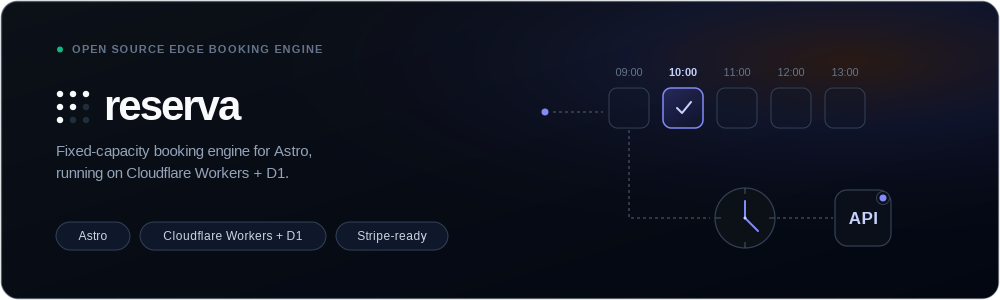
A booking engine for fixed-capacity time slots, built as an Astro integration. It runs in your own Cloudflare account on Workers + D1, with no per-booking fees.
Add Reserva to an Astro 7 site and it mounts a booking API, the confirmation and manage pages, and an admin dashboard, all backed by your own D1 database. It runs on the Workers Free plan; Which Workers plan covers what Paid changes.
Reserva handles availability, holds, payment checks, cancellations and reschedules, refunds, calendar and email delivery, retries, partners and referral codes, and the admin. You build the customer-facing booking form yourself, on the public API.
What it books
Fixed-length slots with a shared capacity: hold, pay, confirm, then cancel or reschedule within
cutoffs. That fits tours, classes, workshops, restaurant tables, court and room hire,
general-admission events, and appointments with interchangeable staff.
examples/configs/ has complete configs for several of these. All
services share one capacity pool.
It doesn't do:
- Multi-day or date-range rentals.
- Assigned seating, where each seat is its own unit.
- Scheduling per staff member.
- A booking widget.
examples/smoke-sitehas a complete one to copy.
Quickstart
bun add @reservajs/astro
bun add @reservajs/stripe   # the official payment adapter
// reserva.config.ts — plain data, shared by the integration and the runtime module
import type { ClientConfig } from '@reservajs/astro';

export default {
  business: {
    name: 'Lisbon Tuk Tours', shortCode: 'LTT', url: 'https://lisbontuktours.example',
    timezone: 'Europe/Lisbon', currency: 'eur',
    contact: { email: 'bookings@lisbontuktours.example', phone: '+351 210 000 000' },
  },
  capacity: { default: 3 },              // tuk-tuks per departure
  admin: { access: { teamDomain: 'https://lisbontuktours.cloudflareaccess.com', aud: '<AUD>' } },
  services: {
    alfama: {
      title: 'Alfama Discovery', durationMin: 60, turnaroundMin: 15,
      schedule: [{ days: [1, 2, 3, 4, 5, 6], firstStart: '09:00', lastStart: '17:00', intervalMin: 60 }],
      occupancy: { seatsPerUnit: 3 },    // one tuk-tuk seats a party of up to 3
      pricing: [{ maxQuantity: 3, priceMinor: 4500 }],
      location: {
        meetingPoints: [{ id: 'se', label: 'Sé Cathedral', mapsUrl: 'https://maps.google.com/?q=Se+Lisboa' }],
      },
    },
  },
} satisfies ClientConfig;
Everything else has a default. A service with only meetingPoints gets one implied pickup
option, so its pricing row needs no pickup.
docs/configuration.md covers the rest.
// astro.config.ts
import { defineConfig } from 'astro/config';
import cloudflare from '@astrojs/cloudflare';
import reserva from '@reservajs/astro';
import config from './reserva.config';

export default defineConfig({
  output: 'server',
  adapter: cloudflare(),
  integrations: [reserva({ config })],
});
// src/reserva-runtime.ts — the only place provider instances and secrets exist
import { defineCloudflareReservaRuntime } from '@reservajs/astro/runtime';
import { stripe } from '@reservajs/stripe';

// `Env` is global, generated by `wrangler types` — no import. The booking config is not imported
// either: the integration already validated it and hands it over through `virtual:reserva/config`.
export default defineCloudflareReservaRuntime<Env>({
  providers: ({ env }) => ({
    payments: stripe({ secretKey: env.STRIPE_SECRET_KEY, webhookSecret: env.STRIPE_WEBHOOK_SECRET }),
  }),
});
Declare the D1 binding and apply the migrations:
// wrangler.jsonc
{
  "name": "lisbon-tuk-tours",
  "compatibility_date": "2026-07-21",
  "d1_databases": [
    { "binding": "RESERVA_DB", "database_name": "reserva", "database_id": "<wrangler d1 create reserva>" }
  ]
}
bunx reserva-migrate --local   # local dev database
bunx reserva-migrate           # remote
That's a working deployment. output: 'static' works too: the injected routes set
prerender: false, so they render on demand.
The runtime module
Astro serializes integration options at build time, and provider instances (clients, closures,
secrets) can't be serialized. So the config travels to the runtime through
virtual:reserva/config, and your runtime module is loaded per request through
virtual:reserva/runtime. The default path is ./src/reserva-runtime.ts; pass
runtimeEntrypoint only if yours is elsewhere.
Bindings come from cloudflare:workers. Don't read locals.runtime.env: it throws on
@astrojs/cloudflare v14. The default D1 binding is RESERVA_DB, and the cache is
RESERVA_CACHE with a fallback to caches.default.
Keep secrets (payment keys, service-account keys, webhook signing keys) out of ClientConfig
and out of the repo. Store them as Worker secrets. Reserva reads its own RESERVA_* secrets and
each config.webhooks[].secretBinding by itself; list in secretBindings only the ones your
own code reads.
Payments
@reservajs/astro has no Stripe dependency. Payments go through the PaymentProvider
interface: install @reservajs/stripe for Stripe Checkout, or
write an adapter for another processor. Reserva always computes the
price; the adapter only charges it.
Point a Stripe webhook at /api/booking/webhooks/payment and subscribe it to
checkout.session.completed, checkout.session.expired,
checkout.session.async_payment_succeeded, checkout.session.async_payment_failed,
charge.refunded, charge.dispute.created and charge.dispute.closed. Turn payment methods on
in the Stripe dashboard, but leave delayed ones off (Multibanco, SEPA Direct Debit, bank
transfer): their money arrives after the hold expires, so Reserva refuses them.
Partners and referral codes
Partners (hotels, agents, affiliates) are managed in the admin at /booking/admin?view=partners.
Each partner gets a code and a referral link, <business.url>?ref=<code>, and can carry an
offer: a percentage off the service price, free pickup, or both. Bookings made with a code show
the partner, the price before the offer and the discount in the admin.
Your site reads ref, resolves it with resolveReferral(), and passes it as referralCode to
quote() and checkout(). Offers stay off until you enable them in the runtime with a minimum
charge per currency. Partner offers has the
full flow.
Booking events
Each booking event reaches two kinds of subscriber, both delivered from one durable outbox.
The set is exported as BOOKING_EVENTS from @reservajs/astro/core:
booking.confirmed, booking.cancelled_by_customer, booking.cancelled_by_operator, booking.rescheduled, booking.no_show, booking.reminder, payment.dispute_created
Hooks run in-process. A plain hook is fire-and-forget; a durable: true hook is retried
like any other side effect:
hooks: [
  { name: 'analytics', handler: async (event, booking) => track(event, booking?.reference) },
  { name: 'ops', durable: true, events: ['booking.confirmed'], handler: pushToOps },
]
Webhooks go in config.webhooks. They're always durable and signed per
Standard Webhooks:
webhooks: [{ name: 'partner', url: 'https://partner.example/reserva', secretBinding: 'PARTNER_WEBHOOK_SECRET', events: ['booking.confirmed'] }]
A subscriber can also name settings.changed, which fires on each admin save so a static site
can rebuild. See Rebuilding a static site.
The envelope and signature headers are in docs/api.md.
Injected routes
All routes are server-rendered. This table is generated from the route manifest:
| Route id | Path | Group |
|---|---|---|
availability |
/api/booking/availability |
customer |
checkout |
/api/booking/checkout |
customer |
quote |
/api/booking/quote |
customer |
resolveReferral |
/api/booking/referral |
customer |
catalog |
/api/booking/catalog |
customer |
webhooksPayment |
/api/booking/webhooks/payment |
webhook |
status |
/api/booking/status |
customer |
manageApi |
/api/booking/manage |
customer |
cancel |
/api/booking/cancel |
customer |
reschedule |
/api/booking/reschedule |
customer |
operatorCancel |
/api/booking/operator/cancel |
ops |
operatorReschedule |
/api/booking/operator/reschedule |
ops |
operatorNoShow |
/api/booking/operator/no-show |
ops |
opsHealth |
/api/booking/ops/health |
ops |
reconcile |
/api/booking/ops/reconcile |
ops |
assetsCss |
/booking/assets/reserva.css |
customer |
assetsJs |
/booking/assets/reserva.js |
customer |
adminPage |
/booking/admin |
admin |
managePage |
/booking/manage |
manage |
confirmationPage |
/booking-confirmation |
customer |
Request and response types are exported from @reservajs/astro/core. Every error is
{ error: { code, message, details? } }, with code from API_ERROR_CODES:
validation_failed, method_not_allowed, payload_too_large, forbidden, not_found, past_cutoff, invalid_transition, slot_unavailable, too_many_holds, quote_changed, partner_storage_unavailable, partner_conflict, payment_session_mismatch, payment_amount_mismatch, invalid_payment_signature, duplicate_payment_ref, confirmation_in_progress, reconciliation_in_progress, refund_conflict, refund_payment_ref_missing, refund_failed, calendar_unavailable, internal_error
Documentation
docs/configuration.md: every config key, pricing, opening hours, locations, metadata fields, routes and CORS.docs/api.md: the endpoints, the typed client, partner offers, webhooks, and why some status codes behave the way they do.docs/deployment.md: secrets, admin access, the setup checklist, the scheduled sweep, and migrations.docs/customization.md: theming, branding, copy, and email templates.docs/providers.md: writing a payment, calendar, email or alert adapter.docs/development.md: the local demo, tests, and contributing.docs/architecture.md: the system map and the rules a change must keep.docs/decisions.md: where Reserva departs from its original spec, and why.AGENTS.md: the integration contract, written for coding agents.
Security reports: see SECURITY.md.
License
MIT