All glory and honor to God יהוה in the name of Yeshua the Messiah (Jesus Christ).
🌐🦀📜 Rullst 📜🦀🌐
Intelligent, Security-Conscious, and Designed for Effortless Productivity — Because With Rullst, We Rule!






Quickstart · Start building · Rullst Academy · Live examples · Documentation · Discord
⚡ Rullst in 30 seconds
cargo install cargo-rullst --version =13.0.0-alpha.3 --locked
cargo rullst new my_app    # choose Blank/API, Blog, SaaS, LMS, Portfolio or ERP
cd my_app
cargo rullst dev           # rebuilds and restarts every time you save
That's it: a running application, generated as readable Rust you can change — no hidden runtime magic. This installs the 13.0.0-alpha.3 prerelease; the v12 line reached end of life on 16 October 2026 (see below).
Installation and prerequisites · Zero-to-Hero tutorial · Build a JSON REST API · CLI reference
Stuck? cargo rullst doctor checks the Rust toolchain and the optional tools
Rullst uses, cargo rullst --help lists every command, and cargo rullst alone
opens an interactive menu.
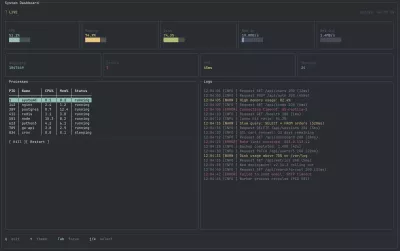
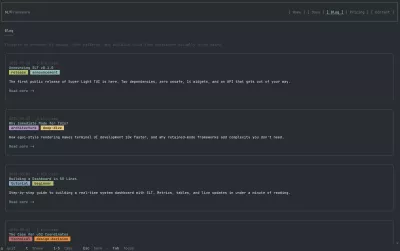
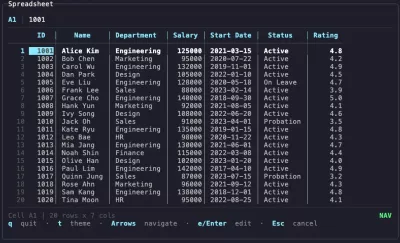
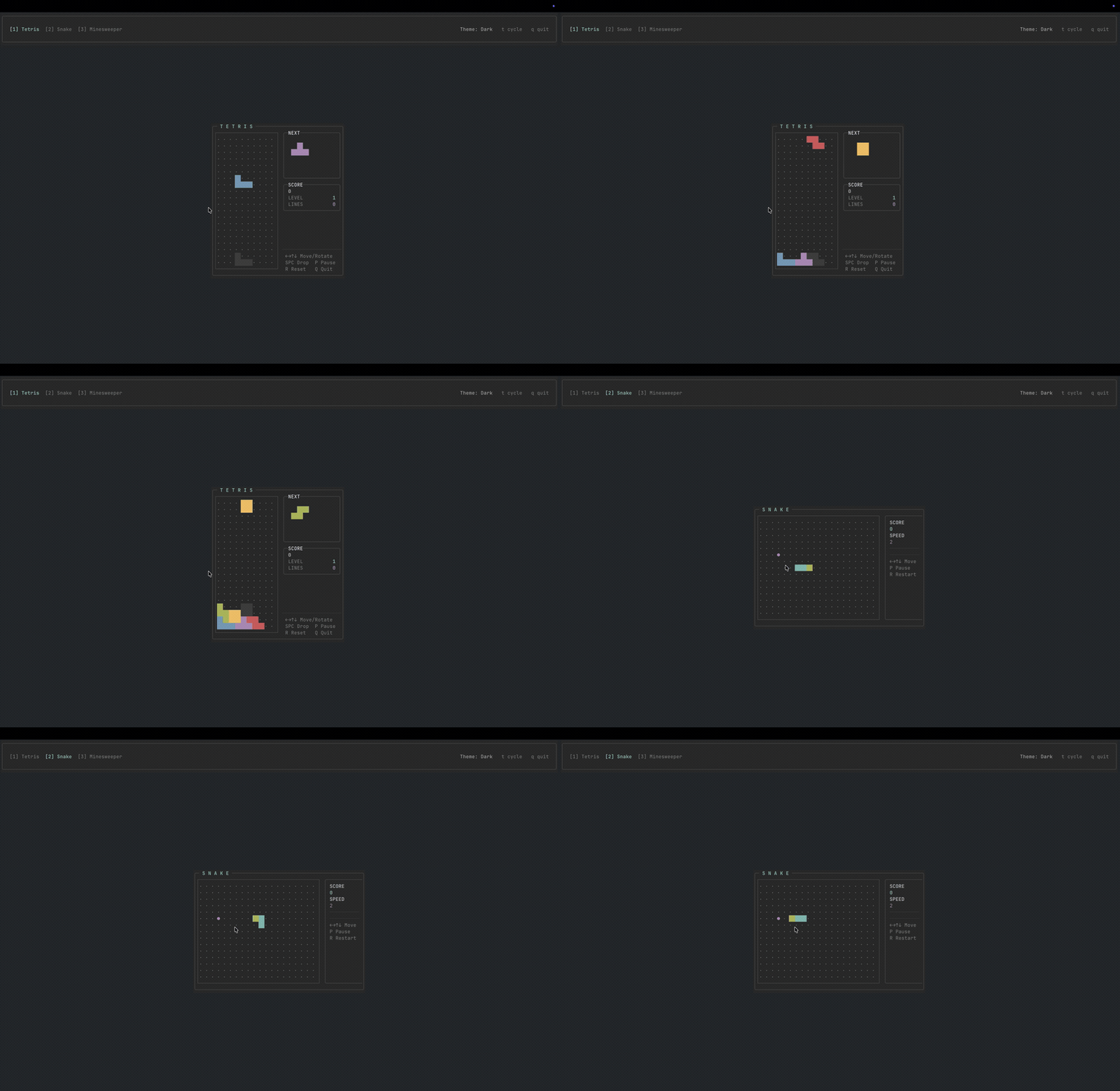
Prefer an interactive dashboard? Run cargo rullst dash
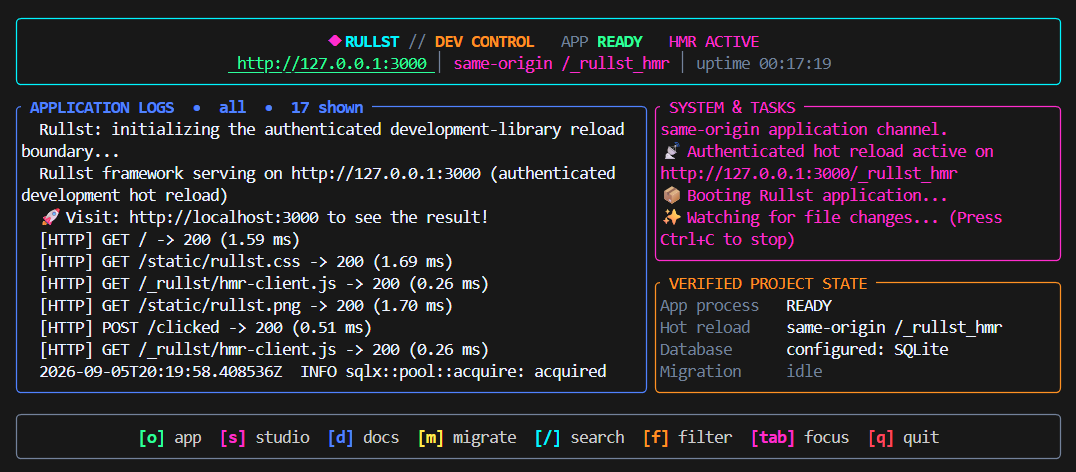
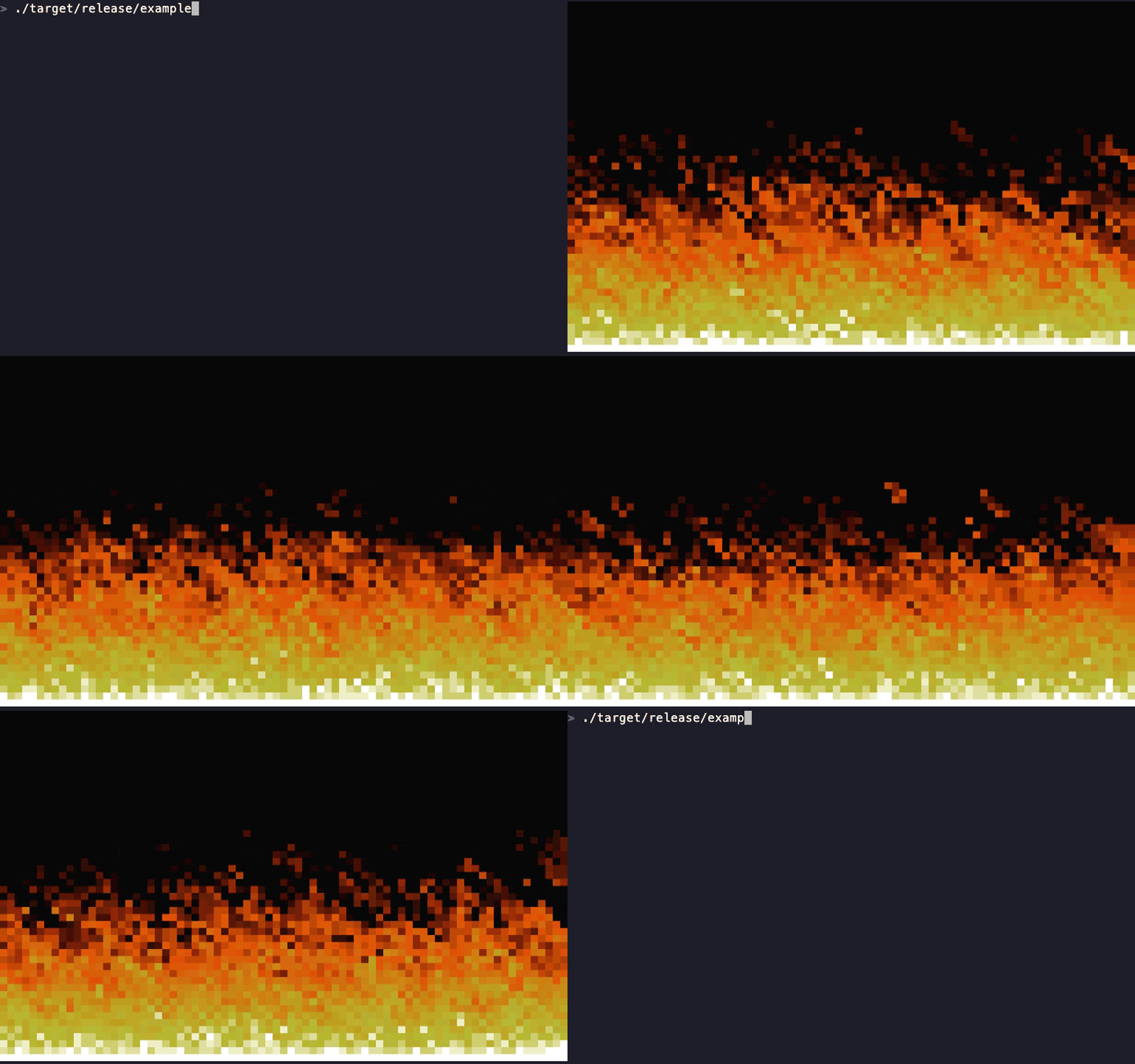
Recorded screenshot; layout and controls can differ by version. Development workflow.
🦀 Code that says what it does
use rullst::{html, routes, Markup, Server};

async fn home() -> Markup {
    html! {
        <div class="min-h-screen bg-slate-900 text-emerald-400 flex flex-col items-center justify-center font-sans">
            <h1 class="text-5xl font-extrabold mb-4">"Hello, Rullst! 📜🦀"</h1>
            <p class="text-slate-400 text-lg">"Your first typed route is running."</p>
        </div>
    }
}

#[tokio::main]
async fn main() -> Result<(), Box<dyn std::error::Error>> {
    let app = routes![
        get("/" => home)
    ];

    Server::new(app).run(3000).await?;
    Ok(())
}
HTML lives in a compile-time html! macro, routes are typed and pages are
server-rendered — HTMX-ready, with no JavaScript bundle to build. This snippet
comes from the Zero-to-Hero tutorial,
and every tutorial's Rust code is compiled in CI.
Prefer a JSON API?
use rullst::{Server, ServerError, routes, server::Json};
use serde::Serialize;

#[derive(Serialize)]
struct HealthResponse {
    status: &'static str,
    framework: &'static str,
}

async fn health() -> Json<HealthResponse> {
    Json(HealthResponse {
        status: "ok",
        framework: "Rullst",
    })
}

#[tokio::main]
async fn main() -> Result<(), ServerError> {
    let app = routes![
        get("/api/health" => health),
    ]
    .layer(rullst::server::from_fn(
        rullst::security::headers_middleware,
    ));

    Server::new(app).run(3000).await
}
curl http://127.0.0.1:3000/api/health
# {"status":"ok","framework":"Rullst"}
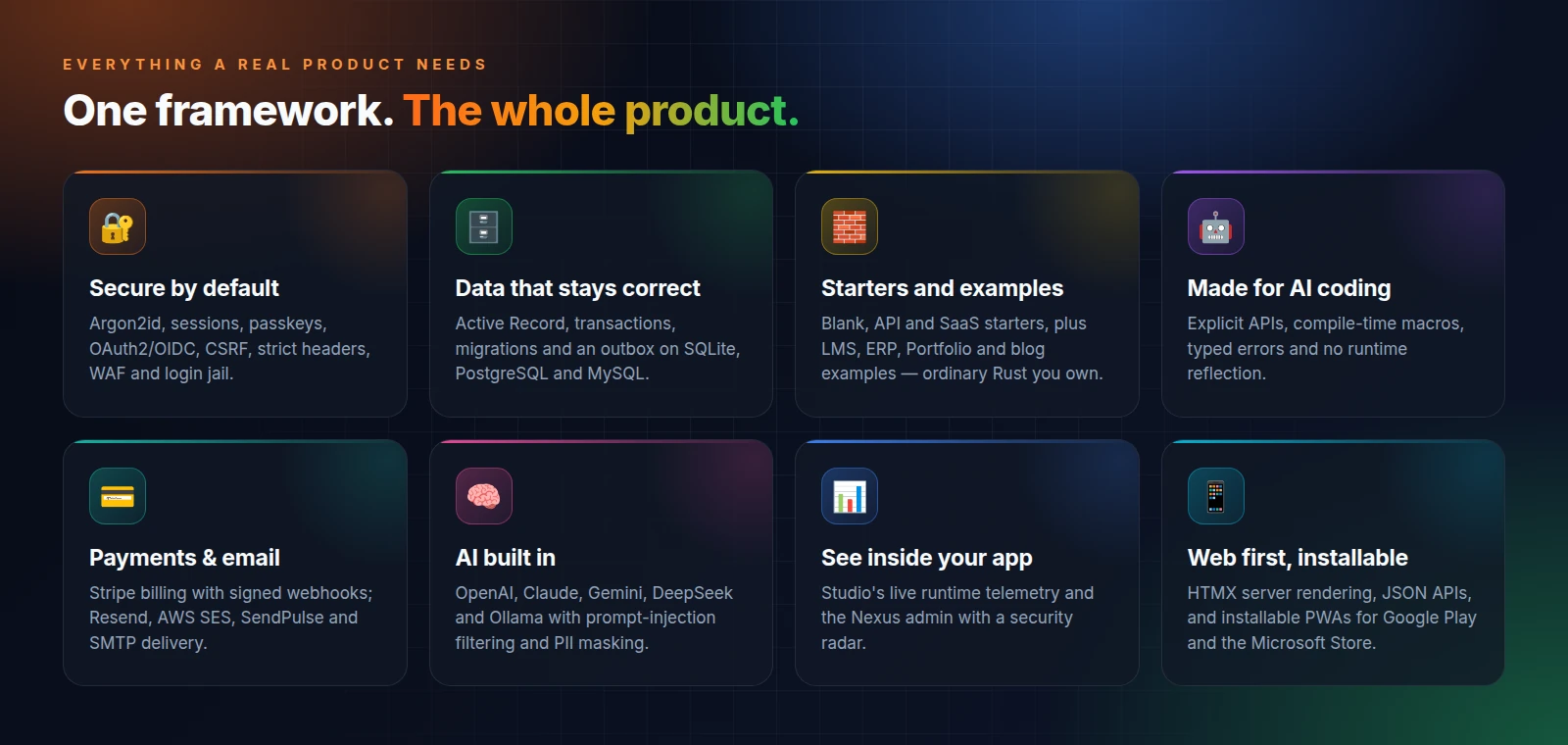
Every capability has a documented boundary — security middleware does not replace your authorization rules, and databases are not interchangeable. See the capability ledger · Why Rullst? · Axum & SQLx escape hatches
🌍 Built with Rullst
Real applications running today, every one of them built with Rullst. Click to explore — their code and deployment recipes live in Rullst/examples.
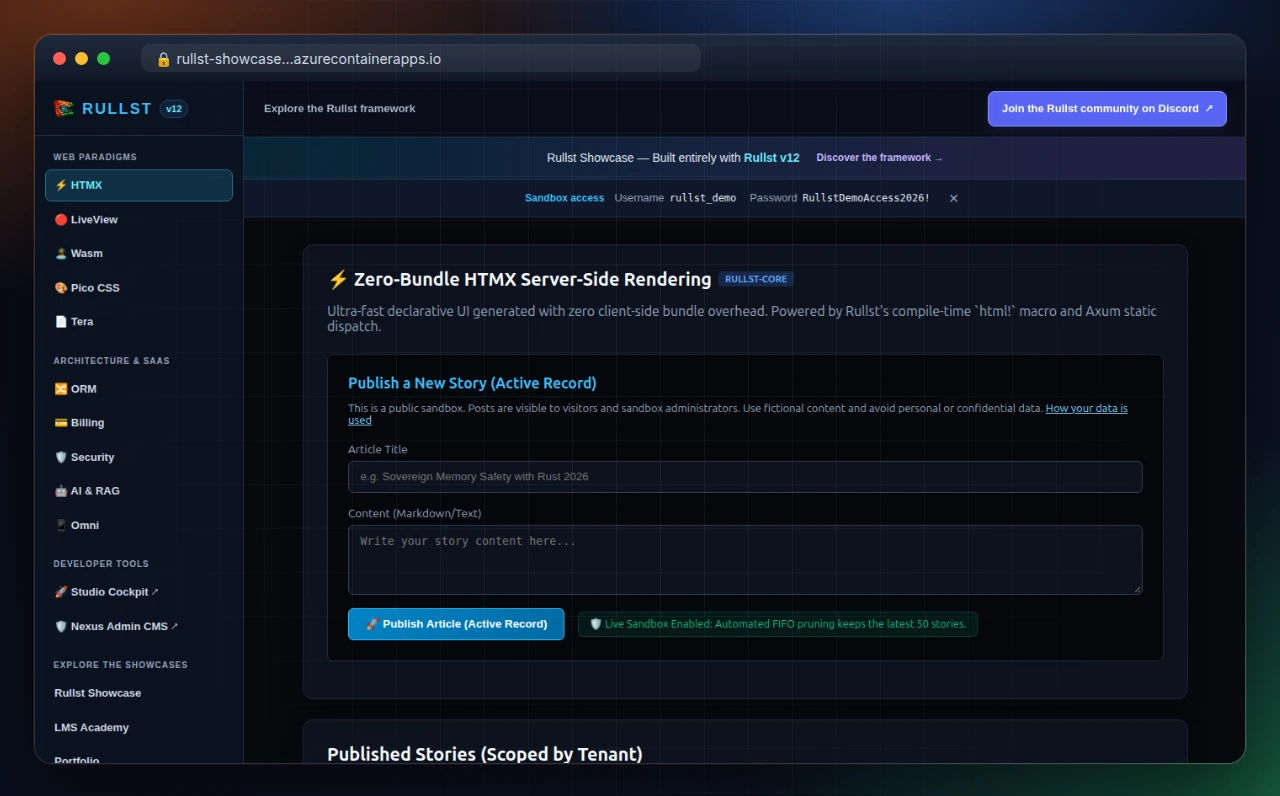
🌐 Showcase — SSR, LiveView, Wasm, ORM, billing, security and AI demos · Open ↗ |
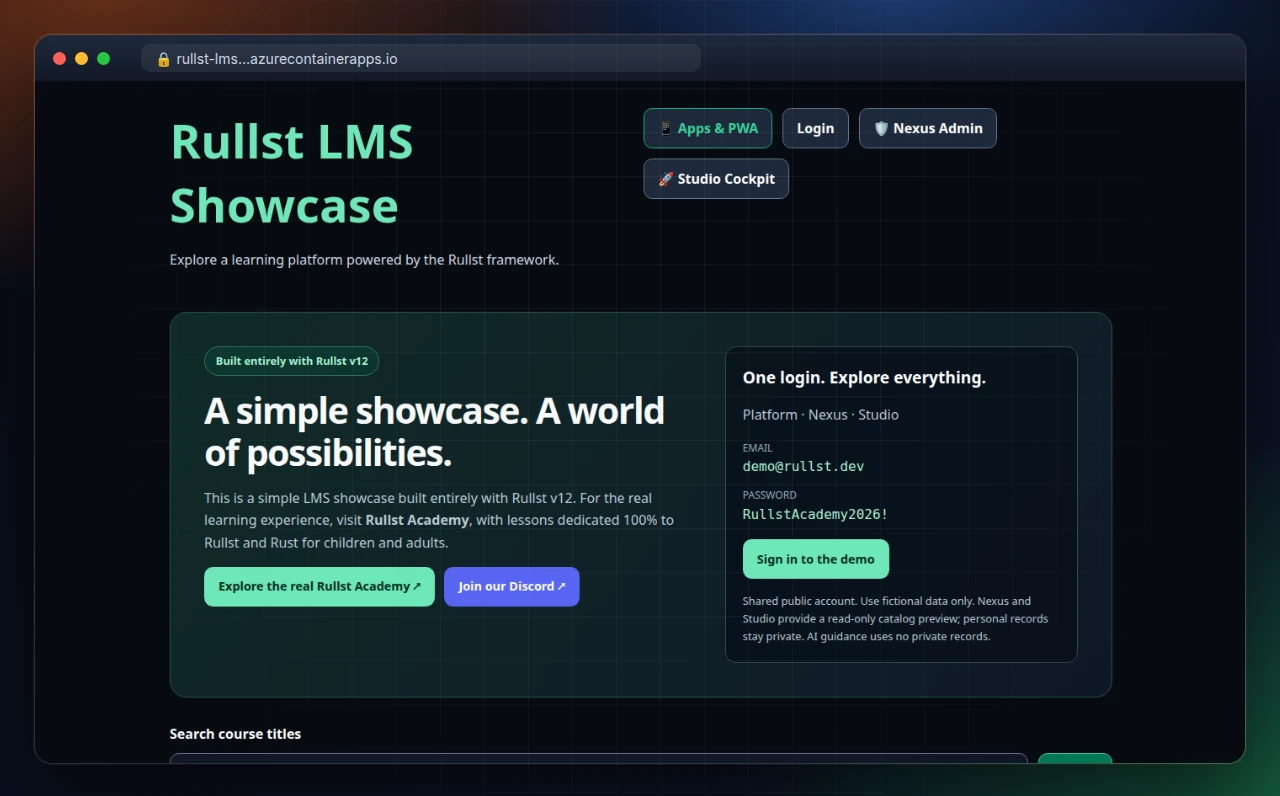
🎓 LMS — course catalog and learning platform · Open ↗ |
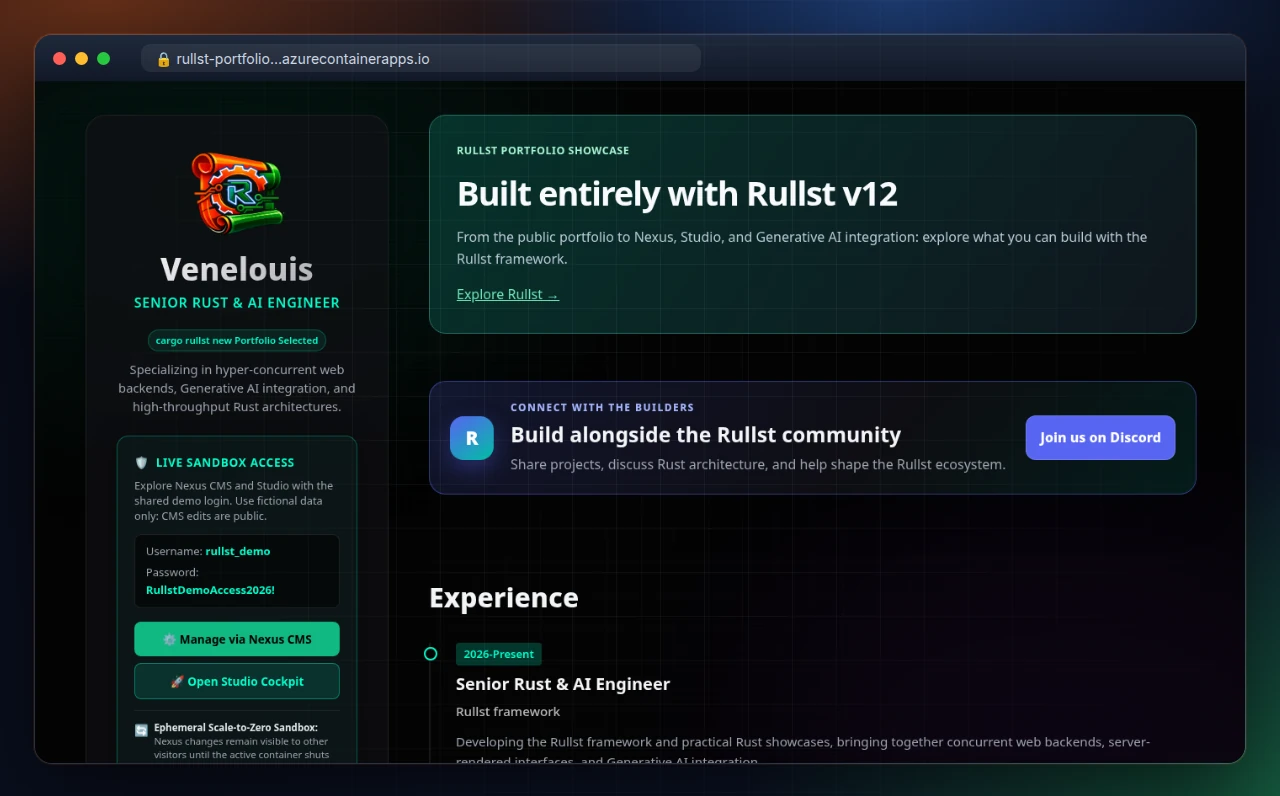
💼 Portfolio — projects, experience, Nexus and Studio · Open ↗ |
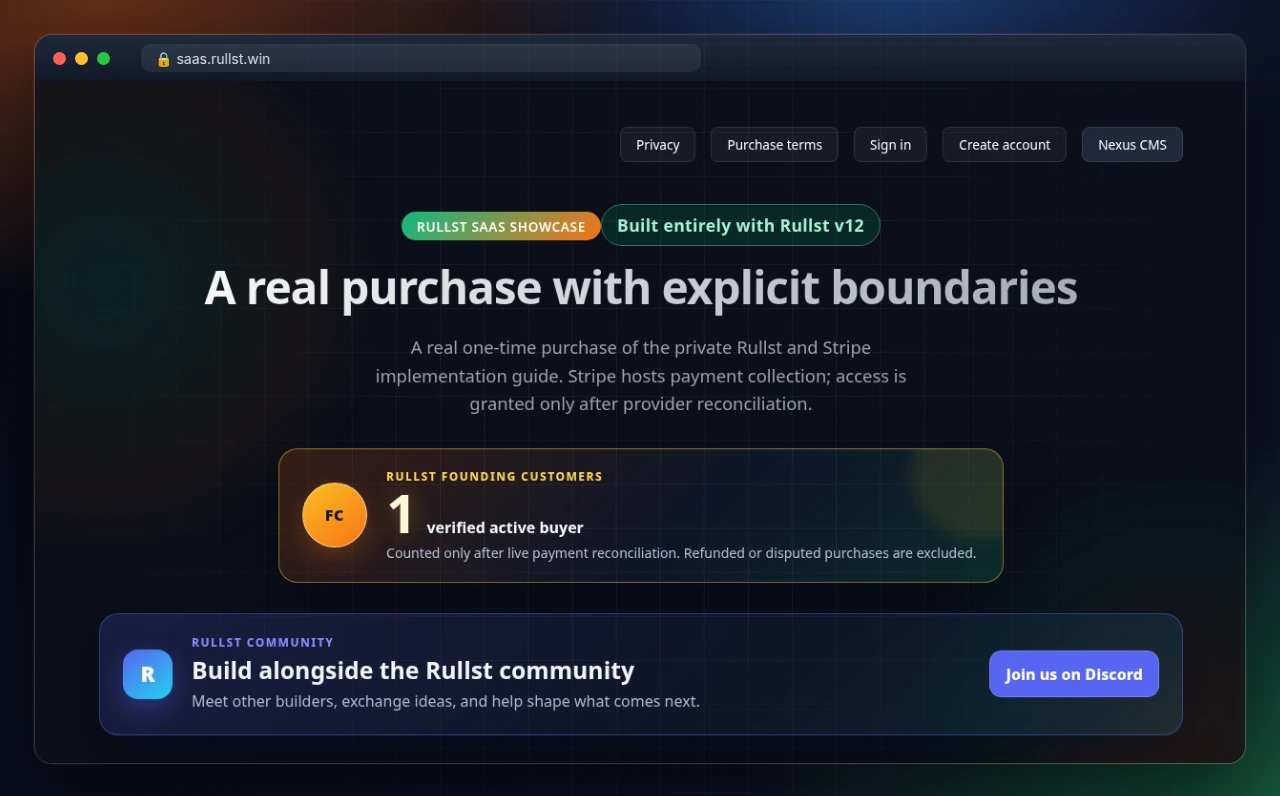
🛒 SaaS in production — real purchases with Stripe · Open ↗ |
The demos scale to zero when idle, so the first visit can take a few seconds to wake up — that is hosting startup, not Rullst's request time. The SaaS checkout is live and charges real money; the Showcase payment demos are not.
▶️ Watch: how to build a SaaS with Rullst
Prefer to run something locally? The reproducible SaaS example uses the v13 CLI from this checkout on Linux and covers generation, login and tenant-scoped notes on a disposable SQLite database, and the WebGPU wave example serves browser graphics from Rullst.
🏗️ Architecture
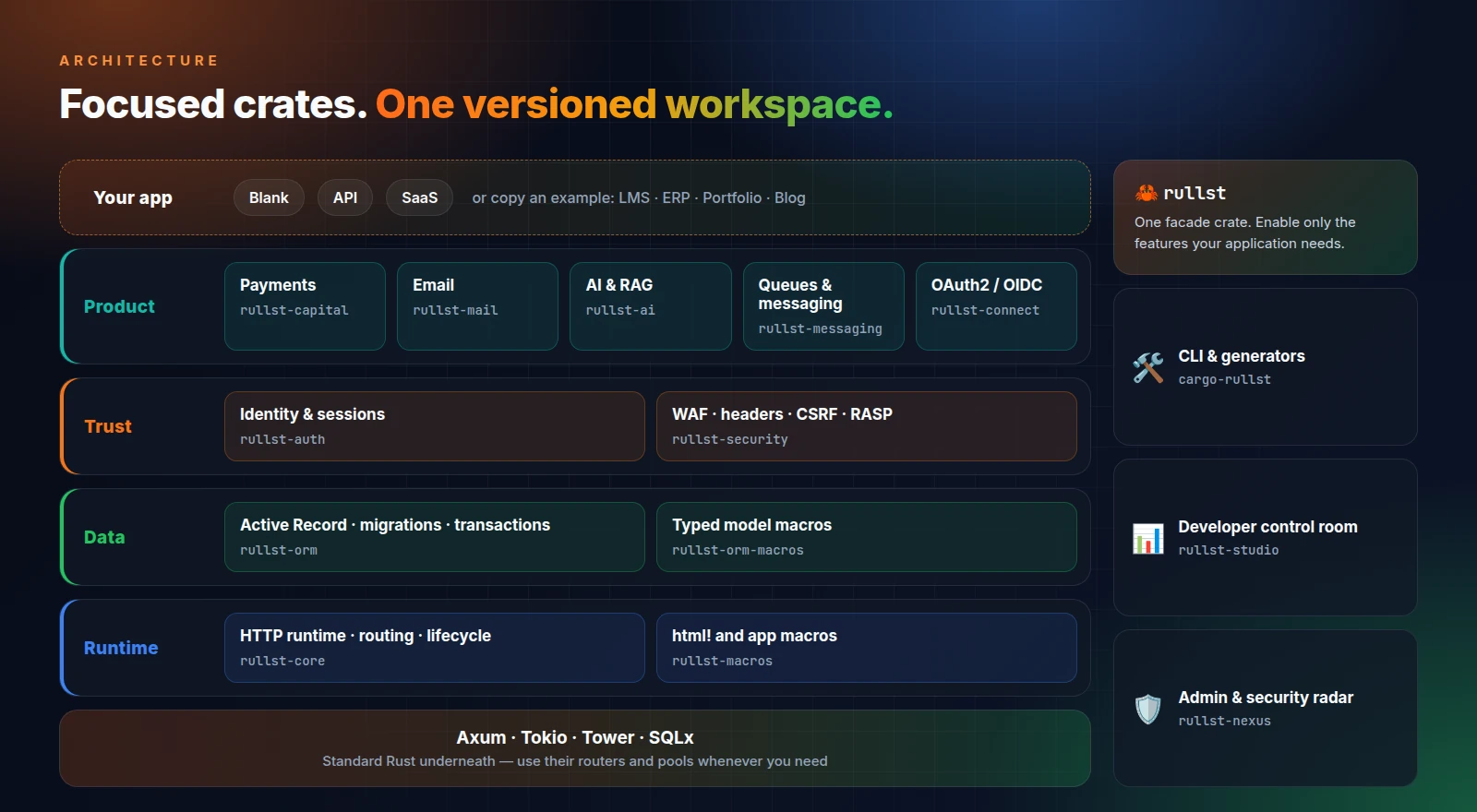
Rullst is a family of focused crates in one versioned workspace — select only what your application needs. The v12 line, now end of life, published sixteen crates; detailed feature and provider boundaries live in the specification. In v13, every crate is labelled Core, Extension or Experimental; see the maturity tiers.
Browse the crate directory
| Crate | Focus | Tier |
|---|---|---|
| rullst | Public framework facade and feature selection | Core |
| rullst-core | HTTP runtime, routing, lifecycle and telemetry | Core |
| rullst-orm | Relational models, transactions and capability-specific persistence | Core |
| rullst-auth | Passwords, sessions, passkeys and authorization helpers | Extension |
| rullst-security | Defense-in-depth middleware, guards and audit helpers | Core |
| rullst-connect | OAuth2/OIDC identity integrations | Extension |
| rullst-ai | Guarded local/cloud clients and tenant-aware retrieval | Extension |
| rullst-capital | Billing contracts, Stripe and experimental InfinitePay adapters, webhooks | Extension |
| rullst-mail | Transactional email with Resend, AWS SES, SendPulse and SMTP transports, and delivery controls | Extension |
| rullst-messaging | Broker-neutral contracts and durable local messaging | Extension |
| rullst-studio | Local developer control room | Extension |
| rullst-nexus | Registered-model admin with explicit access policy | Extension |
| rullst-iot | Bounded no_std helpers and signed OTA verification, not device integration | Experimental |
| rullst-macros | Compile-time HTML and application macros | Core |
| rullst-orm-macros | Typed ORM code generation | Core |
| cargo-rullst | Project scaffolding, development and upgrade CLI | Core |
| cargo-rullst-extras | Optional CLI extras: the terminal AI assistant (cargo rullst ai) and measured efficiency figures (cargo rullst green) |
Experimental |
The v13 workspace on main also contains four new packages, all in the
Experimental tier:
rullst-privacy,
rullst-supervision,
rullst-media and
rullst-labs are in
the v13 release order and were first published in the 13.0.0-alpha.1
prerelease.
Tiers (v13): Core packages are needed by every application. Extensions are optional and supported. Experimental packages are optional, may change between 13.x releases and are not validated in every scenario. Experimental does not mean broken. The maturity tiers page defines each promise and labels the CLI generators.
🤖 For AI assistants
The documentation site publishes llms.txt
(an index of every book page in reading order) and
llms-full.txt (the full
Markdown of those pages in one file). Projects created with Rullst get their own
AGENTS.md, .llms.txt and .rullst/context-map.json
(cargo rullst generate:ai-context), and commands whose result is data accept
--json (machine-readable output).
🎓 Learn with Rullst Academy
Rullst Academy is a free learning platform — built with Rullst — where you can learn Rust, Rullst, Git/GitHub, web development, databases and more through short lessons and practical projects, in Portuguese, English or Spanish.
Start learning at Rullst Academy ↗
🛡️ Engineered like critical infrastructure
Rullst is maintained with the rigor you expect from security software:
- No panics in production code, enforced by CI across the published runtime crates.
- No new
unsafeoutside a reviewed OS/FFI allowlist. - At least 90% line coverage, enforced, plus fuzzing, property tests, sanitizers and Kani/Miri checks on selected critical code.
- Supply-chain hygiene: RustSec and license policy on every change, SHA-pinned Actions, and an SBOM with build-provenance attestation for every release.
- A fast Linux gate on every pull request, with the complete Linux/macOS/Windows matrix every night and before every release.
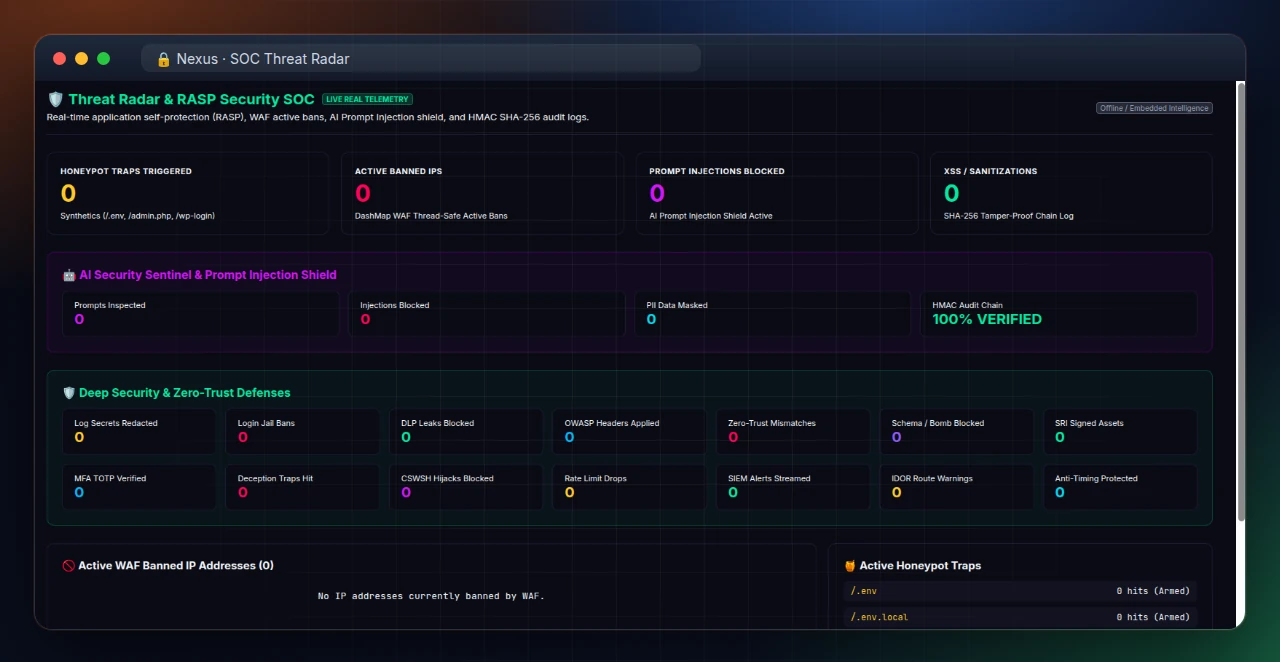
The Nexus security radar (recorded screenshot).
These results are evidence for their stated scope, not a security certification of every application built with Rullst. Explore the release audit, capability status and quality scorecard.
🛡️ Open the verification dashboard (37 workflows)
Badges are pinned to the main branch; they report the latest matching run, not a certification or deployment guarantee.
| Continuous or change-aware gate | Development main status |
Actual scope |
|---|---|---|
| Rust CI |  |
Format, all-target/all-feature Clippy, a Linux gate on pull requests, every Linux shard after merge and the complete Linux/macOS/Windows matrix nightly; Cargo-aware doctests sourced from all 51 tutorial pages, strict DB boundaries, feature boundaries, generated-code checks, and MSRV 1.96.0. |
| Declared MSRV |  |
Every publishable manifest declares Rust 1.96.0 and CI runs an explicit workspace all-feature check with that toolchain. |
| GitHub Actions lint | [