
Architecture checks for coding agents.
ArchKeel checks code against declared boundaries. It reports forbidden imports, misplaced types and gaps in static analysis, with source evidence for review.
Use it in your coding-agent harness or CI. Checks run locally and deterministically, without an LLM. They complement tests of runtime behavior.

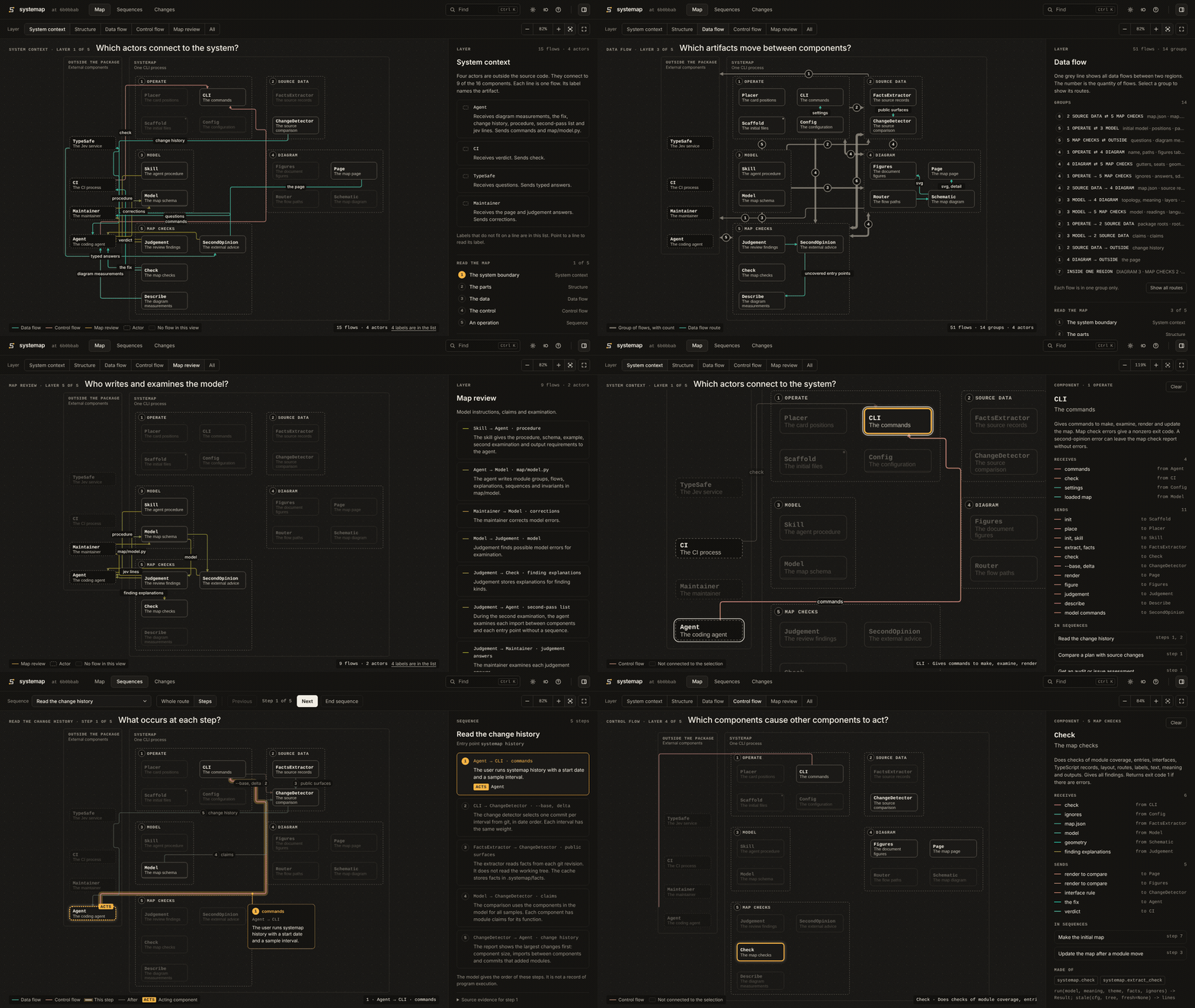
ArchQ Explorer in the report: Compass Flutter's declared architecture. Explore this Target.
Explore observed code, declared architecture and their differences in one offline report. See ArchKeel's current Main report, updated by CI. Browse the Python, Dart and TypeScript demo reports, including UML PASS, FAIL and UNKNOWN examples.
The gallery leads with three complete source projects: Compass booking (111 Dart files), Python RealWorld (72 Python modules), and Nest RealWorld (41 prepared TypeScript inputs). Each links its authored Target, baseline and three source-only variants. Coverage, rule findings and UML results remain separate; the smaller runnable Flutter shop stays a control.
Start here
Start with the first-hour guide: install, init,
read the overview, read the first verdict, then choose how to keep it green.
Requires Python 3.11+ and a Git repository with at least one commit. Run ArchKeel with a Python version that meets your project's requirements.
uv tool install archkeel
archkeel skill install codex    # or claude
Then ask your coding agent:
Set up ArchKeel for this repository. Read the architecture documents,
propose the boundaries, and let me decide which dependencies are allowed.
The skill guides the setup. init drafts components and interfaces;
you decide the target architecture. Existing imports are evidence, not permission.
You can delegate decisions to the agent, but its authorship is recorded separately.
See the onboarding guide for setup and plugin installation.
For an existing setup:
archkeel report      # inspect code and evidence
archkeel validate    # check the contract
report writes architecture.json and an offline architecture.report.html.
Read the verdicts: a report can exit 0 with failed or undecided rules.
validate checks the contract; check also compares a submitted change with its
published expectation. Use archkeel <command> --help for command options.
Validation diagnoses absent or placeholder-only responsibilities on components explicitly marked
decided_by: "architect"; substantive prose is not proof that the stated responsibility is correct.
See the exact marker syntax and exit behavior.
Review the evidence

Fullscreen Explorer: drill down to Python RealWorld's article, comment and tag modules. Explore this Target. Target shows declared intent; cross-scope relationships remain counted separately.
Use the report to inspect findings and source locations, then explore the components. Filters narrow the view without changing the verdicts.
archkeel report --only violations --component store
archkeel report --only calls --component store
Agents start with a focused architecture summary, then query the recorded snapshot:
archkeel report --only architecture --json
archkeel report --input test-artifacts/architecture/architecture.json --only architecture --json
Use --component with an id or scope from the summary, and --only violations for findings.
Saved queries do not rescan or change the repository. See focused agent reports.
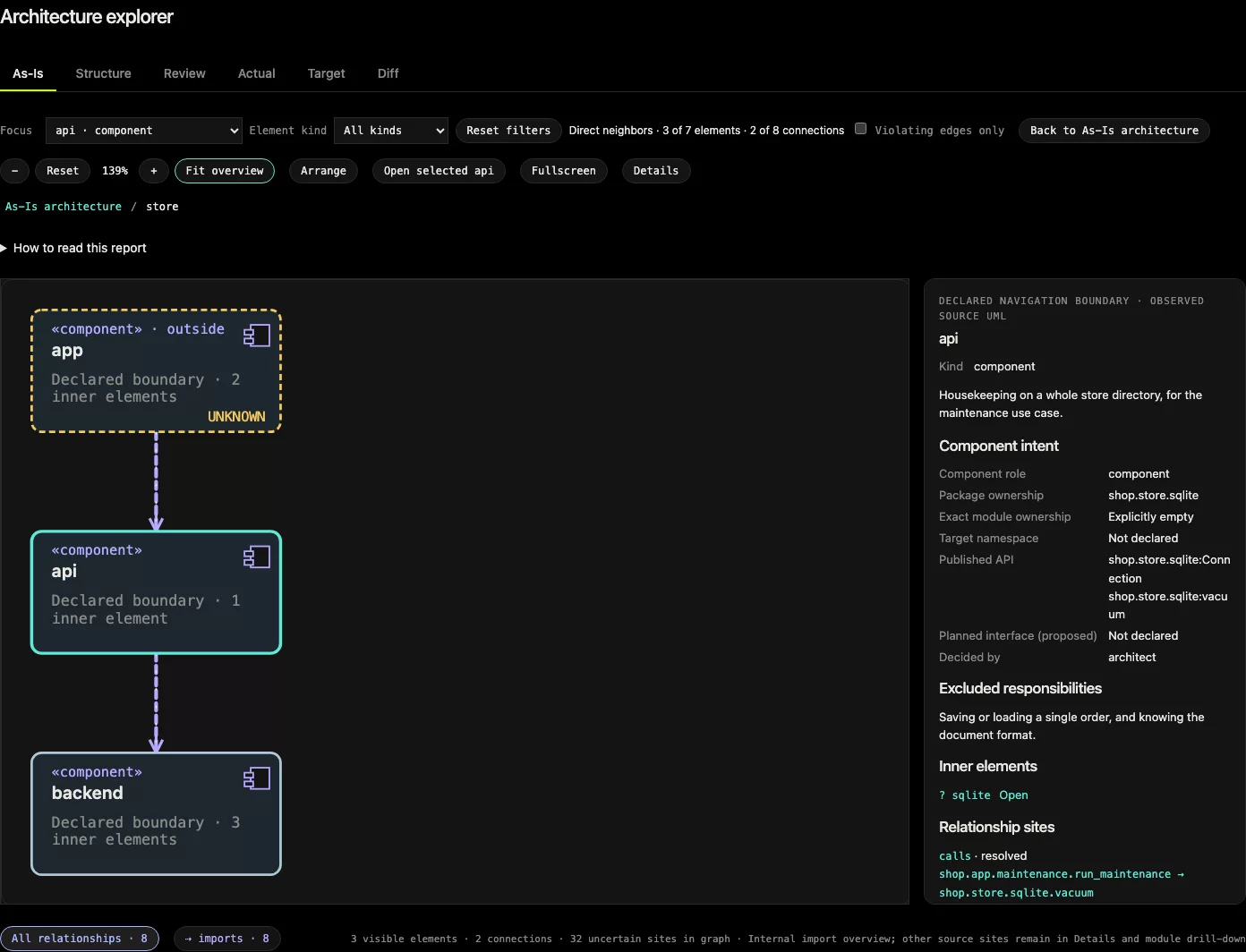
ArchQ Explorer shows As-Is (observed code), Target (declared architecture),
and Diff (their differences). These are views of one snapshot, not two revisions.
It opens inside the report. Fullscreen expands the same Explorer;
Restore keeps your selection and zoom. Search (Ctrl/⌘+K), Health check,
Objects and perspectives help navigate the recorded evidence.
Folders help navigation; they do not establish ownership or runtime behavior.
The fact sheet summarizes boundary permissions until you select a scope. Its complete audit remains available on demand. Health check builds the import matrix when opened; Structure overview shows neutral component measurements without size-based recommendations.
PASS means the required rules have complete evidence and no decided violation.
UNKNOWN means evidence is missing. A rule can fail and still have undecided positions.
A clean graph does not prove a good design.
Dart and TypeScript rules use complete evidence for their own scopes. An unrelated resolution gap can coexist with a proven rule PASS; a confirmed violation remains FAIL alongside incomplete observation. Strict JSON consumers should use command-result schema 9. Current Python observations require an explicit call-binding proof or null for every call. See the compatibility policy before upgrading collectors or saved-report consumers.
Start with a forbidden import
The runnable Shop forbidden-pair fixture adds
shop.render.text -> shop.store at shop/render/text.py:9. It reports
DEP-RENDER-NO-STORE, rule.violated and closed_world.observed_forbidden:
make demo-architecture VARIANT=class-a-forbidden-dependency-pair OUTPUT=build/forbidden.json
The replay writes its report, then exits 2 because validation cannot accept the observed whole-pair ban. Remove the crossing or revisit the declared boundary with its owner; do not allow the forbidden pair just to make validation pass.
Catch changes that finding diffs miss
The runnable call coverage regression fixture shows a change that adds no forbidden import or cycle but makes a call harder to resolve:
 def run(key: str) -> int:
-    return first() + second()
+    handlers = {"first": first, "second": second}
+    return handlers[key]()
make demo runs this fixture. Resolved calls drop from 2 of 2 to 0 of 1 while new finding
fingerprints stay at zero; ArchKeel rejects the candidate because unresolved calls increase
from 0 to 1.
check compares the accepted and candidate commits, checks the contract, and verifies the
candidate against an expectation published before submission. Publication order needs trusted
host records. A local replay checks supplied records without authenticating them.
The reference explains the commit protocol and its limits.
Keep a target the code has not reached
Record existing violations, review the file, then reject new ones in CI:
archkeel validate --baseline known-violations.json --write-baseline
archkeel validate --baseline known-violations.json
Known violations remain FAIL. After fixing them, rewrite the baseline in the same change.
New or increased violations require explicit --accept-new; do not use it to hide a regression.
See the target-first guide for the full workflow.
Try a reproducible example
git clone https://github.com/rapiddweller/archkeel.git
cd archkeel
make demo
make demo-onboarding
make demo rejects a coverage regression and a late expectation, then shows a passing candidate.
make demo-onboarding replays setup on a two-level shop using committed decision fixtures;
it performs no live approvals. More cases are in the demo catalog.
Scope and limits
ArchKeel observes static source in configured roots. Python support covers imports, calls, and declared boundaries. Dart records declarations, members, signatures and bounded source relationships through a Python-hosted Tree-sitter parser. Dart analysis needs no Dart SDK or setup command. TypeScript also records lexical UML declarations and statically bound relationships; ambiguous bindings and unsupported constructs remain UNKNOWN. TypeScript roots may name files or directories. ArchKeel does not prove runtime behavior, performance, or the quality of every design decision. Separate test trees need their own scan and contract.
Exit meanings are defined per command.
Read the docs.
Development
Python, TypeScript and Dart analysis use the Python installation. Building or running the Flutter demo itself still requires Flutter; report generation does not.
make check              # lint, types, logic tests
make gate               # also build, isolated installs and self-validation
make report-browser-tests # optional local Chromium tests
CI checks report data and JavaScript logic without Chromium. Three short local browser smokes check findings, keyboard navigation and unsafe-content escaping. Use the Nightly gallery for manual visual review.
ArchKeel checks its own architecture contract using fresh observations on every test run. See CONTRIBUTING.md.
MIT © 2026 Rapiddweller Asia Co., Ltd. Maintained by Alexander Kell.