
Caura — Shared governed memory for AI agents
Fleet memory for AI agents — governed, shared, self-improving.
MemClaw is now Caura — same product, one name.
Existing memclaw_* tool calls and supported MEMCLAW_* environment aliases continue to work; use caura_* names and current Caura URLs for new configuration. The PyPI name memclaw-client is kept only as a redirect shell (0.5.1) that installs caura-client; it provides no memclaw_client import and no MemClaw class. The npm package @caura/memclaw-client was never published.
Quick Start · Features · Fleet Memory Guide · Performance · MCP · API Reference · Plugin Docs · Contributing · Discord
Caura (formerly MemClaw) — the shared governed memory layer for AI agent fleets
Caura — formerly MemClaw — is open-source memory for multi-tenant, multi-agent AI fleets. Your agents store what they learn, find what the fleet knows, and get smarter with every interaction — learning from each other instead of repeating mistakes.
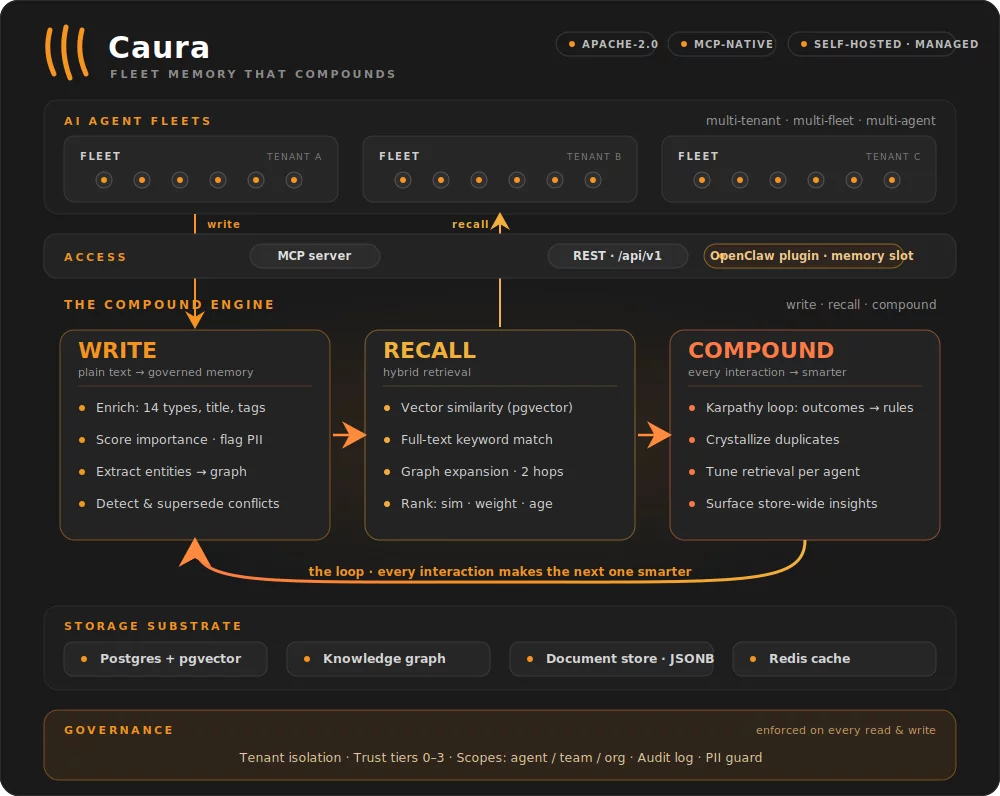
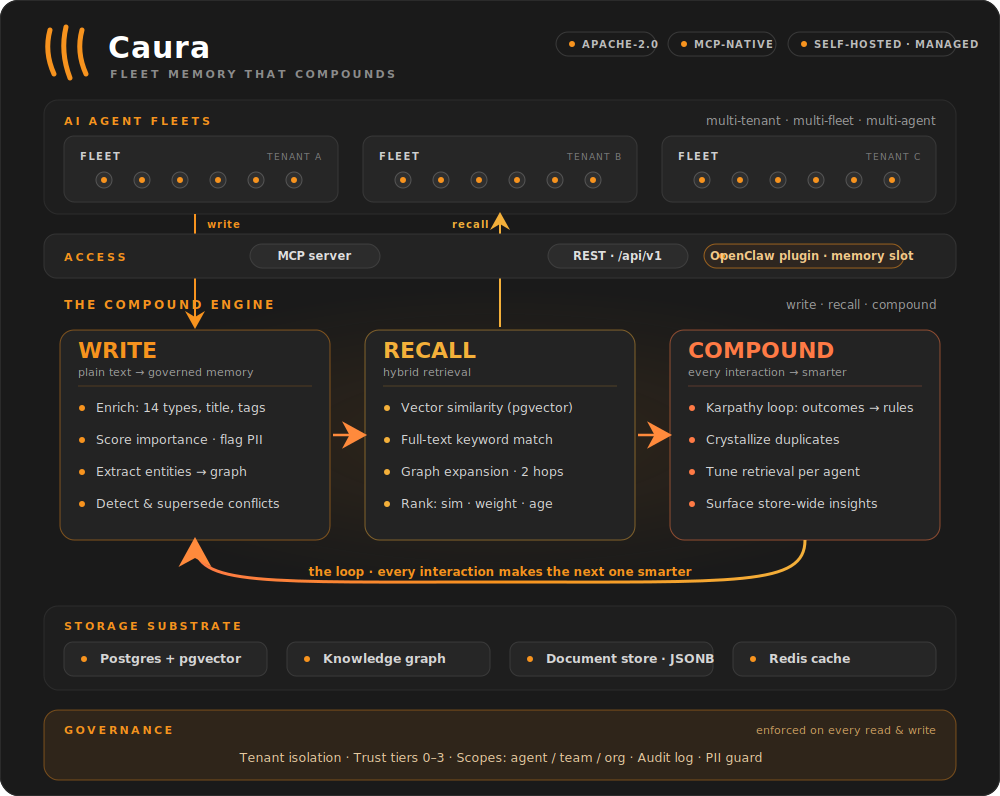
Agents write plain text. Caura turns it into searchable, governed, self-improving memory.
One loop, three pillars: write, recall, compound — every interaction makes the next one smarter.
Built for fleets. One agent works, and that's where most teams start — nothing below changes for a single-agent setup. What Caura adds is headroom: scoped memory, cross-agent outcome propagation, and fleet-wide trust tiers are there from the first write, and they keep paying off as agents multiply. Public agent-memory benchmarks (LoCoMo, LongMemEval) measure one agent, one user, one long conversation — the single-chatbot shape. Fleet governance and workload-specific latency still need validation in the environment where they matter. See the generated Performance block and evidence registry for approved benchmark results, or read the benchmarks write-up.
Production case study: eToro uses Caura as a governed shared-memory layer for its AI-agent work. Architecture deep-dive →
Quick Start
Try it locally — no API key, no signup
The fastest way to see Caura work. Standalone mode runs single-tenant with auth bypassed — start Caura, write a memory, and find it again. (With no key there's nothing to configure: memories are stored without embeddings and found by keyword. Add an AI provider key for semantic search — see Self-Hosted below.)
git clone https://github.com/caura-ai/caura.git
cd caura
cp .env.example .env && echo "IS_STANDALONE=true" >> .env   # single-tenant, no API key
docker compose up -d --wait                                 # Postgres + pgvector + Redis + API + scheduler (~30s)
# Write a memory — no API key needed
curl -X POST http://localhost:8000/api/v1/memories \
  -H "X-API-Key: standalone" -H "Content-Type: application/json" \
  -d '{"tenant_id": "default", "agent_id": "quickstart", "write_mode": "strong", "content": "Our auth service uses JWT with 15-minute expiry."}'

# Find it by keyword — no provider key needed
curl -X POST http://localhost:8000/api/v1/search \
  -H "X-API-Key: standalone" -H "Content-Type: application/json" \
  -d '{"tenant_id": "default", "query": "JWT expiry"}'
The keyless strong-write response includes memory_type, title, status, and weight — plus a summary under metadata — all derived by a deterministic local heuristic from the single content field. With a configured AI provider, those values are model-inferred and metadata can also include tags.
Want semantic paraphrases? The keyless query deliberately reuses words from the memory. After configuring an embedding provider in the next section, try
"authentication token lifetime"instead — matching that phrase to "JWT with 15-minute expiry" exercises semantic recall.
See the fleet effect
For the architecture, evaluation checklist, and a stable GitHub-native citation target, see Shared persistent memory for AI agent fleets.
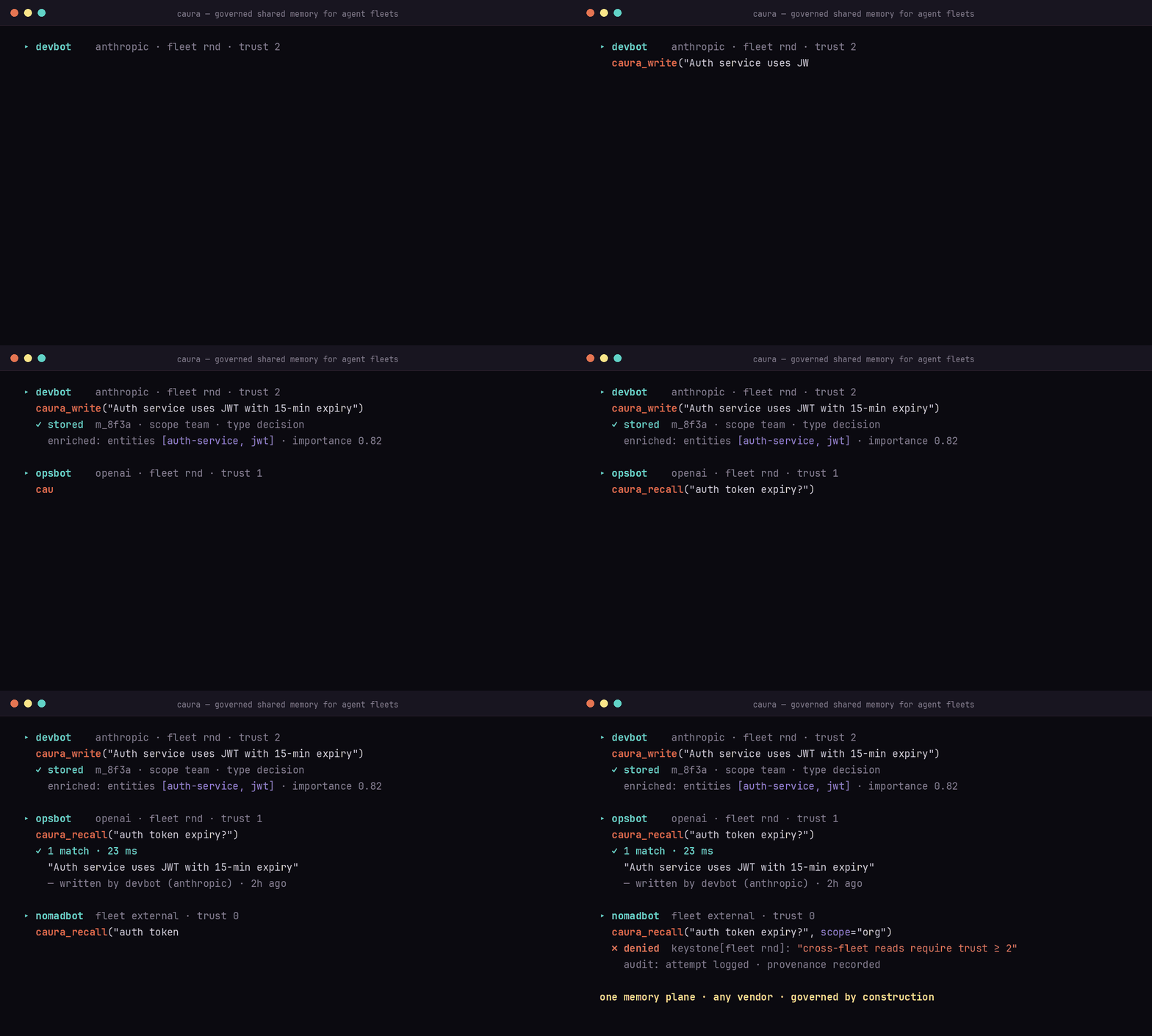
Connect two MCP clients to the same fleet. Agent A records an operational
lesson with caura_write:
{
  "agent_id": "deploy-agent",
  "fleet_id": "platform",
  "visibility": "scope_team",
  "content": "Roll back auth-service with: deployctl rollback auth-service --to <version>."
}
Agent B asks caura_recall from that fleet:
{
  "agent_id": "incident-agent",
  "fleet_ids": ["platform"],
  "query": "How do I roll back auth-service?"
}
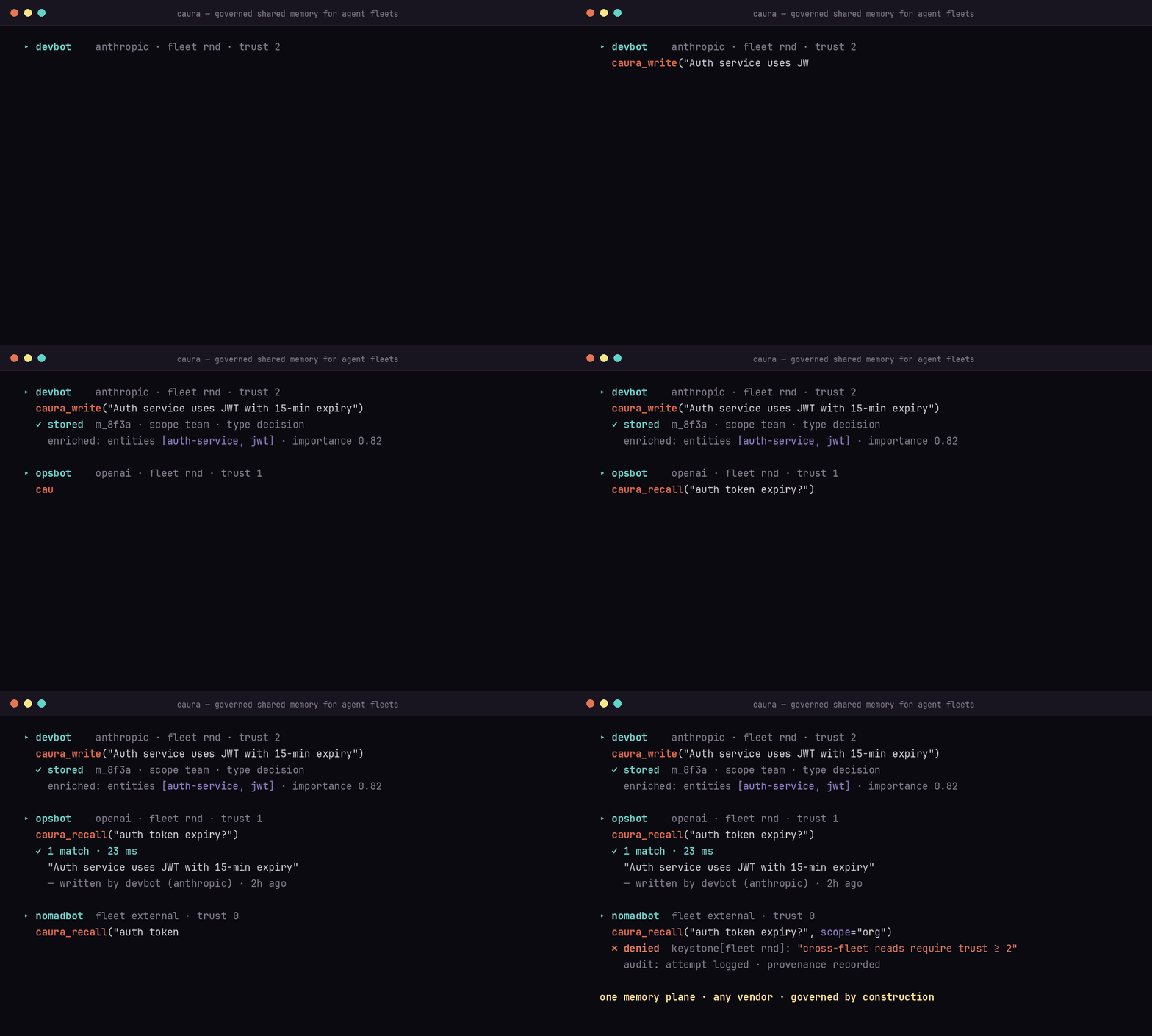
The result identifies deploy-agent as the author: one agent learned it, and
another reused it. scope_agent would keep the memory private;
scope_team shares it within the fleet; scope_org enables governed
cross-fleet recall subject to the trust ladder.
For production, give each client its own
agent-scoped credential.
Ready for semantic recall, multi-tenant, a managed host, or an OpenClaw fleet? Pick a path below.
Four paths — pick the one that matches your setup:
| Path | When | Time to first memory |
|---|---|---|
| Managed platform | Quickest. We host the DB + scaling. | ~2 min |
| Self-hosted (Docker) | Privacy / on-prem / air-gapped. | ~5 min |
| OpenClaw plugin | You already run an OpenClaw fleet — install Caura as a plugin against any of the above. | ~3 min |
| Rail SDK | You write the agent yourself, in Python or TypeScript, and want it to recall rules and facts before every turn and store what it learned after. Works against any of the above. | ~2 min |
Managed Platform
Get up and running in minutes — no infrastructure, automatic updates, usage analytics, and enterprise-grade security included.
- Sign up free on caura.ai.
- Create an API key in the dashboard under Connect › Keys.
- Connect through MCP or REST:
{
  "mcpServers": {
    "caura": {
      "url": "https://caura.ai/mcp",
      "headers": { "X-API-Key": "mc_your_api_key_here" }
    }
  }
}
For a production fleet, provision one agent-scoped credential per agent. See Integrating without the OpenClaw plugin for credential scopes, headers, and provisioning.
Using the tenant-scoped dashboard key? Pass an explicit agent_id on every MCP
tool call; the gateway rejects the reserved mcp-agent default on that path.
Self-Hosted (Open Source)
Docker Compose starts PostgreSQL + pgvector, Redis, the storage service, the
REST/MCP API, and the core-operations lifecycle scheduler (nightly expiry,
archival, purge and crystallization). The keyless example above is the shortest
path; add a provider for semantic recall.
- Complete self-hosting guide — providers, auth, service topology, security, offline operation, and tests
- Local embedder — fully local semantic search with no cloud API calls
- Manual deployment without Docker
OpenClaw Plugin
Already running an OpenClaw fleet? Install Caura as a plugin against either the managed platform or your self-hosted stack:
The plugin claims OpenClaw's memory slot and exposes the same agent-facing
memory tools. Use the
agent installer's one-line setup,
then see the OpenClaw integration guide for
agent prompts and trust levels. Already have nodes running? Keeping them current
— auto-upgrade and the manual re-install — is covered in
docs/plugin-upgrade.md.
The plugin talks only to the Caura server you configure (CAURA_API_URL) and
identifies itself on every request with
User-Agent: openclaw-plugin/<version> (node/<major>), which the server's
self-hosted heartbeat uses to count connected plugin installs, and with
X-Caura-Surface: openclaw_plugin, which labels the audit rows its writes
produce (Audit attribution). It will not send
CAURA_API_KEY over plain http:// to anything but loopback: point
CAURA_API_URL at https://, or set CAURA_ALLOW_INSECURE_HTTP=true in the
plugin .env to accept cleartext on a trusted private network.
Python client
Talk to any managed or self-hosted Caura deployment from Python:
pip install caura-client
See the Python client guide for examples and the full API.
TypeScript client
The Node 18+ client has no runtime dependencies:
npm install @caura/client
See the TypeScript client guide for installation and package-name compatibility details.
Rail SDK
Give an agent memory around every turn. Rail fetches the governance rules and the facts relevant to the current message before your agent runs, hands you prompt-ready context, then extracts and stores what the turn taught. Python and TypeScript share the same semantics; both work against managed and self-hosted Caura.
pip install caura-rail        # Python 3.10+
npm install @caura/rail       # Node.js 22+
Point it at any Caura with CAURA_URL and CAURA_API_KEY (for the standalone
Docker server above: http://localhost:8000 and standalone), then wrap each
agent turn:
from caura_rail import MemoryScope, Rail, RestMemoryStore

with RestMemoryStore.from_env() as store:
    rail = Rail(store, MemoryScope(agent_id="support-1", fleet_id="support"))
    with rail.turn("Remember: We deploy in eu-west-1.") as turn:
        # Call your model here; turn.context.text holds rules first, then facts.
        turn.reply = "Noted. " + turn.context.text
    print([w.status for w in turn.writes])   # ['written'], or ['deduplicated'] on a rerun
import { MemoryScope, Rail, RestMemoryStore } from "@caura/rail";

const rail = new Rail({
  store: RestMemoryStore.fromEnv(process.env),
  scope: new MemoryScope({ agentId: "support-1", fleetId: "support" }),
});
const turn = await rail.turn("Remember: We deploy in eu-west-1.", (_, ctx) => "Noted. " + ctx.text);
console.log(turn.writes.map(w => w.status));   // ['written'], or ['deduplicated'] on a rerun
Each turn recalls, runs your code, extracts, and writes; a turn whose code raises writes nothing, and writes that fail on a temporary error wait in an outbox you replay. Use the clients above when you only need to call the API; use Rail when an agent should remember and follow rules. Guide, API reference, and reliability semantics live in the Rail repository.
⭐ If Caura just worked for you, star the repo — it's how other fleet builders find us, and it shapes how much time we can invest in the OSS edition.
Features
Governance
- Tenant isolation — row-level database separation per tenant; PII auto-detected and flagged on every write (surfaced in memory metadata as
contains_pii/pii_types) - Visibility scopes — every memory is stamped at write time:
scope_agent(private),scope_team(fleet-wide, default), orscope_org(cross-fleet). Cross-fleet recall is permissioned, not open - Agent trust tiers — four levels control cross-fleet reads, writes, and deletes. Agents are either provisioned atomically via
POST /admin/agent-keys/provisionon the managed platform (caura.ai; a self-hosted core-api has no such route) or auto-registered on first write - Full audit log — every write, delete, and transition logged with tenant and scope context
- Agent activity digests — per-agent digests, generated server-side for opted-in orgs (org setting
agent_digest.enabled, off by default) on the org's cadence (agent_digest.cadence:dailyby default, orweeklyorboth; an org on the default gets no weekly digest). They run from core-operations'agent-digest/agent-digest-weeklycron ticks and are read back via the reports endpoints incore-api(GET /api/v1/reports,GET /api/v1/reports/agent-activity). A tenant that hasn't opted in pays zero cost
Memory Pipeline
- Single-pass LLM enrichment — every write auto-classifies into one of 7 memory types (the server writes outcome, rule and insight itself), generates title/summary, scores importance, flags PII, and extracts entities — from a single
contentfield - Hybrid search — pgvector semantic similarity + full-text keyword matching + knowledge graph expansion (up to 2 hops), ranked by composite score of similarity, importance, freshness, and graph boost. When a result set holds both a superseded memory and the memory that replaced it, the replacement is always ranked immediately above it — a stale row can surface, but never above its own correction
- Live knowledge graph — people, orgs, locations, and concepts extracted into entities and relations on every write. Entity resolution runs exact name match first, then a deterministic canonical-name match (case- and whitespace-insensitive, and ignoring a leading
the/a/an/new/old/current/existing/legacy— so "the new analytics service" and "analytics service" are one entity), then semantic similarity (>0.85 cosine). A qualifier is only dropped while two or more words remain, so "new york" never collapses into "york". Every surface form seen is kept as an alias on the entity - Contradiction detection — RDF triple comparison + LLM semantic analysis detects conflicting memories and automatically supersedes them, with full contradiction chain tracking
Self-Improving Memory
- Outcome-based learning (Karpathy Loop) — agents report success/failure after acting on recalled memories; the system reinforces what works and auto-generates preventive
rule-type memories on failure - Crystallization — LLM merges near-duplicate memories into canonical atomic facts with full provenance; 8-status lifecycle automation retires stale data
- Per-agent retrieval tuning — each agent optimizes its own retrieval profile (top_k, min_similarity, graph_max_hops, blend weights) from feedback, so search quality compounds with every interaction
Integrations
- MCP server — built-in Model Context Protocol at
/mcp(Streamable HTTP). Connect Claude Desktop, Claude Code, Cursor, Windsurf, or any MCP client with a URL and API key - Multi-provider LLM — primary + fallback provider chain per tenant (OpenAI, Gemini, Anthropic, OpenRouter) with platform defaults for zero-config tenants
- Document store — structured JSONB collections alongside semantic memories for exact-field lookups (customer records, config, task lists)
How Caura compares
Accuracy benchmarks cluster the leading tools in a narrow band (see Performance). Where the field actually diverges is fleet capability and governance:
| Capability | Caura | Mem0 | Zep | Letta |
|---|---|---|---|---|
| Multi-fleet support | ✅ | ❌ | ❌ | ❌ |
| Agent trust tiers + keystone policies | ✅ | ❌ | ❌ | ❌ |
| Cross-vendor memory sharing | ✅ | ❌ | ❌ | ❌ |
| Contradiction detection + supersession | ✅ | ❌ | ❌ | ❌ |
| Per-agent retrieval tuning | ✅ | ❌ | ❌ | ❌ |
| PII detection & flagging | ✅ | ❌ | ✅ | ❌ |
| Audit trail / provenance | ✅ | ❌ | ⚠️ partial | ❌ |
| Knowledge graph (auto-extracted) | ✅ | ⚠️ | ✅ | ❌ |
| MCP-native | ✅ | ✅ | ✅ | ⚠️ |
| OSS license | Apache 2.0 | Apache 2.0 | Apache 2.0 | Apache 2.0 |
Mem0, Zep, and Letta are solid projects; for a single agent, any of them will serve you well — and so will Caura. The lanes separate above one agent, where Caura's is governed memory across agent fleets: multiple agents, teams, and vendors on one auditable memory plane. Comparison reflects our reading of public docs as of June 2026 — corrections welcome via issue or PR.
Performance
Benchmarked against the two most-cited public agent-memory benchmarks. Full results, methodology, and how to reproduce them live in BENCHMARKS.md; operator-scale context is in docs/performance.md; the full write-up is on the blog.
- LoCoMo accuracy: Caura scored 77.9% (1,199/1,540) under its documented LoCoMo semantic-judge protocol using the retrieval-augmented agentic-v1 pipeline.
- LongMemEval reference judge: Caura answered 461 of 500 LongMemEval_S questions correctly (92.2%) under the benchmark's GPT-4o reference judge.
- LongMemEval secondary judge: The same 500 frozen LongMemEval_S answers scored 90.2% (451/500) under the secondary Gemini 3.5 Flash-Lite judge.
- LongMemEval token efficiency: On LongMemEval_S, the median compact retrieved context was 22,410 tokens versus a 107,706-token full haystack: 79.2% context-only savings; counting every reader call yields 75.4%.
Only active, approved claims appear here. Control, withdrawn, and withheld
records remain in the evidence registry and are excluded from promotional copy.
See evidence/claims.json and
EVIDENCE.md. Do not hand-edit this block.
MCP (Model Context Protocol)
Add Caura to any MCP client with one config block.
Self-hosted (localhost):
{
  "mcpServers": {
    "caura": {
      "url": "http://localhost:8000/mcp",
      "headers": { "