Clay Seal Identity

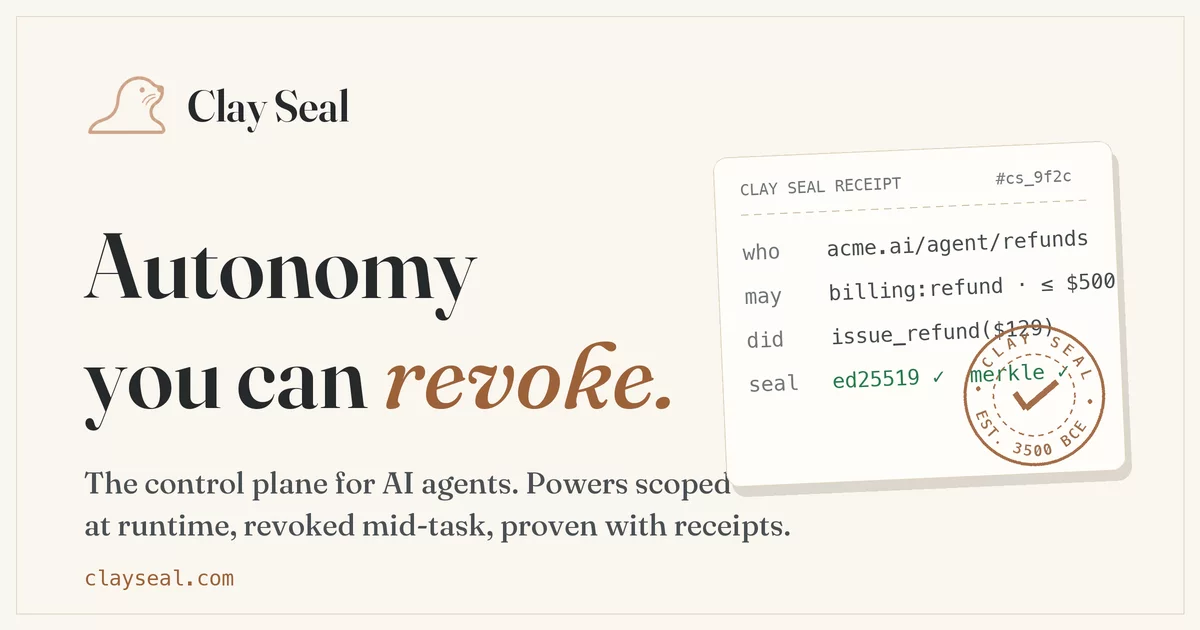
Most agents share an API key. Steal the key, you are the agent. Clay Seal Identity gives each run its own short-lived attested credential, bound to a holder key. A stolen token is not enough. You can check who acted without calling home.
PyPI: clayseal-identity. Import:
clayseal.identity. Receipts live in clayseal-receipts. Identity is not a
sandbox by itself.
Attestation, federation, and deployment notes: docs/THREAT_MODEL.md, docs/DEPLOYMENT.md.
Install
pip install clayseal-identity
Hosted FastAPI service:
pip install "clayseal-identity[server]"
pip install "clayseal-identity[server,kms]"
From source:
git clone https://github.com/clayseal/clayseal-identity.git
cd clayseal-identity
python -m venv .venv && source .venv/bin/activate
pip install -e ".[dev]"
pytest backend/tests sdk/python/tests -q
python examples/01_quickstart.py
Or scripts/bootstrap.sh.
Quickstart
python examples/01_quickstart.py
python examples/05_inspect_token.py
python examples/02_capabilities.py
python examples/04_mcp_server.py   # needs the [mcp] extra
Protect an MCP server
from mcp.server.fastmcp import FastMCP
from clayseal.identity.integrations.mcp_server import (
    ClaySealTokenVerifier, ToolGuard, build_auth_settings,
)

mcp = FastMCP("tools", token_verifier=verifier, auth=auth_settings)

@mcp.tool()
@guard.require()
def search_web(query: str) -> str: ...
Details in docs/INTEGRATIONS.md. Framework on-ramps: integrations/.
Inspect a token
Inspection is for humans. It decodes claims without trusting the token. Use
verify_offline(...) or session.validate() before enforcement.
from clayseal.identity import inspect_token

inspection = inspect_token(session.token)
print("\n".join(inspection.summary_lines()))
Hosted service
uvicorn clayseal.backend.main:app --reload
Production: TLS, pin issuer and audience, Postgres, Alembic before deploy, signing material in a KMS.
Docs
Contributing
See CONTRIBUTING.md and CODE_OF_CONDUCT.md. Security issues: SECURITY.md. Do not open a public issue.
License
MIT. See LICENSE.