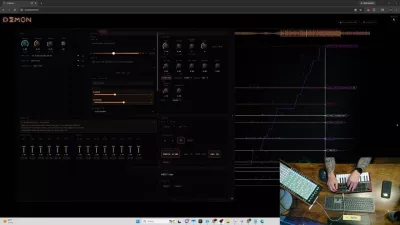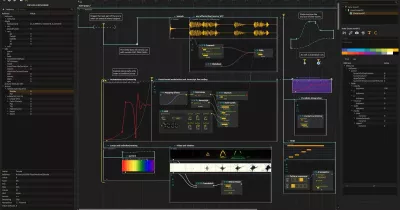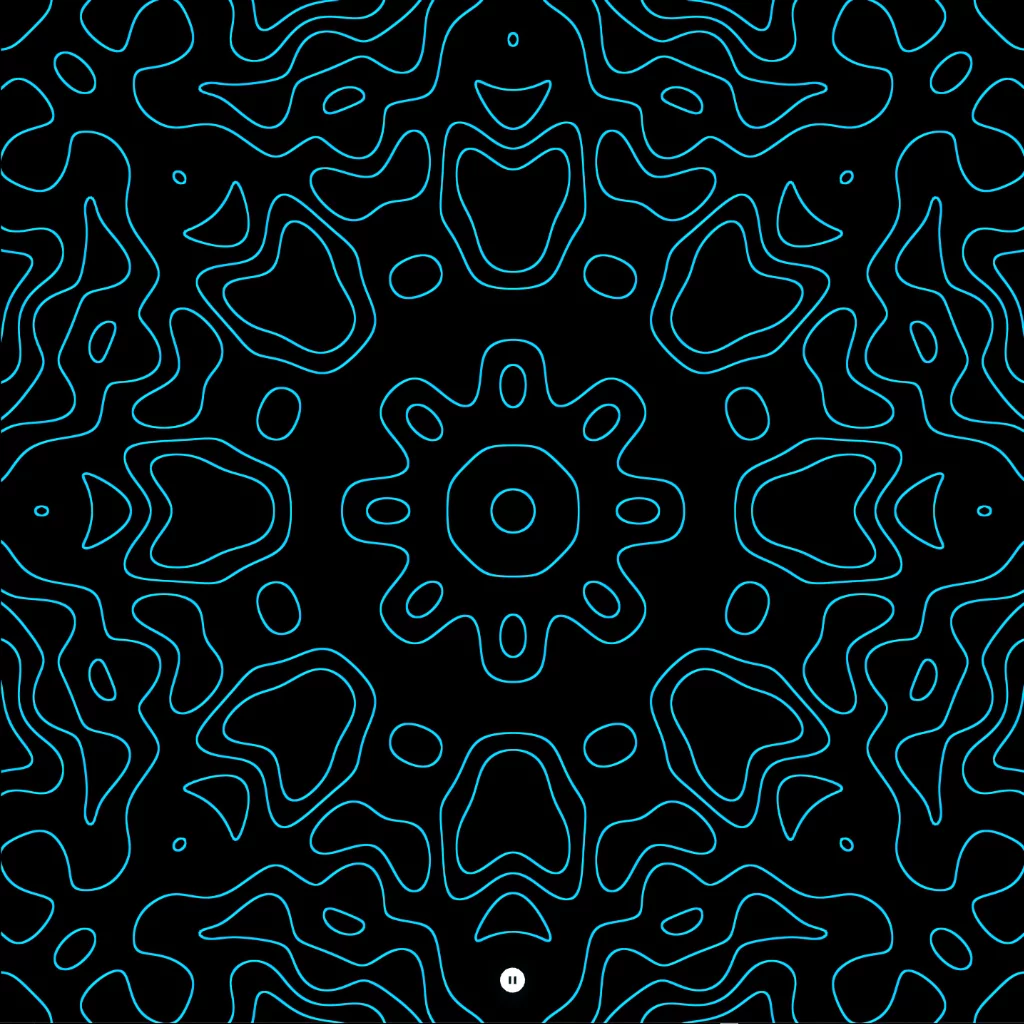

Another Dimension of Music — a web app that visualizes how sound waves affect a fluid surface in real time.
Audio input (files, radio streams, microphone) drives a WebGL2 simulation that renders dynamic cymatic wave patterns on an HTML5 canvas.
Try it at cymatics.app.
It ships three ways:
- The app: a full studio with presets, a 9-band EQ, an XY light pad and every engine parameter on a knob.
<cymatics-view>: the engine as a single-file web component for any page.- The studio as a library: the whole app, mountable inside another page.
Plain JavaScript and GLSL. Vite is the only build tool, and the engine has no runtime dependencies. It needs a browser with WebGL2.
Prerequisites
Node.js 18 or newer. That's it.
Quick Start
npm install
npm run dev
The app will be available at http://localhost:3000.
Commands
| Command | Description |
|---|---|
npm run dev |
Vite dev server on :3000 (start is an alias) |
npm run build |
Production build into dist/ |
npm run preview |
Serve the production build locally |
npm test |
Unit tests (node --test) for the element and studio modules |
npm run build:element |
<cymatics-view> as one ES module in dist-element/ |
npm run build:studio |
The studio as a library in dist-studio/ |
<cymatics-view>
<script type="module" src="cymatics-view.js"></script>
<cymatics-view look="water"></cymatics-view>
look:water,mercury,linesorglow.max-dprcaps the pixel ratio (default 2).element.connect(audioNode)taps any Web Audio node and returns a disconnect function.element.push(bins, sampleRate)takes 1,024 bins of 0..1 from anything else. With neither, it eases into an idle swell.pausedandzoomproperties, and a read-onlysupported.- Fires
cymatics-unsupportedwhen WebGL2 is missing.
/element-test.html on the dev server drives it with a synthetic song (?look=…).
The studio as a library
npm run build:studio produces cymatics-studio.js and style.css. Mount it
with mountStudio(root, host), where host supplies preset storage, audio
sources and the standalone-only chrome; see src/studio/host.js.
/?host=fake on the dev server runs a hosted studio on a synthetic spectrum.
Project Structure
cymatics/
├── index.html
├── engine-test.html      # dev-only engine harness (see below)
├── element-test.html     # dev-only <cymatics-view> harness
├── styles.css
├── vite.config.js
├── docs/                 # design notes
├── public/               # icons, static assets
├── test/                 # node --test unit tests
└── src/
    ├── index.js          # app bootstrap, PWA, drag-and-drop
    ├── controls.js       # the 29 controllable parameters
    ├── default-presets.js
    ├── storage.js        # IndexedDB CRUD for user scenes
    ├── mpeg.js           # MPEG frame parsing for radio streams
    ├── components/       # web components: canvas, controls, audio, EQ, presets
    ├── element/          # <cymatics-view>
    ├── studio/           # the studio as a library (mountStudio, host seams)
    └── engine-js/        # the engine — WebGL2, see its README
        ├── index.js      # entry point, render loop, command API
        ├── cymatics.js   # wave field
        ├── liquidsim.js  # fluid solver
        ├── renderer.js   # PBR / emissive rendering
        ├── view.js       # render path selection and pass sequencing
        ├── glutil.js     # programs, FBOs, textures
        └── shaders/      # GLSL (#version 300 es)
Architecture
┌──────────────────────────────────────────────────────┐
│  HTML5 Canvas                                        │
└─────────────────────────┬────────────────────────────┘
                          │
┌─────────────────────────┴────────────────────────────┐
│  Engine (src/engine-js/) — WebGL2                    │
│  - Cymatics wave field         (GPU, fragment shader)│
│  - Fluid dynamics              (GPU, ping-pong FBOs) │
│  - PBR / emissive rendering    (GPU, fragment shader)│
└──┬──────────────────────────────────────┬────────────┘
   │  Command API                         │  Audio
   │  engine.sendCommand(str)             │  pushAudioSpectrum(Float32Array)
   │                                      │
┌──┴──────────────────────────────────────┴────────────┐
│  Web UI (Vite + Web Components)                      │
│  - Audio capture (Web Audio API)                     │
│  - Controls, presets, EQ                             │
│  - File/stream/microphone input                      │
└──────────────────────────────────────────────────────┘
Essentially all the work happens on the GPU. Per frame the JS averages ~1,030 FFT bins into 4 bands, sets uniforms, and issues the draw calls.
Engine API
// Text commands — used by saved presets and existing call sites.
engine.sendCommand('set cymatics {"contour_mode":1}')
engine.sendCommand('get renderer')   // → the config object

// Audio, once per frame.
engine.pushAudioSpectrum(float32Bins, numBins, sampleRate)

// Reflection / refraction maps, from encoded PNG/JPEG bytes.
engine.upload('reflection', bytes)
New code can also reach engine.view.cymatics, .renderer and .liquid
directly and set properties without going through the command strings.
Engine harness
/engine-test.html (dev server only, not in the production build) drives the
engine with a synthetic spectrum, so the render paths can be exercised without
an audio source or a user gesture:
http://localhost:3000/engine-test.html?mode=emissive   # default look, 2 passes
http://localhost:3000/engine-test.html?mode=pbr        # fluid + PBR, ~52 passes
It reports fps, frame time, and which float texture formats the browser supports.
Contributing
Issues and pull requests are welcome. Before opening a PR, run npm test and
npm run build, and check the change in a browser: most of what matters here
is visual and lives on the GPU, so a screenshot or short clip helps a review a
lot. Design notes are in docs/ and in CLAUDE.md, which documents the
architecture in more depth than this README.
By submitting a contribution you agree that it is licensed under the same PolyForm Noncommercial License, and that the copyright holders may also license it to others under commercial terms.
Credits
The rendering engine is a JavaScript port of C++ engine written by Tuomo Hirvonen, which first powered Cymatics as WebAssembly.
The knob control is adapted from precision-inputs by Chris Johnson (MIT). The dither texture is from Christoph Peters' free blue noise textures (CC0). Radio search uses the Radio Browser API.
License
Cymatics is source-available under the PolyForm Noncommercial License 1.0.0. You are free to use, modify and share it for any noncommercial purpose: personal projects, art, study, research, teaching, and use by charities, schools and public institutions.
Commercial use needs a separate license. That includes using Cymatics or
<cymatics-view> in a product, a paid service, a client project, a commercial
venue or a brand's website. To ask about a commercial license, contact
Miika Kuisma.
Copyright 2026 Miika Kuisma; engine portions copyright 2021-2022 Tuomo Hirvonen. See NOTICE for third-party attributions.