FirstFetch — AI Job Intelligence
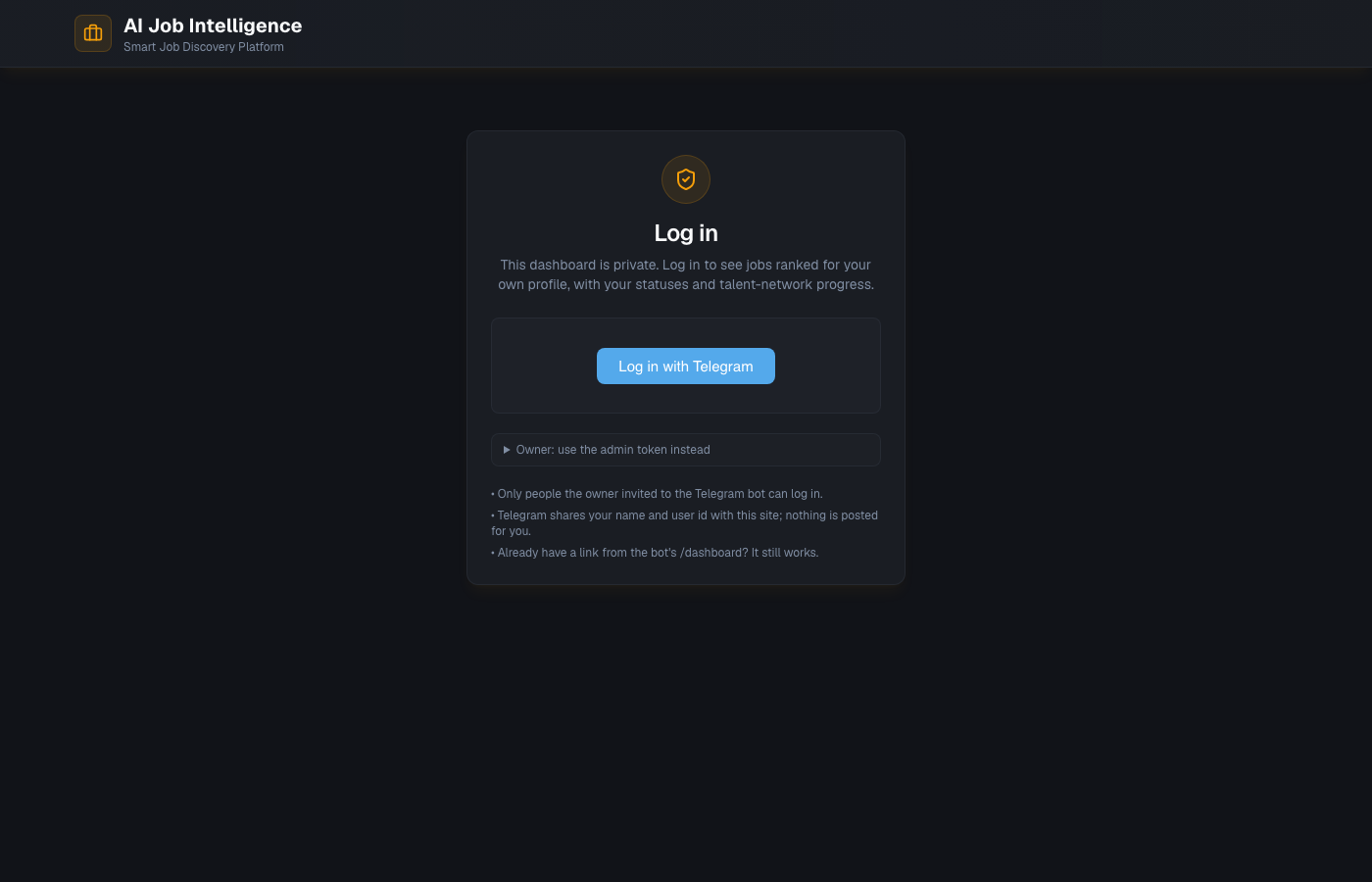
Live demo: firstfetch-eight.vercel.app (private: invite-only, log in with Telegram; refreshed daily by Vercel Cron). Logged out you only see the login page; the screenshots below show what's behind it. The API is private too, and its interactive docs are off in production (run it locally for /api/docs).
FirstFetch pulls listings from public job APIs, scores each one against your profile with an explainable 0–100 score, and sends the strong matches to Notion.
I built it because job boards rank by recency, not fit, and most "remote" listings quietly require living in the US. FirstFetch reads the location and work-authorization rules first, so jobs you can't apply for never reach the top of the list.
$ python -m worker.cli discover --sources sources.example.yaml --top 3
Rank  Fit  Hire  Elig  Title                                           Company               Source
--------------------------------------------------------------------------------------------------------------
  89   80    99  yes   Senior Data Engineer                            (company)             djinni+freehire
                       fit: Title matches target role 'data engineer' · Skills: python, llm, postgres, scraping, gcp · ...
                       hire: Open to applicants worldwide · Competition low: 0 applied, 7 views · Posted 41 h ago: early applicant · ...
  84   75    93  yes   SDET - III (RAGas Automation Testing)           (company)             freehire
                       fit: Title matches target role 'automation' · Skills: python, llm, scraping, rag, aws, gcp · ...
                       hire: Open to applicants worldwide · Competition low: 0 applied, 6 views · Posted 2 days ago · Full-time
  81   77    85  yes   Senior Backend Developer (Python)               (company)             weworkremotely+workingnomads
                       fit: Title matches target role 'backend' · Skills: python, postgres, docker, aws, gcp · ...
                       hire: Open to applicants worldwide · Timezone requirement 'CET (+/- 3 hours)' fits UTC+3 · Posted 3 h ago: ...
--------------------------------------------------------------------------------------------------------------
per source: remotive 12 (0.4 s), remoteok 89 (1.6 s), himalayas 7 (0.4 s), arbeitnow 4 (1.3 s), greenhouse 659 (6.3 s),
            lever 10 (2.4 s), freehire 137 (8.3 s), djinni 287 (3.3 s), weworkremotely 95 (4.0 s), jobicy 56 (3.0 s), workingnomads 23 (2.6 s)
1379 fetched · 1359 unique · 119 eligible · 709 not open to your location · 0 LLM calls (0 tokens)
runtime 47.1 s
Real output from 2026-10-19 using the rules-only extractor (no API key); company names replaced and URL lines left out here.
Architecture
flowchart TD
    cron["Vercel Cron (daily, 04:00 UTC)"] --> discover["GET /api/cron/discover (FastAPI on Vercel)"]
    discover --> sources["Source adapters: job APIs, RSS feeds, Greenhouse, Lever (disabled sources skipped)"]
    sources --> dedupe["Cross-source dedupe"]
    dedupe --> rules["Rules extraction + scoring: fit, hire probability, location eligibility (hybrid / US-only detection)"]
    rules --> db[("Neon Postgres: jobs, per-user scores, tracker, LLM usage")]
    discover --> enrich["LLM extraction for the day's top jobs by rules rank"]
    enrich --> budget{"Budget guard: monthly cap + daily limits"}
    budget -->|"within budget"| openai["OpenAI (fallback model if the default is unavailable)"]
    budget -->|"refused or failed: keep rules facts"| db
    openai -->|"facts, rescored per user"| db
    db --> digest["Telegram daily digest"]
    bot["Telegram bot webhook: /top, /login one-time links, cover letters"] <--> db
    bot -->|"cover letters"| budget
    db --> api["Private API (ff_session cookie)"]
    api --> dash["Next.js dashboard behind Telegram login"]
One daily Vercel Cron request drives the pipeline: every enabled source is fetched, deduplicated and scored by deterministic rules, then the day's best jobs get an OpenAI read inside a hard monthly budget, keeping the rules facts whenever a call is refused or fails. Everything lands in Neon Postgres with a score per user, and the same run sends each user their Telegram digest. The bot and the Next.js dashboard read the same database; the dashboard and API are private, reached through Telegram login or a one-time /login link from the bot, which sets the ff_session cookie.
How it works
 sources ──► fetch ──► dedupe ──► rules extract ──► score ──► Postgres / Notion / webhook ──► LLM extract* ──► rescore
 (11 APIs +   (retry,   (per source   (skills,          (0-100 with                           (*once a day: the
  Playwright) throttle) + across      seniority,         reasons)                              day's top 30 by rules
                        boards)       salary, risks)                                           rank, within budget)
-
Sources (
worker/sources/): FreeHire, Djinni, We Work Remotely, Jobicy, Working Nomads, Remotive, RemoteOK, Arbeitnow, Himalayas, any Greenhouse or Lever careers board, plus an opt-in Playwright scraper for sites without an API (see Sources for each one's terms and limits). All requests go through one HTTP client with throttling, exponential backoff with jitter,Retry-Aftersupport, and pacing onX-RateLimit-Remaining/X-RateLimit-Resetwhen an API sends them. -
Full descriptions (
worker/sources/fulltext.py): RemoteOK and Himalayas sometimes return only an excerpt, which under-counts skills. When a new posting from those sources has a description shorter thanFULL_DESCRIPTION_MIN_CHARS(1500), FirstFetch fetches the posting page and uses the JSON-LDJobPosting.descriptionif the page has one, or else the block holding most of the page's text, with navigation, sidebars, footers and link lists left out. Page fetches use the same throttled client, identify asFirstFetch/…, checkrobots.txt(cached per host,Crawl-delayhonored) and stop trying a host after two failures in a row. The API text is kept whenever a fetch fails or the page has less text. Each scrape run has a budget,FULL_DESCRIPTION_MAX_PAGES(10) andFULL_DESCRIPTION_MAX_SECONDS(20), so the daily serverless run stays well inside its time limit. Each run's stats showfull_descriptions: {candidates, fetched, failed, skipped, ...}. SetFULL_DESCRIPTION_MIN_CHARS=0to turn it off,FULL_DESCRIPTION_SOURCESto change which sources are fetched, or"full_descriptions": true/falsein a source's config to override one source. Usediscover --no-full-descriptionsto skip it from the CLI. -
Extraction (
worker/ai.py): keyword rules for every job. WithOPENAI_API_KEY(orLLM_BASE_URLpointing at an OpenAI-compatible server such as Ollama), the day's best jobs by rules rank are also read by the model, with a strict JSON schema validated by Pydantic, inside a hard monthly budget. Any failure falls back to rules, with a warning, instead of failing the run. See AI features and budget. -
Scoring (
worker/matching.py): deterministic, so it's testable and auditable. The LLM supplies facts; it doesn't decide the score.Component Points Notes Role 25 target title in the job title (5 if only in the description) Skills 35 weighted coverage of your top skills; halved for off-target titles Location 15 "USA only", work-authorization clauses, on-site roles, office days, and "who may apply" sentences naming only regions you're not in ("candidates must reside in South America or Mexico", "Latam and Europe remote ONLY") make a job ineligible (score capped at 20). "Must be based in EMEA" stays open to Ethiopia; "US hours" / "EU time zone" is about hours, not residence Seniority 10 Salary 10 top of the range, normalized to annual USD, against min_salary_usd(5 when unknown)Recency 5 days since the posting went live, or since its last update when the source reports one (see below) Risk flags −10 each commission-only, unpaid, upfront fees, vague postings -
Hire probability (
worker/hire.py): a second, separate 0–100 score for can I realistically get this job?, with its own reasons. See Hire probability and rank. Jobs are ranked byrank, the geometric mean of fit and hire probability. -
Cross-source dedupe (
worker/pipeline.py): the same job seen on several boards becomes one posting. Two postings are linked when their URLs match after droppingwww., trailing slashes and tracking parameters (utm_*,ref, …), which catches FreeHire's copies of Djinni and We Work Remotely jobs, or when normalized title + company match across different sources, including We Work Remotely'sCompany: Titlestyle that other boards copy into the title. One board listing the same title twice is kept as two openings. The richest record wins (most structured facts, then longest description), its gaps are filled from the others, the longest description is kept, the link-back board's URL stays the job URL, a board that posted the job directly beats an aggregator on location, and every board's URL is kept insource_urls(stored injobs_raw.meta). -
Recency dates:
posted_atis always when the posting first went live. Greenhouse also returnsupdated_at, which keeps moving while a role stays open, so a requisition first published months ago isn't scored as stale: recency uses the newer of the two, and the reason says which (Updated 3 days ago, first posted 251 days agovsPosted 60 days ago). An update less than a day after publishing counts as the original post.updated_atis kept injobs_raw.meta(no column) and refreshed on every scrape, soPOST /api/analyzerescores stored rows. Lever's public API only hascreatedAt, so Lever recency is the creation date; the other boards report a single publication date. -
Salary normalization (
worker/salary.py): hourly × 2080 (40 h × 52 weeks), daily × 260, weekly × 52, monthly × 12; no period means annual and no currency means USD. Other currencies convert with a dated static table (USD per unit), whichFX_RATES_JSON='{"EUR": 1.1}'overrides or extends. A currency or period the table doesn't know is scored as unknown, never guessed. Period and currency are read from the source's fields or from text such as$40/hr,€5,000 per month,£70k,USD 120,000 - 150,000. The reason shows both figures, e.g.Salary up to €60,000/yr ≈ $70,200. Storedsalary_min/salary_maxstay in the source's own unit. -
Dashboard (
frontend/): jobs are sorted by rank by default (a selector switches to best fit or newest). Each job card shows the rank, the fit score, the top reasons, an eligibility badge (Eligible / Not open to your location / Eligibility unknown) and a hire-chance badge. "Why this score" expands the per-component points as bars, the risk penalty, the ineligible cap and the matched skills, all read from the storedextracted_json.match, then the hire-probability gates, weighted factors and reasons fromextracted_json.hire. Jobs not open to your location are hidden by default; the "Show N jobs not open to your location" toggle brings them back. -
Notion (
worker/notion.py): upserts keyed by job URL, so re-runs update scores without duplicating pages. TheStatusyou set in Notion is never overwritten. -
Telegram and tracker (
backend/app/telegram/,backend/app/tracker.py): a daily digest of the best new matches with Applied / Save / Not for me buttons, an owner-only bot, and a per-job application tracker whose 👎/⭐/✅ history nudges similar jobs down or up. See Telegram alerts.
Stack: Python 3.12, FastAPI, SQLAlchemy + Alembic, PostgreSQL (pgvector), Redis + RQ, httpx, Pydantic, Next.js dashboard, Docker Compose, GitHub Actions.
Sources
Source (type) |
Endpoint | Filters FirstFetch sends | Terms and limits |
|---|---|---|---|
FreeHire (freehire) |
GET https://freehire.me/api/v1/agent/jobs/search (OpenAPI) |
any search param: q (with title: and OR), work_mode, regions, employment_type, is_tech, posted_within_days, sort, limit/offset; several queries per source, list values sent as repeated params |
No key. 300 req/min for agent search, 600/min for other reads; X-RateLimit-* on every response and 429 + Retry-After. Asks for a User-Agent naming the project. Unknown params are dropped and listed in meta.ignored_params: FirstFetch fails the source (strict: false logs instead). Optional company_remote_regions reads /companies?remote_regions= to learn which companies hire remotely in Africa. Each request retries twice with waits capped at 10 s (FreeHire sometimes answers 522 with a long Retry-After), and max_seconds (45) bounds the whole source. |
Djinni (djinni) |
https://djinni.co/jobs/rss/ |
primary_keyword, exp_level, english_level, employment |
Public RSS, up to 100 items per query. Other params (region, keywords, page) are silently ignored by the feed, so FirstFetch refuses them. |
We Work Remotely (weworkremotely) |
https://weworkremotely.com/categories/remote-<category>-jobs.rss |
one feed per categories entry (back-end-programming, full-stack-programming, devops-sysadmin, programming, …) |
Terms ask for a link back: the weworkremotely.com URL stays the job URL. <country>, when present, is the real restriction (<region> says "Anywhere in the World" even then). Disabled (migration 008): its listings ask candidates to pay before applying. A disabled source isn't scraped and its stored jobs are hidden from the dashboard and Telegram. |
Jobicy (jobicy) |
https://jobicy.com/api/v2/remote-jobs (docs) |
count, geo (anywhere, emea, …), industry, tag |
Automated sync passes at most once per hour (the daily cron is well inside that); credit Jobicy and send applicants to the listing URL. appliedFilters is checked: a filter that wasn't applied fails the source. Last 7 days only. |
Working Nomads (workingnomads) |
https://www.workingnomads.com/api/exposed_jobs/ |
none server-side; categories and keywords filter locally |
Latest ~40 listings, no parameters. |
| Remotive, RemoteOK, Arbeitnow, Himalayas, Greenhouse, Lever | see worker/sources/adapters.py |
see Limitations |
Every source accepts max_age_days (drop older postings) and max_results. sources.example.yaml has queries tuned for a remote backend/AI engineer in Ethiopia.
Hire probability and rank
The fit score says whether a job is right for you. Hire probability (worker/hire.py) says whether applying is likely to pay off. Each factor is 0–1 and gets a reason:
hire_probability = 100 × eligibility × timezone × language × risk × (Σ weight × factor / 100)
rank             = round(100 × √(fit/100 × hire_probability/100))
Gates multiply because any one of them can make an application pointless; the weighted factors average because they trade off.
| Factor | Kind | Value |
|---|---|---|
| Eligibility certainty | gate | 1.0 explicitly worldwide / anywhere / global / Africa / your country (location text, or FreeHire regions/countries); 0.9 when the LLM read an explicit "worldwide" or your region in the posting ("AI read: …"); 0.9 EMEA; 0.75 MENA (Ethiopia isn't always counted in it); 0.85 posting silent but FreeHire lists the company as hiring remotely in Africa; 0.9 another of your eligible_terms; 0.5 bare "Remote"; 0.02 not open to your location (same verdict as the fit score) |
| Timezone | gate | stated requirements in the location, timezone note or description ("US time zones only", "CET ±2h", "UTC-3 to UTC+3", "overlap with EST", which adds 4 h of slack) against timezone: 1.0 inside the window, 0.75 within 2 h, 0.45 within 4 h, 0.25 within 6 h, else 0.1; 1.0 when nothing is stated |
| Risk | gate | the lowest of the posting's risk flags (rules or LLM): not a real job or asks you to pay 0.1, unpaid 0.3, commission only 0.5; else 1.0 (a vague description only costs fit points) |
| Language | gate | 0.1 if another language is required ("fluent German", "French is a must", "Japanese-speaking"; "… is a plus" doesn't count) and it isn't in languages; 0.35 if the posting itself isn't in English (source field, or script/stopword detection); else 1.0 |
| Competition | weight 30 | pressure = applicants + views/20; factor = 1 / (1 + 4 × pressure / max_competition), floor 0.1. With the default 50: 0 → 1.0, 12.5 → 0.5, 25 → 0.33, 50 → 0.2. Unknown (most boards) 0.5 |
| Freshness | weight 30 | 1.0 for the first 48 h, then halves every 5 days (7 days ≈ 0.5, 12 days ≈ 0.25), floor 0.05; unknown date 0.4. FreeHire postings whose date the source keeps restating (fake_freshness) are dated from when FreeHire first saw them |
| Seniority | weight 20 | 1.0 when the stated (source) or title level is in your seniority, 0.55 one level off, 0.25 two, 0.1 further; 0.7 unknown. Halved (or quartered) when the posting asks for more years than years_experience, if you set it |
| Employment type | weight 20 | your employment_types weight (default full-time 1.0, contract 0.6); types you don't list 0.1; unknown 0.8. Read from the source, else the title, else a clear phrase like "this is a contract role" |
Profile settings (all optional, defaults suit a remote job search from Ethiopia):
employment_types: {full_time: 1.0, contract: 0.6}
timezone: UTC+3
max_competition: 50
languages: [english, amharic]
location: {country: Ethiopia, country_code: et}
# years_experience: 5
The worker stores extracted_json.hire (score, factors, reasons), extracted_json.hire_probability and extracted_json.rank (both 0–100) next to match; score stays the 0–1 fit score. GET /api/jobs?sort=rank orders by rank, then fit. The dashboard's ScoreDetails mirrors the weights above.
AI features and budget
Two optional features use an OpenAI model, both through one budgeted caller (worker/llm.py, worker/budget.py):
- Extraction of job facts for the day's best jobs: who may apply (
location_restriction,worldwide), seniority, employment type, timezone requirement, minimum years, risk flags. They feed the fit score and hire probability. When the model's reading changes eligibility, the job says so: AI read: applicants must be in the United States or AI read: open to applicants worldwide. The model can settle an unknown ("Remote") either way and catch a restriction the rules missed, but never re-opens a job the rules found restricted. - Cover letters in Telegram: the ✍️ Cover letter button under every digest and
/topcard, or/cover <job id>. The letter is written from your resume (/cv: paste the text, or upload a .txt, .md or .pdf; the owner can also runpython -m worker.cli set-resume resume.pdf), the job's title, company and description, and your profile. The prompt asks for at most 220 words tied to the job's stated requirements, a professional tone without clichés, plain text you can paste, and above all honesty: nothing that isn't in the resume, and nothing claimed that the resume doesn't show (worker/cover_letter.py,HONESTY_RULES). The letter is sent to you and not stored; only the usage row (tokens and cost) is. (/resumealready resumes the digest, so the resume command is/cv.)
Models and prices (MODEL_PRICES in worker/llm.py, from the
OpenAI pricing page o