
Kebabstack
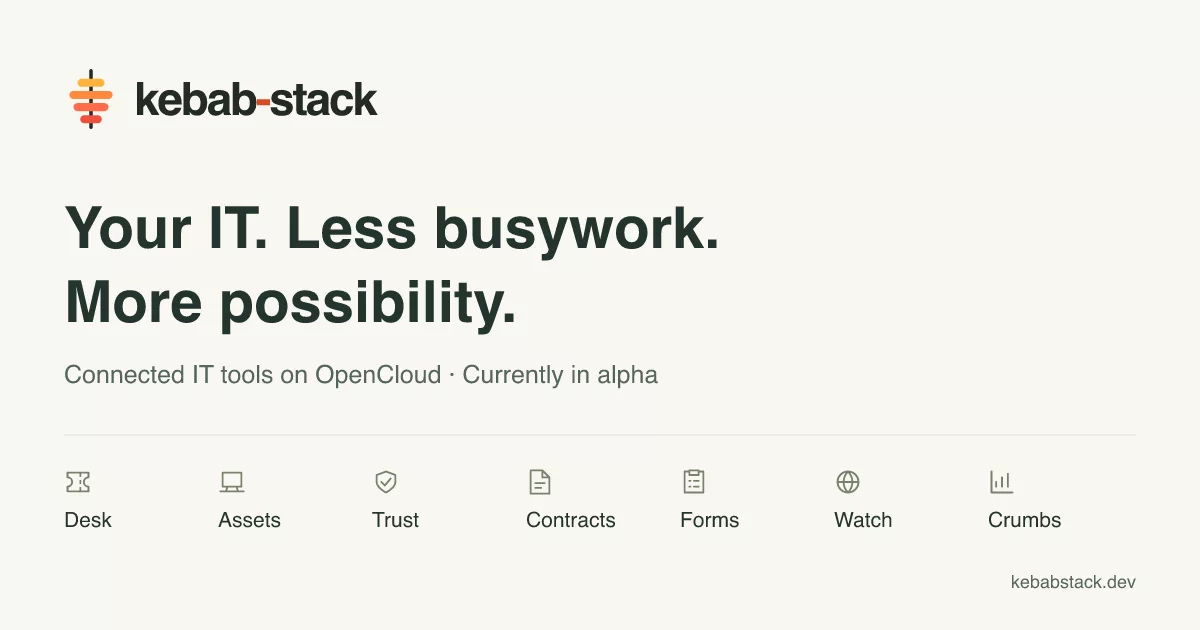
An open-source IT suite for startups and SMEs, running on a Cloud Engine.
kebab-stack brings people, sign-in, service requests, device inventory and domain monitoring into one suite. The Hub supplies the directory and access rules; apps share its sign-in and navigation. Kitchen installs and updates the modules, and Vault takes and restores canister snapshots.
Hub Permissions centrally defines roles for Assets, Contracts, Desk, Forms, Trust, Watch, Crumbs and Doku. Global Hub owners/admins inherit app administration; employees receive their own and explicitly shared content. See the permission model and upgrade sequence before rolling out these releases.
Status: public alpha source. This is a working codebase, not a feature-equivalent replacement for every IAM, ITSM or endpoint-management product. Start with a disposable pilot. Read the known limits and operator guide before deciding what to run here.
The staged product and marketplace roadmap tracks Hub Operations, connected workflows and the acceptance gates for a sanitized public distribution. Planned functionality is separate from the implemented modules listed below.
Why consider it?
There are no kebab-stack per-seat licence fees or paid security tiers: the code is MIT licensed. A shared directory and sign-in can reduce duplicate integration work. Motoko stores application state with the backend, so these modules do not need a separately operated application SQL database or Kubernetes cluster. Crumbs supports native canister collection; an optional Node collector adds a local SQLite delivery queue.
You still pay for Cloud Engine infrastructure, external services such as AI, and people's time to configure, maintain and support the suite. Savings depend on the subscriptions you can actually retire and the workload you measure. We have no validated monthly cost or capacity benchmark yet. Decision guide and cost model · Entscheidungshilfe auf Deutsch.
Sovereignty here means access to the source and control of your application canisters and engine configuration. It does not automatically mean confidentiality from node operators, a particular country, or independence from ICP. Review the chosen operators, jurisdictions, controllers and external data flows.
What exists
| Module | Role | Status |
|---|---|---|
| Hub | Directory, passkey/SSO sign-in (several providers), groups, access policies, SCIM input from several sources, Okta pull, optional OpenTeam directory input, notifications; OIDC provider for external software | alpha |
| Doku | Reviewed documentation from confirmed internal Desk solutions or manual drafts, rich-text editor, immutable published history and version-scoped external links; one internal library | alpha |
| Desk | Internal and customer support, connected offboarding, project workflows, on-call schedules, incident response, service status and scoped HR/Finance reports | alpha |
| Assets | Device inventory, MDM/Apple imports, assignment history and hardware sales; employee offers and external magic-link dealrooms with invoices | alpha |
| Watch | DNS/domain monitoring, posture and expiry evidence; optional notifications | alpha |
| Crumbs | Cookieless analytics with optional consented browser recognition, AI/campaign sources, scroll goals, revenue, multi-site reports and optional guided Google integrations; native collection with optional Node ingress | alpha pilot |
| Vault | Per-canister snapshots, schedules and restore | alpha |
| Kitchen | Verified releases in Hub → Apps | alpha |
| SDK | Motoko and browser contracts for another app | alpha |
| Forms | Form builder with anonymous public links; review pipeline (received → in review → accepted/declined) with ratings, assignees, notes, insights and CSV; sharing, import, 90-day trash | alpha |
| Trust | Device posture from a read-only osquery agent: enrolment, checks and scores, per-person view, plain-language questions; owners from Assets | alpha |
| Bug | Ship the Bug — 2D/3D switch, shared profiles, guest play, optional local names or Internet Identity and separate opt-in leaderboards | alpha |
| Contracts | Upload → AI review → SaaS overview; owners, seats, renewals, scoped license keys and 90-day reminders; USD/CHF/EUR costs and management reports without currency conversion; document upload and browser PDF extraction; read-only Brex imports, individual payment assignment and guided completion | alpha |
| kebab-mcp | Your apps from your AI assistant: an MCP server that signs into every app as the person through the hub (one-time code → personal token, live Candid, curated tools) | alpha |
Hub, Desk, Assets, Watch, Crumbs, Trust, Forms, Bug, Contracts and Kitchen each have a backend and a static frontend canister. Vault has one backend and is operated through the Hub. A snapshot is per canister, not an atomic backup of the whole suite.
Identity and access in plain terms
A person is a directory entry; a passkey login is linked to that person with an invitation. An app receives only the directory and capabilities granted to it. Revoking access in the Hub triggers a push; bundled apps also refresh their complete directory every 30 seconds and refuse access once its age reaches 60 seconds. A Hub outage therefore interrupts app access. Upstream IdP changes only start this window after the Hub has learned of them. External OIDC clients have their own token/session expiry; outbound SCIM deprovisioning is not shipped.
Start here
- Install: prepare the engine and controller identity, deploy Kitchen, generate a one-time setup code, then finish setup in the browser.
- Operate and recover: controller recovery, offboarding, upgrades, snapshots, rollback and external services.
- Build an app using the SDK.
- Connect an AI assistant: the hub's assistant lane and the
kebab-mcpserver — a chat assistant acts as the person, with the person's rights. - Contribute and verify: pinned tools, tests, version rules and release checks. Every module has its own version and changelog.
The complete suite is published at kebabstack/kebabstack-source. This distribution starts with a reviewed snapshot and a new Git history; customer records, secrets, deployment receipts and private configuration are excluded. The repository and served /sdk/ documentation are maintained together. See what is included and how to review it. Marketplace listing and operational qualification remain separate milestones.
Licence
Kebabstack code is MIT licensed. Bundled upstream code and credited imagery retain their own licenses; see third-party notices.
Hardware coordination across Hub, Desk and Assets is described in the offboarding operator guide: discover assigned equipment, plan its disposition and verify the result without duplicate updates.
Cross-app Operations
Hub → Operations combines current Desk, Trust, Assets, Contracts and Watch summaries with a focused next-action panel. Administration remains in the source tools and permissions in Hub. The signed-in work view and separately paired TV screens are implemented; retained trends follow. See coverage and limits.
Scoped on-call HR/Finance reporting is available as an alpha in Desk. See the service reporting workflow and pilot limits. Hourly statements and CSV exports do not automate payroll payment or country-specific compensation law.
Product logos
Logo library and design rules define the permanent Kebabstack product marks approved from kebabstack.dev. Use design/logos/registry.json; never invent a separate app logo, emoji or coloured tile. Run npm run brand:sync and npm run brand:check when changing a mark or adding a tool. Keep the website, app favicon/header, Hub menu, Kitchen recipe and Cloud Engine console aligned. Company and external-app branding remain separate.
Product design standard
The Brand & Product System is the shared design and UX authority.
Before changing a user-facing flow or adding a tool, read its relevant rules in
the complete standard, reuse the canonical logos/shared
foundations, and use the review template. The standard
covers behavior, permissions, SSO, states, automation, privacy and accessibility
as well as appearance. Existing apps are migrated through the
adoption plan; the target tokens do not silently replace
hub/dist/tokens.css. Run npm run design:build and npm run design:check for
standard changes. Keep source, generated docs, versions and changelogs aligned.
OpenSaaS interoperability: Hub can use OpenTeam as an optional directory source. See the setup and verified compatibility scope. Authentication and Kebabstack roles remain Hub-managed; no OpenSaaS-wide certification is claimed.
Desk also includes an alpha IT Workboard for project tasks, linked internal tickets and optional hardware sales, with existing Hub and source permissions.
Documentation milestone
Doku adds a human-reviewed internal documentation workflow from confirmed Desk solutions. Alpha 0.2 provides a WYSIWYG editor, direct manual creation, reviewed proposals, published history and optional password-protected external version links with expiry/revocation. AI suggestions, Slack review reminders and scoped spaces remain planned; no automatic documentation update is shipped.