
okl — Observed Knowledge Ledger
Verified memory for coding agents, and the loop that keeps it true.
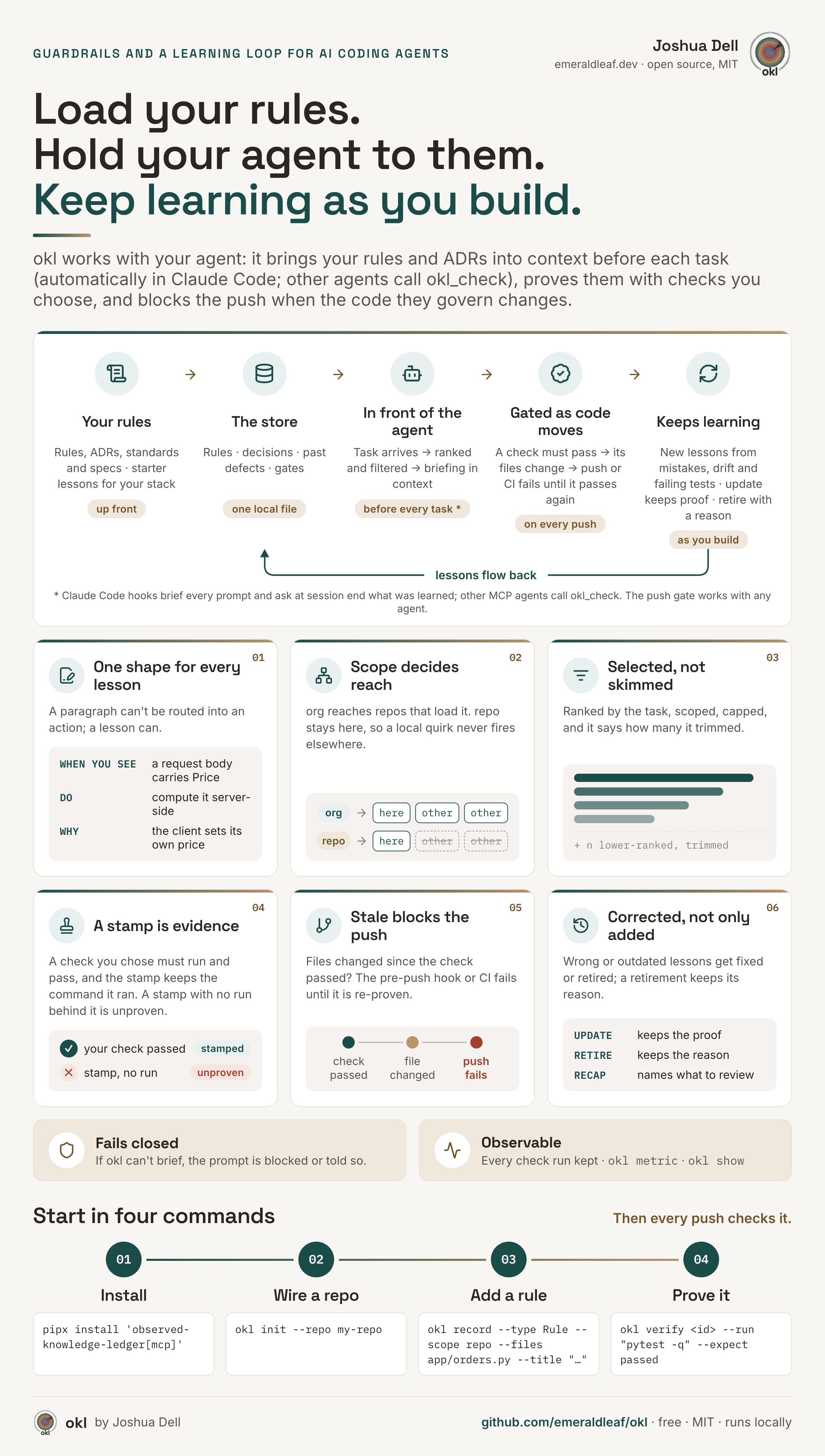
Your rules, architecture decisions, past defects, documentation and diagrams: recorded once,
briefed to your agent before every task (by a hook in Claude Code; any MCP agent can ask for
the same briefing), each proven by a check you choose, flagged before you push (or in CI) when
what it covers changes, and corrected or retired as you build. Prompts advise; the gate
enforces. Use it in one repo, or share one store across every repo your team runs.
Under the hood: typed records, keyword search and one-step links. No embeddings by default,
no model calls in the loop, no automatic capture; an optional local embedding arm exists,
measured and off until you turn it on (REPORT §4q). A lesson is written
on purpose and proven by a check.






🚀 Quickstart · 📘 Getting started · 📥 Load your rules · 🔬 How it works · 📊 Results · 🧪 Eval report · 🧩 Plugin
pipx install 'observed-knowledge-ledger[mcp]'   # the command it installs is `okl`
okl init --repo my-repo                         # hooks, MCP server, push gate, starter lessons
42% → 7%. On eight tasks written to invite defects the store already knew about, 68 of 163 unbriefed attempts repeated one against 11 of 164 briefed, pooled over seven A/B runs with a different model judging than generating (the receipts, §5 finding 7). Small sample, one-shot code on bait tasks; what it does and does not show.
What goes wrong, and what catches it
| When | What okl does |
|---|---|
| The agent is about to repeat a defect you already paid for | the briefing puts the lesson in front of it before the task, selected by the task's words |
| Code a lesson covers changes after its last check | okl drift goes red; the pre-push hook holds the push (or CI fails) until the check passes again or the code is back to what passed; the next briefing marks the lesson STALE |
| A lesson turns out to be wrong | okl retire --reason keeps it, briefed as AVOID so nobody restates it; nothing is deleted |
| A lesson is replaced | okl retire --by <new-id>; the briefing points to the replacement |
| The store cannot be reached | the Claude Code hook blocks the prompt and says why; the MCP tool says it was not briefed. Never a clean "no rules apply" |
| A session changed files and recorded nothing | the Stop hook asks once what was learned, and names the lessons the session touched |
Quickstart
New here? docs/GETTING-STARTED.md walks through setup and the habit of adding lessons as you build a feature. Already have a
CLAUDE.md, ADRs, standards or specs? Load your rules shows how to load them, prove the ones that matter, and keep them current.
1. Install the CLI. Python 3.11+ (0.8.9 is the last release for 3.10), git for drift. macOS and Linux; Windows is untested (#85).[^name]
pipx install 'observed-knowledge-ledger[mcp]'
2. Wire your repo, from its root:
okl init --repo my-repo --dry-run   # lists every file it would write; writes nothing
okl init --repo my-repo             # config, Claude Code hooks, MCP server, pre-push drift gate, starter lessons
init detects your stack (*.csproj, package.json, pyproject.toml …), sets the repo's
interests from it, and fills the store with 20 starter lessons that hold on almost any
codebase plus the bundled packs for your stack, so the first prompt is already briefed
(--interests chooses your own subjects; --no-seed leaves the store empty). It wires Claude
Code when the repo has a .claude/ directory or claude is on your PATH (--claude /
--no-claude), installs a pre-push hook that blocks a push only when lessons have drifted
(--no-git-hook skips it; --ci installs the GitHub workflow instead, --ci --git-hook both),
and remembers both choices. Every path it writes, and what each is for:
What okl init writes.
3. Add a rule of your own. The starter lessons are generic; what pays is what only your
codebase knows. Tell your agent — "record an okl rule for this repo: order lookups are
scoped to the signed-in customer; governs app/orders.py" — and it records the lesson with
okl's okl_record MCP tool (in Claude Code, /record drafts it and asks you first).
Underneath, that is one CLI call you can also run yourself:
okl record --type Rule --scope repo --id order-owner-scope \
  --title "Order lookups are scoped to the signed-in customer" \
  --symptom "an endpoint fetches an order by id with no owner filter" \
  --fix "filter by the caller's customer id in the query; return 404 on no match"
Then prove it: okl verify order-owner-scope --run "pytest -q tests/test_orders.py" --expect passed.
Loading the rules, ADRs and specs you already wrote, and the bundled packs, is
Seed it.
4. Check it works:
okl check --task "add an endpoint that returns an order for the logged-in user"
okl doctor                  # flags other memory tools, double wiring, and where drift is gated
[^name]: https://github.com/emeraldleaf/okl/blob/main/The PyPI name differs because PyPI refuses okl as confusable with oki; everything you type afterwards is okl.
Which agent, which part
| Claude Code | Any MCP agent (Cursor, Codex, Copilot …) | Any agent, or none | |
|---|---|---|---|
| Briefing before each task | a hook on every prompt, automatic, fails closed | the okl_check tool, when the agent calls it |
okl check in the terminal or a script |
| Recording what was learned | the Stop hook asks once per session that changed files | the okl_record tool |
okl record |
| Proof and drift | okl verify, okl reverify, okl drift |
the same commands | the same commands |
| The gate | the pre-push hook | the pre-push hook | the pre-push hook, or the CI workflow (okl init --ci) |
The hooks are Claude Code's; everything else is a command or an MCP tool and works anywhere. Setting up another agent: Getting started.
What a normal day looks like
- You prompt as usual. The pre-task hook runs
okl checkon what you typed and puts the relevant lessons in the agent's context before it starts, and shows you one line — okl · briefed 9 lesson(s): … — so you can see it working (OKL_QUIET=1hides it). - When you learn something worth keeping — a decision, a convention the agent broke,
a bug you fixed — say so and the agent records it (
okl_record, orokl record), with the files it governs. In Claude Code the Stop hook also asks once, at the end of a session that changed files, what was learned, and names the lessons the session was briefed on and those whose files it changed, so the agent can propose correcting or retiring one (you approve). - Using another agent? The briefing and recording are MCP tools (
okl mcp); register them and add one line to yourAGENTS.md: before each task callokl_check. The hooks that do this automatically are Claude Code's; see Getting started. - When a lesson needs correcting, take its
[id]from the briefing and change only what is wrong:okl update <id> --fix "..."(or theokl_updatetool) keeps the rest, including its proof, unless you change its governed--files: then it needs verifying again, andokl reverifyre-runs its stored check.okl show <id>prints the whole lesson, with how often its check has passed and failed: every run ofokl verifyandokl reverifyis kept, so a check that caught a change leaves a record. Recording an existing id again is refused, because it used to replace the lesson and wipe its proof. - When a lesson is wrong or replaced, retire it with a reason; nothing is deleted.
okl retire <id> --reason "..."keeps a wrong one briefed as AVOID, so nobody restates it;--by <new-id>takes a replaced one out of briefings, which point to the new one;--obsoleteis for a lesson whose subject is gone. A fixed defect is not retired: it keeps briefing against its return. - Proving a lesson is true is a check you run, not a flag you set:
okl verify <id> --run "pytest -q tests/test_orders.py" --expect "passed". - When code a lesson governs changes,
okl driftgoes red until its check passes again, or the code is put back as it was when the check passed (a lesson recorded with--filesis also red until its firstokl verify). The briefing says so too: such a lesson is marked STALE (or UNVERIFIED, or UNPROVEN) with the file that changed, so the agent confirms it against the code instead of trusting it blindly.okl reverifyre-runs each drifted lesson's stored check after you confirm. With the GitHub workflow (okl init --ci), CI reads a committed snapshot,okl-drift.json, whichokl verifycreates the first time a lesson with--filesis verified and keeps current after that: commit it after the code change it verifies. Until then CI warns "Drift not checked", which is expected. Without the workflow,okl verifywrites no snapshot unless one is already committed. - Headless runs (
claude -p, scripts, CI agents) setOKL_DISABLED_HOOKS=encode, or the end-of-session question replaces the printed answer.
The problem it solves
A team, or an agent, fixes a subtle bug, learns why it happened, and writes a rule to prevent it. Weeks later, in a different file or a different repository, the same class of bug comes back, because the person or agent doing the new work never saw that rule. The knowledge existed; it was not in front of whoever needed it, at the moment they needed it. And when it was, it was often out of date: the code it described had moved on.
okl answers both. The relevant lessons are read automatically at the start of a task, not looked up if someone remembers to, and a lesson stays true or goes stale loudly: each is proven by a check you choose and re-opened when the code it covers changes.
This is a v0 starter, not production-hardened. It ships an end-to-end test suite (pytest -q
shows the suite and its result in your environment). The core is stdlib-only with zero
required dependencies.
What okl is
A store of your engineering lessons, and the machinery that keeps them true. Typed records (rules, architecture decisions, known defects, gates, tombstones, retractions) that are briefed into an agent's context before a task and go stale loudly when the code they describe moves on. Everything measured in evals/REPORT.md measures this.
It is worth being precise about what that store fills up with, because "lessons a codebase has learned" invites the picture of a bug database. In the 183-record corpus in seed/ it is mostly not that: 110 Rules, 20 Decisions and 7 Gates against 36 Defects — conventions the code follows and trade-offs already settled, not a ledger of things that broke. Count it yourself:
python3 -c "import json,glob,collections; c=collections.Counter(
  n['type'] for f in glob.glob('seed/*.json') for n in json.load(open(f))['nodes']); print(c)"
A second, optional thing ships in the package: okl scaffold, a starter
kit for the in-repo discipline the store assumes (a lean rules file, mechanical gates, a
review agent, an eval harness). It has never been measured; use it to get a new repo to the
state where a store has something to attach to.
What okl is not for
okl holds lessons: what an agent would see or do (the symptom), what to do instead (the fix), why, and where it can be proven, the check. Most of a good agent setup is other things, and they work better elsewhere:
| If it is… | Put it in | Why not okl |
|---|---|---|
| a rule every session needs, whatever the task | CLAUDE.md / AGENTS.md |
those load in full every time; a briefing picks lessons per task |
| a procedure: how to release, migrate or set up | a skill, runbook or script | a procedure is read whole and in order; a briefing hands over a few short records |
| commands, and "for X, read Y" pointers | CLAUDE.md / AGENTS.md, or a skill |
it is a map the agent needs on every relevant task |
| formatting and code style | a formatter or linter | a tool enforces it on every line; a lesson can only remind |
| a bug that is still open | your issue tracker | the tracker owns open work; okl keeps what was learned once it is fixed |
| secrets, credentials, personal data | nowhere near okl | the store is shared and its lessons are copied into agent context |
Everything with a symptom and a fix belongs here: a convention the code follows, a decision made on purpose, a defect class you have already paid for. The getting-started guide has the same split from the side of recording.
What it keeps from drifting, and how
Knowledge rots in a specific way: the code changes and everything written about the code silently stops being true. Each row below catches a different version of that, and it is worth knowing which one catches what, because they do not overlap.
| Drift | Caught by | How it works | Fires when |
|---|---|---|---|
| A rule vs. the code it governs | okl drift --gate |
a record declares the path globs it governs, and okl verify records the commit its check passed at |
those files differ between that commit and HEAD (a verification with no recorded commit, or one this clone lacks, compares commit times instead) — or the rule has never been verified at all, so a new --files rule is red until its first okl verify — or its stamp has no observed check behind it |
| A retired identifier reappearing in prose | check-tombstones.sh |
greps the working tree's source, docs, comments and config for every tombstoned name | any non-allowlisted hit |
| A withdrawn claim being restated | check-retractions.sh |
greps the working tree's markdown for the exact quoted claim from the retraction registry | the quote appears outside the registry |
| A doc nobody links to | check-doc-orphans.sh |
checks that each top-level docs/ doc or image is named by a hub file or a docs/*.md (one hop, not transitive) |
nothing names it, so it drifts unread |
| A link pointing at a file that moved | check-links.sh |
reads every markdown file listed by git ls-files and checks each local link's target exists in the working tree |
the target does not exist |
| A diagram source with no rendered image | check-diagram-pairs.sh |
pairs each editable source with its export; format-agnostic via OKL_DIAGRAM_SRC_EXT/OUT_EXT |
reviewers would see nothing. A hand-authored image with no source is noted, never failed, and a repo with no diagram sources is a clean no-op |
| Verification going quietly stale | TTL + verified_by |
records carry when they were last verified and by which observed check; a TTL applies only to records given --ttl-days (none by default) |
past its TTL, a record is shown demoted rather than deleted |
Three honest limits on that table:
- Diagram content is still a human job.
check-diagram-pairs.shproves the rendered image exists; nothing proves it matches the source it was exported from, or that either matches the code. For that, name the diagram in a record's--filesalongside the code it depicts, so changing the code turns the drift gate red until someone re-verifies the picture. This repo holds its README that way; its pipeline diagram is generated from the code instead, and a test fails when the committed render no longer matches. - Comments are covered only by the tombstone gate. It finds a retired name in
.md,.py,.ts,.tsx,.cs,.yaml,.yml,.jsonand.shfiles; the retraction gate reads markdown only. Any other stale comment is not caught, andokl reverifyre-stamps a governed file without reading its comments, so a check has to test the claim a comment makes for drift to mean anything. okl driftonly watches what a record claims. A file no record governs is not watched by anything. Coverage is a curation decision, and the gap is invisible until something breaks — which is why the mechanical gates above sca