See it work: demo.md — technique prompts and open-ended creative briefs, each given to a fresh agent with only the skill and the MCP, its result beside the hand-built reference. The suite is in demos/.
The rendering engine behind PromoShot
(App Store),
and an open implementation of its project format. A .promo project is a
folder — metadata.json plus its media — and this workspace is everything
needed to validate, inspect, and render one to stills, image sequences, or
mp4 with mixed audio: no app attached, byte-for-byte the same compositor the
apps ship.
The design bet is that the format is the interface. An assistant, a
script, or a person writes metadata.json; the engine renders it the same
everywhere — the Mac and iOS apps (Metal + VideoToolbox), this repo's CLI,
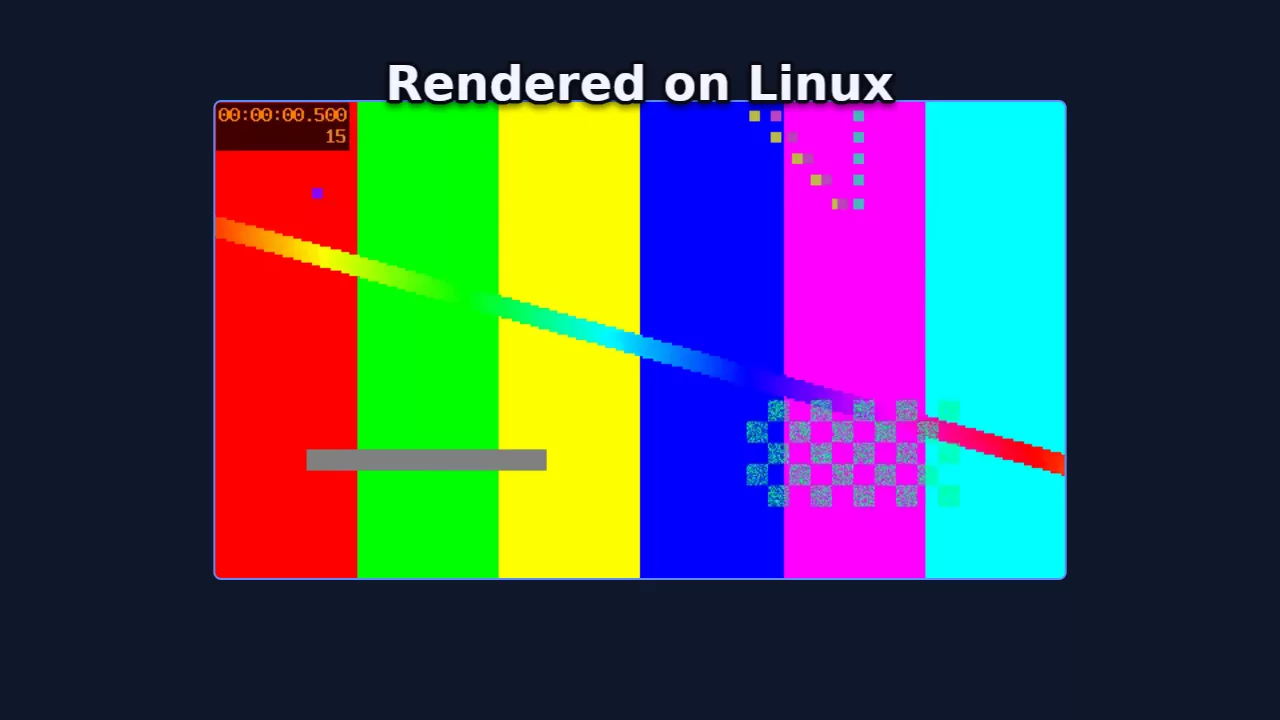
or a headless Linux box with no GPU at all (wgpu on lavapipe, ffmpeg as a
subprocess). The format has three faces behind one truth: an authoring
subset with four validated recipes (promo schema), the full document
(--full), and a types-only JSON Schema generated from the parser's own
structs (--types) — and the parser the validator runs is the parser the
renderers use, so "validates" means "renders".
Not the other PromoShot
This is the open engine (and App Store app) for PromoShot by Alexander Garmash — a full layer / keyframe / timeline editor for screen recordings, video, and photos (Mac; iPhone and iPad open the same .promo projects).
It is not the similarly named App Store apps that turn screenshots into template videos (for example “PromoShot: Screenshot to Video”). If you want keyframes, masks, GPU compositing, and an open .promo format, you want this one: promoshot.app · App Store.
Product listing / PAD
Consumer apps: promoshot.app · App Store. Software directories can ingest this PAD 4.0 file:
https://raw.githubusercontent.com/GarAlex/promoshot/main/promoshot.pad.xml
Crates
| Crate | What it owns |
|---|---|
promo-model |
The format: wire structs, migrations, palette roles, schema.md |
promo-timeline |
Timeline math: keyframes, trims, attachments, waits, validation |
promo-gpu |
wgpu compositing: quads, borders, letterbox, vectors, color conversion |
promo-text |
Caption shaping and effects (cosmic-text) |
promo-engine |
Preview/export orchestration, frame cache, memory governor, PCM mixer |
promo-media |
Decoder/encoder trait registry; ffmpeg-subprocess backend + conformance suite |
promo-editor |
The document's edit vocabulary: commands with undo, the wizard's arrangement, theme rules — what promo_apply and promo_slideshow are built on |
promo-cli |
promo — render a project from the command line |
promoshot-mcp |
MCP server over stdio, for agents |
Build and verify
./check-all.sh # fmt, clippy -D warnings, all tests, release build
Rendering video needs ffmpeg (and ffprobe) on PATH — frames are composited
on the GPU and piped to it raw; ffmpeg only decodes and encodes. On a headless
Linux machine, mesa-vulkan-drivers (lavapipe) is enough of a GPU.
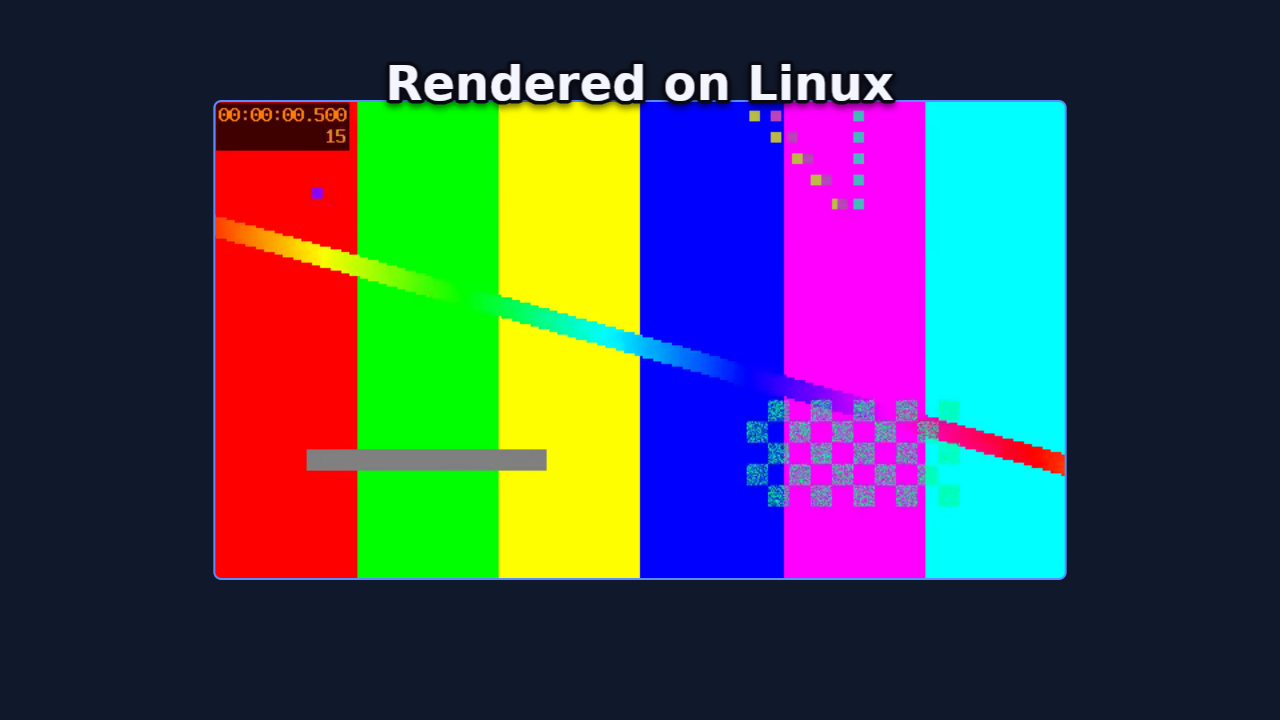
Headless Linux, no GPU
The Linux release tarball carries its own CPU renderer: a lavapipe/ folder
(Mesa's lavapipe, its libraries and a Vulkan loader; licences in
lavapipe/NOTICES.txt) beside promo. Keep the folder next to the binary
and a machine with no Vulkan driver at all — a fresh container, or a
redeploy that dropped mesa-vulkan-drivers — still renders. promo picks,
in order: a real GPU; the system's lavapipe; the bundled lavapipe (saying so
once on stderr); SwiftShader, with a warning, since it is 10–50× slower than
lavapipe. With none of them it lists what it tried and the fix
(sudo apt-get install -y mesa-vulkan-drivers libvulkan1).
PROMO_LAVAPIPE=<dir> points at the folder elsewhere; PROMO_LAVAPIPE=off
never uses it. The binaries need glibc 2.39 (Ubuntu 24.04, Debian 13).
A machine with no fonts at all still renders: text falls back to a
built-in face (Tuffy) with a warning; install fonts-dejavu-core and
fonts-liberation for real ones.
What a CPU costs, measured on a 703-frame 1080×1920 reel with narration:
| Renderer | promo video |
|---|---|
| Mac GPU (Apple silicon, Metal) | 13.7 s |
| lavapipe, 8 cores | 18.9 s |
| lavapipe, 2 cores | 77 s |
| lavapipe, 1 core | 179 s |
(lavapipe in an amd64-emulated ubuntu:24.04 container; SwiftShader took about half an hour on a comparable reel.)
promo video survives being killed. It encodes in segments (10 s of video
each; --segment <s>) into <out>.promo-parts/ beside the output, and the
same command run again skips the finished segments and goes on from there,
saying how many it found. The segments are joined without re-encoding, the
soundtrack is mixed once for the whole range and muxed in at the join — no
edge in the sound, in sync to the sample — and the folder is removed on
success. The folder is keyed by a digest of the project's files and the
render settings, so an edited project starts over instead of reusing stale
segments. --from/--to take seconds (12.5) or frames (375f), to split
a long render into chunks.
The CLI
cargo build --release -p promo-cli     # -> target/release/promo

promo schema                            # authoring subset + recipes; --full, --types
promo validate <project> [--strict]     # "NOT OK" lists what will not render; --strict exits 1 on any finding
promo inspect  <project>                # canvas, layers, missing media, undefined colours
promo upsert-keyframe <project> --args '{"layer":"bg","time":2,"zoom":1.2}'
                                        # the MCP authoring tools as verbs (init, upsert-layer,
                                        # upsert-keyframe, apply, slideshow, explain, diff)
promo still    <project> --out f.png --time 2.5
promo frames   <project> --out frames/ --fps 30 --from 0 --to 4
promo video    <project> --out out.mp4 --fps 30      # resumable; --from/--to 12.5 or 375f
Add --json to any project command for machine output — one object on
stdout, errors included, exit codes unchanged.
promo video mixes the soundtrack the apps would: trims and media cuts,
held frames, speed with pitch preserved, keyframed volume, a focused
narration ducking everything under it, and only the audio tracks the
project keeps.
Headless renders are CLEAN — no watermark, and no license, serial or key will ever be asked for. (The Mac and iOS apps watermark free-tier renders; that is their App Store Pro line, and it stays on their side of the fence.)
The MCP server
promoshot-mcp speaks Model Context Protocol over stdio, so any MCP client
can author, inspect and render projects. It owns no rendering code — every
render shells to promo (found next to the executable, or on PATH, or via
--promo), so the CLI stays the single contract.
Connect an agent
Two pieces: the MCP server (tools) and the skill (workflow). Neither is vendor-specific. Agents do not find this repo by themselves.
The apps open what this engine writes from PromoShot 3.0 on. The App
Store's 2.3.1 reads projects up to minReaderVersion 17 (no nested
compositions, no 3D) and cannot be launched with --mcp-stdio.
1. Build — or don't
cargo build --release -p promo-cli -p promoshot-mcp
# binaries: target/release/promo  target/release/promoshot-mcp
scripts/install-local.sh   # …and on PATH, linked from target/release,
                           # so every later build is what runs
No Rust toolchain? Grab the prebuilt pair from
Releases (linux-x64,
macos-arm64; each asset's sha256 is on the release), or pull the image:
docker pull ghcr.io/garalex/promoshot-mcp — both carry promo and
promoshot-mcp together.
Put both on PATH, or pass --promo to the server. Rendering video also
wants ffmpeg/ffprobe on PATH. promo skill install then puts the
agent skill where every agent tool on the machine reads it — the shared
~/.agents/skills (Codex, Gemini CLI, Cursor, GitHub Copilot, Grok
Build) and the own folder of each tool found that reads only its own
(Claude Code, Antigravity); promo skill prints it.
2. MCP (required for tools)
Claude Code / Cursor / any mcp.json:
{
  "mcpServers": {
    "promoshot-headless": {
      "command": "/ABS/PATH/target/release/promoshot-mcp",
      "args": ["--workspace", "/ABS/PATH/Promo", "--root", "/ABS/PATH/Promo"]
    }
  }
}
--workspace is where new projects go; --root fences which projects the
server will touch — pointing both at one folder is the tidy setup. Both
optional. --log <file> appends one line per tool call — when,
which tool, how many milliseconds, how it went — for a session's own
accounting; the demo pages are built from it.
Client one-liners:
# Claude Code
claude mcp add promoshot-headless /ABS/PATH/target/release/promoshot-mcp

# Grok Build
grok mcp add promoshot-headless -- /ABS/PATH/target/release/promoshot-mcp \
  --workspace /ABS/PATH/Promo --root /ABS/PATH/Promo
grok inspect   # confirms the server registered

# Docker — the host needs nothing but docker (details below)
docker build -t promoshot-mcp .
# then command: docker, args: ["run","-i","--rm","-v","/ABS/PATH/Promo:/projects","promoshot-mcp"]
On a Mac with PromoShot 3.0 installed, the app is a server too — the same tools, with the person's open document, undo and approvals behind them. Switch Automation on in PromoShot's Settings, then register the app itself; it launches when the client starts it:
claude mcp add promoshot -- "/Applications/PromoShot.app/Contents/MacOS/PromoShot" --mcp-stdio
Settings ▸ Automation shows that line with this Mac's own path, and the
URL form for clients that take one. promoshot names the app and
promoshot-headless the binary, so both can be registered side by side;
the skill asks which to use when both are there.
3. Skill (the workflow)
Same file everywhere: skill/SKILL.md.
REPO=https://github.com/GarAlex/promoshot
git clone --depth 1 $REPO /tmp/promoshot

# Claude Code (Grok Build also scans this folder)
mkdir -p ~/.claude/skills/promoshot
cp /tmp/promoshot/skill/SKILL.md ~/.claude/skills/promoshot/SKILL.md

# Grok Build explicit path
mkdir -p ~/.grok/skills/promoshot
cp /tmp/promoshot/skill/SKILL.md ~/.grok/skills/promoshot/SKILL.md

# OpenAI Codex / many others
mkdir -p ~/.agents/skills/promoshot
cp /tmp/promoshot/skill/SKILL.md ~/.agents/skills/promoshot/SKILL.md

# Cursor project (in the repo the user is editing, not this engine repo)
mkdir -p .cursor/rules
cp /tmp/promoshot/skill/SKILL.md .cursor/rules/promoshot.md
# or: mkdir -p .agents/skills/promoshot && cp SKILL.md there
Any agent that reads instructions can be handed the file directly; it assumes only these tools (or the CLI).
4. Verify — ask the agent for a render:
Render examples/ProductCard.promo to a still at 3s.
One promo_validate, one promo_render_still, and a device-framed app
demo comes back as a path. From there, "make me a promo for
The tools
Tools: promo_schema (authoring subset + four validated recipes;
promo_schema_full is the whole format; promo_schema_types is the format
as a generated, types-only JSON Schema — also checked in at
docs/promo.schema.json for $schema editor
autocomplete), promo_validate, promo_inspect (each layer listed with
its id — the handle the editing tools take),
promo_render_still, promo_render_frames, promo_render_video,
promo_render_gif, promo_proxy, promo_workspace; the senses —
promo_media_probe, promo_media_turntable (a model seen from around),
promo_media_filmstrip (a contact sheet of a SOURCE clip, times per cell),
promo_media_silences (silence spans and their inverse) and
promo_media_scenes (scene cuts and the shots between them), so an agent
knows what footage holds before composing with it; the editor trio,
promo_init, promo_upsert_layer and promo_upsert_keyframe: create a
project, add image/video/caption layers with placements, then animate —
a second placement keyframe is a push-in, viewport keyframes a Ken Burns;
your short ids are used verbatim, unnamed ones get canonical UUIDs, pixel
sizes are stamped, and the composition keeps covering its layers. Device
frames bake headless too — the same slab the apps draw. promo_slideshow
is the wizard: pictures and clips in, a complete classic, carousel or
store-listing show out, a caption on any slide becoming a layer that
lives with its picture. promo_apply reaches the whole vocabulary: a
batch of editor commands (delete, move, update any layer, upsert any
keyframe, patch a resource) applied atomically, the command schema served
with it. promo_explain answers why a layer is where it is at a time, and
promo_diff what changed since a project was last looked at;
promo_transcribe drafts captions from speech. promo_voices
lists a provider's voices and promo_speak synthesizes narration with the
person's own provider key — or with no key at all, from local voices —
reusing unchanged text by receipt. The authoring tools answer
with an inline thumbnail of the composition, so a misplaced layer is caught
at the moment it happens. The tools write ordinary metadata.json
through the format's own parser — the schema stays the source of truth, and
hand-editing remains first-class. Renders default their output BESIDE the
project, into <Name> Exports/, and return the path written, never the
bytes.
Flags, all optional: --workspace <dir> (where promo_workspace points;
else $PROMOSHOT_WORKSPACE, else the XDG data dir), --root <dir> (refuse
projects outside this tree), --promo <path>.
Narration keys
Narration spends the person's own provider account, and the key never passes through the agent: no tool takes one, none shows one. Register it once in the OS keyring — macOS Keychain, the Secret Service on Linux (GNOME Keyring, KWallet), the Credential Manager on Windows:
promoshot-mcp key set openai        # reads the key from stdin: paste, then Ctrl-D
promoshot-mcp key status            # where each provider's key comes from, never the key
promoshot-mcp key remove openai
Providers: openai, elevenlabs, google. The key is read from stdin so
it lands in no shell history, no config file and no argument list.
Where there is no keyring — the Docker image, a CI runner — the key is
read from a secrets file, the way Docker, Kubernetes and CI systems
hand secrets over: /run/secrets/OPENAI_API_KEY (likewise
ELEVENLABS_API_KEY, GOOGLE_API_KEY), or the path named by
OPENAI_API_KEY_FILE. A mode-0400 file, never an environment variable
that docker inspect and every same-user process can read:
docker run -i --rm \
  -v "$HOME/.secrets/openai:/run/secrets/OPENAI_API_KEY:ro" \
  -v /path/to/your/projects:/projects promoshot-mcp
An agent can ask before it plans: promo_speak with {"check": true}
spends nothing and reports, per provider, whether a key is present and
what a real call would synthesize. A real call checks every pending
narration's key before buying anything, and writes each receipt back the
moment it is paid for, so a failure part-way never makes the next call
pay twice. Keys travel in request headers, never URLs, and nothing logs
them.
Local voices — no key
Provider local narrates on this machine with
local-tts: English voices with
Apache-2.0 weights, so the audio is yours to publish (a system voice like
macOS's is licensed for personal use only). No key, no account, nothing
spent; after a one-time download, no network. Install a voice package once:
promoshot-mcp voices list                      # packages, sizes, licences, what is installed
promoshot-mcp voices install kokoro-en-q8      # 106 MB: 28 voices, US and UK, the best English
promoshot-mcp voices install kitten-nano-en    # 31 MB, 8 voices
Every file comes from its pinned upstream URL (Hugging Face or GitHub at a
fixed commit) and is checked against its SHA-256 before the package
appears. Packages live in ~/Library/Application Support/PromoShot/Voices
on macOS, ~/.local/share/promoshot/voices on Linux, or wherever
PROMOSHOT_VOICES points; PROMOSHOT_VOICES_MIRROR names a mirror tried first.
A script then says "speech": {"text": "…", "provider": "local", "voiceID": "kokoro-en-q8/af_heart"}; promo_voices with provider local lists every
id with upstream's listening grade, best first (af_heart, af_bella,
af_nicole, bf_emma, …). British voices read with American
pronunciation. Running the install again over an older Kokoro package adds
the voices it lacks without downloading the model again. Takes are .wav. The English dictionary refuses words it does not
know rather than guessing — a product name, mostly. Spell those once per
project in Resources/pronunciations.dict, CMU format:
PROMOSHOT P R OW1 M OW0 SH AA2 T
Words the dictionary lacks are otherwise guessed — split at capitals into
known words (YouTube, ChatGPT), spelled when an acronym (API), or guessed by
a small model trained on the dictionary — and promo_speak lists every guess
as a ready-to-paste line. Pin or correct one in that file and call
promo_speak again: editing it re-voices the project's local takes.
Docker
The image is the whole render environment — server, CLI, ffmpeg, a software Vulkan and the fonts — so a client needs nothing on the host:
docker build -t promoshot-mcp .
{
  "mcpServers": {
    "promoshot-headless": {
      "command": "docker",
      "args": ["run", "-i", "--rm",
               "-v", "/path/to/your/projects:/projects",
               "promoshot-mcp"]
    }
  }
}
For keyless narration, give the image a voices volume and install a package into it once; every later run reads it:
docker run --rm -v promoshot-voices:/voices --entrypoint promoshot-mcp \
  promoshot-mcp voices install kokoro-en-q8
and add "-v", "promoshot-voices:/voices" to the args above.
Projects live under the mount; promo_workspace answers /projects. All
the examples are baked in, so the image proves itself with no
mount at all — render ProductCard.promo first; the device-framed app
demo is the one that teaches the product-promo path. server.json is the MCP Registry manifest (io.github.GarAlex/promoshot) for the published
image (ghcr.io/garalex/promoshot-mcp). GitHub's MCP Registry consumes that feed after mcp-publisher publish.
mcp-name: io.github.GarAlex/promoshot
The skill is drift-tested: a test pins it to the server's actual tool list, so it cannot teach tools that do not exist.
The Mac app carries its own MCP server (Settings → Automation) sharing the core tool names, plus app-only abilities — opening the editor, speech synthesis. The authoring pair, the senses and the types schema are headless-first.
What a session looks like — three requests in, a validated pro