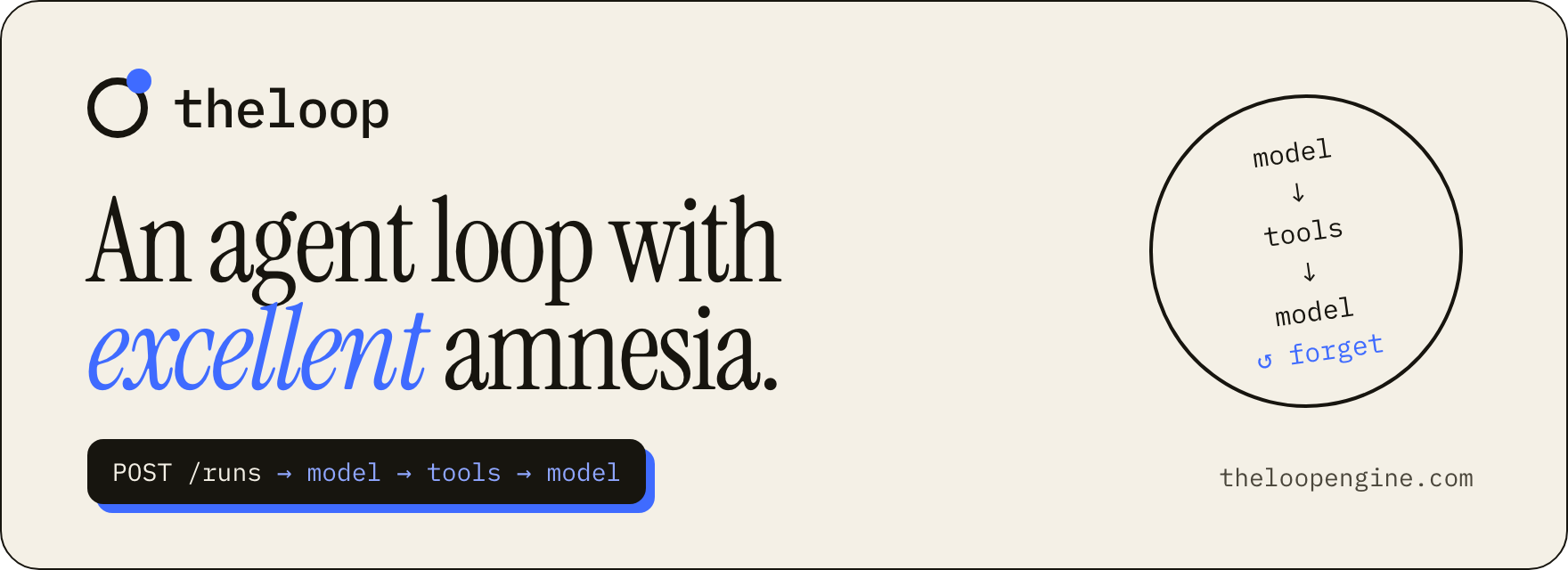
The agent loop as a stateless HTTP service.
One POST /runs is one run: model → tools → model, streamed, billed per attempt, then forgotten.





Website · Quickstart · SPEC · Trust model · Compare · Example harness · Changelog · Roadmap
The request carries everything: provider, model, key, prompt, full history, tools (URL + schema), limits. theloop runs "model → tools → model", streams text over SSE, delivers the result and billing-grade usage by callback — and forgets the run.
Built for teams that ship assistants to many users: multi-tenant by construction, per-request keys, one usage record per provider attempt, write tools as intents that your system approves and executes.
Note
Status: v1 — the contract is frozen (SPEC.md) and implemented: Node 22, TypeScript, Hono, Vercel AI SDK 6. Tests run without network or keys. New features arrive as additive fields, like skills and deferred tools (CHANGELOG.md). "1.0" is a promise about the contract (semver: no breaking changes within 1.x), not a claim of operational maturity — the implementation is young; expect fixes, not contract changes.
One run, the whole story
With the engine running (Quickstart), one synchronous run (wait: true), with the
Anthropic key taken from ANTHROPIC_API_KEY:
curl -s http://localhost:8080/runs \
  -H "Authorization: Bearer $ENGINE_TOKEN" -H 'Content-Type: application/json' \
  -d '{ "contract_version": "1",
        "llm": { "provider": "anthropic", "model": "claude-sonnet-5" },
        "messages": [ { "role": "user", "content": [ { "type": "text", "text": "Hello!" } ] } ],
        "wait": true }'
The answer is a synchronous 200 with the result body, usage included. No database was harmed.
Without wait, the response
carries stream_url (SSE) and cancel_url, and the result goes to callback.url. Tools, write
intents, limits and everything else — SPEC.md.
Why
- Everything in the request, nothing in the engine. No database, no configs, no tenant registry. Your backend decides what the assistant is on every call.
- One result, at-least-once. Callback with retries, deduplication by
run_id, results readable viaGET /runs/{id}for recovery, late results placed by history revision. - Writes are intents. A tool with
effect: "write"answersdeferredwith an operation id; the mutation happens in your system after approval — never inside a tool call. With tools built that way, a prompt-injected model can request an action but cannot carry it out — see Trust model for what that depends on. - Usage you can bill. Every provider attempt, including failed and interrupted ones, with
uncached input, cache read / write and an explicit
estimatedflag. Optional cost from your price list, with token and cost budgets. - Controlled egress. HTTPS only, host allowlist, no private IPs, no redirects, header filtering; provider keys never in logs, SSE, callbacks or error bodies.
- Providers. Anthropic, OpenAI, DeepSeek, GLM (z.ai), GigaChat, MiniMax and any OpenAI-compatible endpoint, with per-key queues and AIMD rate limiting.
- Skills and deferred tools.
skills[]in theSKILL.mdshape: the model sees an index and loads a skill's instructions and tools mid-run. Deferred tools stay out of the context until a skill orsearch_tools(BM25) brings them in, and the prompt cache survives (tool_referenceon Anthropic). Still stateless: what is loaded comes from the history. See Skills and deferred tools. - Debuggable. An event journal per run and session (
GET /logs), with content, without shipping prompts to your log pipeline: in memory, and withLOG_DIRin day files on disk that survive a deploy and keep a week. - Presentation invariants. Mark what the harness renders, and the engine keeps one card or deck per run, keeps blocks out of tool steps, and checks that card values came from tool results.
- Always answers on a limit. The last allowed step goes without tools, so a run that
hits
max_stepsormax_tool_callsstill ends with an answer, not an empty error.
Skills and deferred tools
A request can carry instructions and tools the model pulls in only when it needs them:
"tools": [
  { "name": "getOrder", "...": "...", "effect": "read" },
  { "name": "createReturn", "...": "...", "effect": "write", "defer_loading": true }
],
"skills": [
  { "name": "order-returns",
    "description": "Return and refund policy. Use when the user asks about a return.",
    "body": "# Returns\n\nCheck the order status first ...",
    "tools": ["createReturn"] }
]
The model sees getOrder, a built-in load_skill and a one-line index of skills in the system
prompt. When the conversation turns to returns, it calls load_skill("order-returns"), gets the
instructions, and createReturn is callable from the next step. A deferred tool that belongs to
no skill is found with the built-in search_tools. Built-ins cost a step but not a tool call,
and the harness only has to store the engine's tool messages as usual: the next run restores
what was loaded from the history. Details: SPEC §6.8,
RFC 0001.
Quickstart
From source (Node 22.9+):
git clone https://github.com/paveler/theloop.git && cd theloop
npm install
cp .env.example .env      # set ENGINE_TOKEN and at least one provider key
npm run dev               # reads .env; http://localhost:8080
Docker, without cloning — images are published on every release:
docker run -p 8080:8080 -e ENGINE_TOKEN=change-me -e ANTHROPIC_API_KEY=sk-ant-… ghcr.io/paveler/theloop:1
Or build your own: docker build -t theloop . && docker run -p 8080:8080 --env-file .env theloop.
Then send the run from One run, the whole story.
Next: a whole integration. examples/sqlite-harness is a complete
harness on SQLite with no dependencies — history, a read tool, a write tool with approval, the
continuation of the conversation, recovery — and a chat in the terminal:
npm run example:sqlite.
Trust model
A model can ask. It can't act. The engine enforces what it can see; your tool endpoints carry the rest. The "a model can ask, not act" property holds only if all of the following are true.
What you guarantee
- Write endpoints only register an intent (SPEC §6.4): create or find an operation, answer
deferredwith its id, change nothing. The engine flags a write tool that answers anything else astool_protocol_error, but it detects after the call — it cannot undo a mutation the endpoint already made. - Tools marked
readreally have no side effects. The engine trustseffect: a mutating tool labelledreadis executed synchronously, with nodeferredand no approval. This is the easiest way to break the model. - Approval and execution happen in your system, with the operation version checked and the operation id passed downstream as the idempotency key (§6.4).
- Tool endpoints scope data by
meta(tenant, user) from the engine call, never by ids inargs— the model can put any id there. - Only trusted servers hold
ENGINE_TOKEN: whoever has it chooses prompts, tools and endpoints. End-user clients get run-scoped tokens only.
What the engine guarantees
- It never executes a mutation itself.
- It does not execute two calls of one write tool in one step.
- It refuses write tools without the context needed for idempotency (
write_context_missing). - It validates tool arguments before calling an endpoint.
- All outbound requests go through the egress allowlist.
How it fits
flowchart LR
    client["End-user client"] -- "SSE, cancel<br/>(run token)" --> engine(["theloop"])
    harness["Your harness"] -- "POST /runs, GET, ack" --> engine
    engine -- "tool calls" --> tools["Your tool endpoints"]
    engine -. "callback:<br/>result + usage" .-> harness
The harness is your backend (or a low-code platform, or a workflow tool): it stores history, assistants, tools and operations, and owns approvals and billing. Its obligations are listed in SPEC.md, Appendix A.
How it compares
Most agent tools solve a neighbouring problem, not this one. Each link is a two-minute page that also says where the other tool wins.
| Tool | What it is | Pick it when… | Full comparison |
|---|---|---|---|
| LangChain | A framework you build into a Python or JS app | the agent should live inside your code, with RAG and a big ecosystem | vs LangChain |
| LangGraph | Agents as graphs, every step checkpointed | long, branching workflows must resume mid-step after a crash | vs LangGraph |
| OpenAI Responses / Agents API | OpenAI's hosted loop; conversations stored by default | you're all-in on OpenAI and want hosted web search or code interpreter | vs OpenAI |
| Vercel AI SDK | A TypeScript library with an in-process tool loop — theloop is built on it | your backend is TypeScript and serves a single tenant | vs AI SDK |
| LiteLLM | A gateway in front of 100+ model providers | you need central keys, budgets and fallbacks for model calls — it can also sit behind theloop's openai-compatible provider |
vs LiteLLM |
| n8n | A visual workflow builder with AI nodes | you automate your own team's work on a canvas | vs n8n |
Pick theloop when the assistant ships inside your product to many customers, your backend already owns the data, any language or low-code platform should drive it over HTTP, writes must wait for your approval, and usage must be billable per attempt. All comparisons: theloopengine.com/vs.
Code map
Where everything lives in src/
src/
  index.ts              entry point: env → engine → HTTP, SIGTERM
  app.ts                Hono routes, CORS, auth, body limit, graceful shutdown
  config.ts             env (SPEC §14)
  contracts.ts          zod: RunRequest, StoredMessage, ToolResponse, RunResult
  errors.ts             error codes and their HTTP statuses (§12.1)
  i18n.ts               engine-injected text, en / ru (Appendix B)
  log.ts, log-buffer.ts structured events; the in-memory journal for GET /logs (§12.4)
  log-disk.ts           the journal on disk: day files, retention, reads past memory (§12.4)
  alerts.ts             error webhook (§12.3)
  runs/registry.ts      in-memory runs: status, SSE buffer, tokens, session lock, idempotency
  runs/runner.ts        the loop, step by step: one streamText per step → finish-step →
                        limits → tools → next step
  runs/provider.ts      one provider attempt, error classification
  runs/messages.ts      StoredMessage ↔ ModelMessage, context estimate and trimming, dates
  runs/output-checks.ts the format gate for fenced blocks (§5.4)
  runs/skills.ts        skills, deferred tools, load_skill, activation from history (§6.8)
  runs/usage.ts         attempts ok / failed / unknown, normalization, cost, budgets
  runs/callback.ts      at-least-once result delivery
  runs/validate.ts      request validation
  runs/images.ts        image validation and download through egress
  tools/http.ts         tool calls: ok / error / accepted / deferred, effect control, retries
  tools/search.ts       BM25 over deferred tools for search_tools (§6.8)
  tools/args.ts         conservative argument validation against input_schema
  egress/               the single outbound HTTP client: allowlist, private IPs, no redirects
  stream/sse.ts         SSE with replay, snapshot, gap, backpressure
  providers/            allowlist, model factory, GigaChat OAuth and translator, per-key queue
Development
npm test                  # vitest, no network, no keys
npm run typecheck
npm run smoke             # live run against real providers, keys from .env (not in CI)
npm run build && npm start
Documents
- SPEC.md — the contract: API, message format, loop semantics, limits, reliability.
- CHANGELOG.md — what changed in each release and what is on
main. - ROADMAP.md — proposals: MCP, more providers, compaction, sub-runs, a reference harness with channels and memory.
- docs/rfcs — design documents for larger features, starting with RFC 0001, skills and deferred tools.
- examples/sqlite-harness — a complete harness: what your backend does around the engine, obligation by obligation.
- AGENTS.md — how to work on the code: commands, architecture rules, conventions, tests, releases. Written for AI coding agents; a good short version for contributors too.
License
Apache License 2.0 — see LICENSE and NOTICE.
It forgets. You don't have to. · theloopengine.com