
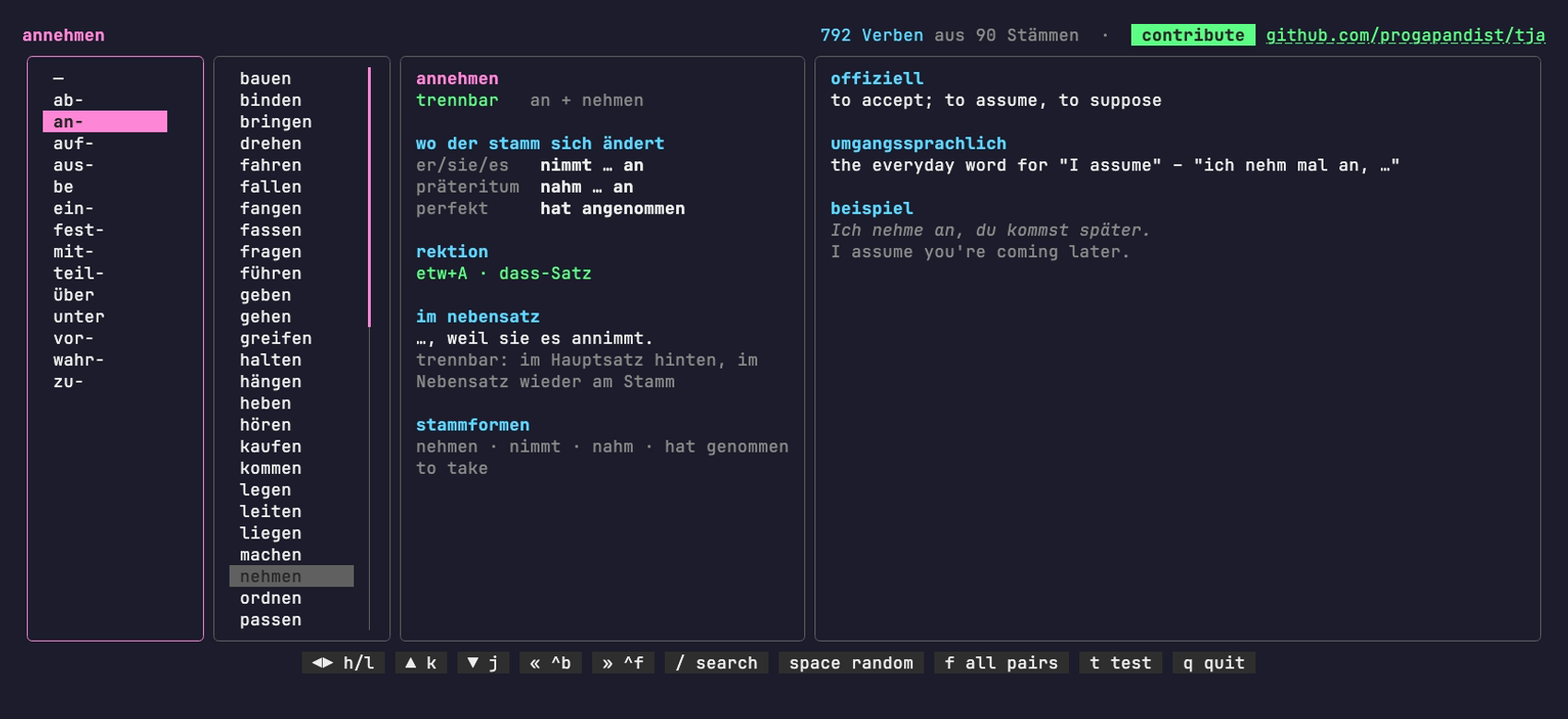
A one-armed-bandit TUI for German verbs: two reels, prefixes and stems, that filter each other. Whatever they land on is always a real word — spinning the reels is the vocabulary list.
Try it in your browser → progapanda.org/tja — a real one, in a container, no install.
go install github.com/progapandist/tja@latest   # or, in a clone:
go run .
Prebuilt binaries for macOS and Linux (amd64/arm64) are on the releases page.
The panes
- Prefix reel — only the prefixes that make a word with the stem showing.
Separable ones carry the dictionary hyphen (
auf-vsbe), inferred from the data. - Stem reel — only the stems that take the prefix showing.
- Forms — just the places where the root actually changes: 3rd person singular, preterite, perfect with its auxiliary. Plus the rection: which cases and prepositions the verb governs.
- Meanings — the official meaning, the colloquial or idiomatic one, and an example sentence with its English translation. German phrases quoted in the colloquial note carry their translation too.
The forms pane also generates a subordinate clause for every verb — the one place
where a separable prefix rejoins its stem: main clause ruft … an, Nebensatz
…, weil sie mich anruft. The object comes from the rection, so the clause is
something you could actually say.
The header carries the verb count and a clickable repo link (OSC 8). Both reels carry a scrollbar. The layout has three shapes: four panes at 100 columns or more, reels plus one combined pane down to 64, and reels above a detail pane below that.
j/k spin · h/l switch reel · ^d/^u half page · ^f/^b page · g/G ends ·
/ search · f filtering on/off · space random combination · t flash cards · q quit
f turns the mutual filtering off: both reels then list everything, prefixes
that make no word with the stem showing (and vice versa) are dimmed rather than
hidden, and landing between two words shows the form the rules would build,
marked as not attested. f again snaps back to a real word.
Mouse and touch
The reels scroll with the wheel and select on click or tap. The footer is a row
of buttons — ⇄ switches reel, ▲ ▼ spin, ⇞ ⇟ page, and the rest mirror the
keys — so the whole thing is usable on a phone without a keyboard. In test mode
a tap anywhere reveals the card or deals the next one.
Search
/ searches prefixes, stems and meanings at once, fuzzily: mitneh finds
mitnehmen, zusbrech finds zusammenbrechen, burgle finds einbrechen
through its English gloss. Umlauts are optional — uber and ueber both find
übernehmen. ↑↓ cycles hits, enter keeps the one showing, esc puts the
reels back.
Test mode
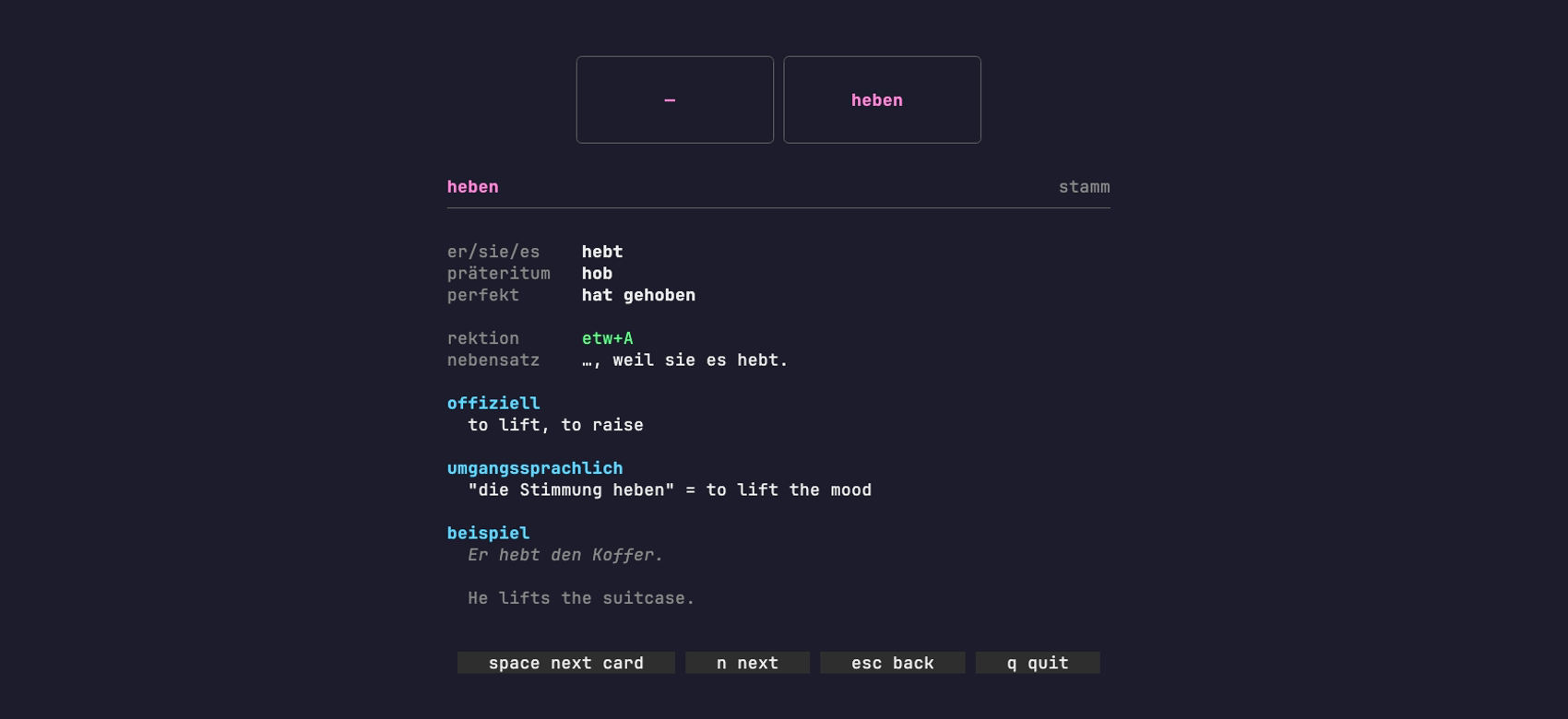
t deals a random real combination as a card: one prefix, one stem, nothing else.
space reveals forms, rection and meanings, space/n deals the next one,
esc returns to the reels — parked on the card you just saw. The buttons along
the bottom do the same, for thumbs.
Screenshots are generated: go build -o /tmp/tjabin . && vhs docs/demo.tape.
Data
Everything lives in verbs.txt, one verb per line, pipe-delimited:
=stem|gloss|present 3sg|preterite|participle|aux
verb|separable t/f|official|colloquial|example|use|example in English|aux override
96 stems, 835 verbs, chosen from the high-frequency verbs where a prefix genuinely shifts the meaning. Adding more needs no code: append lines.
Conjugated forms are derived, not stored — separable prefixes detach and swallow
the ge- (nimmt … an, angenommen), inseparable ones replace it
(übernimmt, übernommen). See Verb.Forms in data.go.